

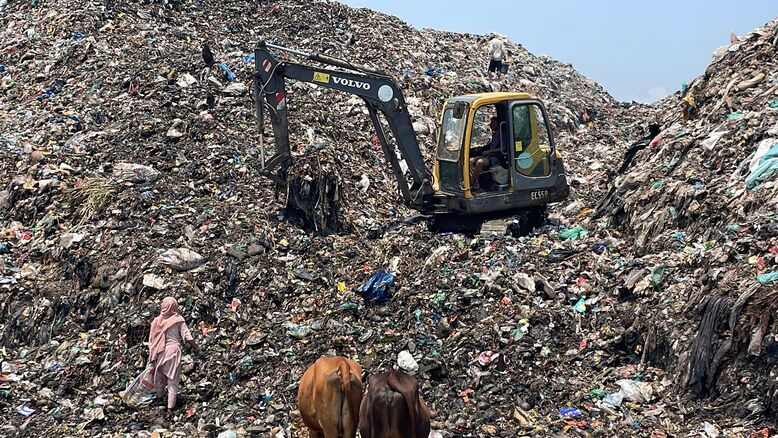
As the world marks World Environment Day with renewed calls for environmental protection and pollution control, a sprawling municipal dumping site in the Kasturaghat area of Cox’s Bazar stands as a clear example of the environmental and public health challenges facing the coastal town.
For years, tonnes of solid waste have been piled up at the Cox’s Bazar municipality’s dumping ground, exposing nearby residents to foul odours, air pollution and disease.
Environmentalists and residents allege that toxic waste from the site is also finding its way into the Bakkhali River, posing a growing threat to aquatic ecosystems and biodiversity.
Sabila Khatun, who lives adjacent to the dumping site with her extended family of 12 members, says most of her family members have been suffering from allergies, respiratory problems and skin diseases for years.
“The stench and polluted air from the waste dump make our lives unbearable,” she said.
“The situation becomes even worse during hot weather and after rainfall. Occasionally it is difficult to remain inside the house because of the smell.”
Resident Sabe Meraj, whose 10-member family has also been dealing with recurring health problems, voiced similar concerns.
“Members of my family frequently suffer from fever, coughs, breathing difficulties and allergy-related illnesses,” he said, adding that children and elderly people are the worst affected.
According to residents, between 70 and 90 families living in and around Peshkarpara and neighbouring areas are directly exposed to the impacts of the dumping site.
Persistent odours, mosquito infestations, toxic smoke and poor environmental conditions have become part of their daily lives.
Residents also claim that waste at the site is often burned or catches fire spontaneously, releasing thick smoke across surrounding neighbourhoods.
During rainfall, contaminated leachate flows into nearby areas before eventually draining into the Bakkhali River.
Environmental activists warn that the dumping ground has become a textbook example of how poor waste management can affect both public health and the environment.
Nazrul Islam, general secretary of the Cox’s Bazar district chapter of the Bangladesh Poribesh Andolon (BAPA), said toxic waste from the landfill was directly polluting the Bakkhali River.
He stated that the landfill was degrading the river’s water quality and damaging aquatic habitats.
“In the long term, such pollution could lead to a serious environmental crisis,” he added.
He questioned the municipality’s role in addressing pollution.
“On one hand, the municipality urges people not to dump waste into drains, canals and rivers. On the other hand, large volumes of municipal waste remain piled up beside the river. This contradiction is deeply concerning,” he added.
The municipal authorities acknowledge the problem and are taking steps to improve waste management.
Cox’s Bazar Municipality Chief Executive Officer Adnan Chowdhury said a project supported by the Japan International Cooperation Agency (JICA) was underway to modernise the existing dumping station.
“Many of the current waste-management challenges will be addressed once the project is completed,” he said.
He added that plans were also in place to establish a new dumping station in the SMP area of the town, while a separate waste-processing facility already exists in Chainda outside the municipal area.
He stated, “We are striving to implement a modern waste-management system that will greatly diminish environmental pollution in the future.”
When contacted, Cox’s Bazar Department of Environment Deputy Director Zamir Uddin said the allegations would be reviewed and necessary action taken if warranted.
World Environment Day is observed annually on 5 June to promote awareness of environmental protection, climate action and pollution prevention. Yet the reality facing residents of Kasturaghat presents a troubling contrast to the day’s message.
Local residents hope that authorities will take swift, effective measures to address the long-standing environmental and public health concerns. Environmentalists, meanwhile, argue that a modern and environmentally sustainable waste-management system is no longer optional for Cox’s Bazar, an internationally recognised tourist destination.
For many residents, the message of World Environment Day is simple: a pollution-free town, a protected Bakkhali River and a safe, healthy environment for future generations.
By Abdu Rashid Manik
Photo: Abdu Rashid Manik