
Film lovers in Cox’s Bazar have finally had the opportunity to watch films on the big screen again after nearly seven years, renewing calls for a modern cinema hall in the country’s premier tourist destination.
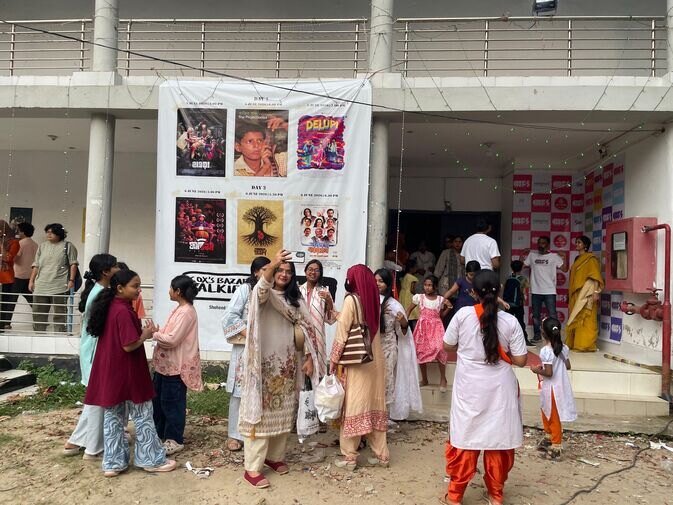
The opportunity came through the two-day film screening programme titled Cox’s Bazar Talkies, which began on Friday, ending a long period during which local audiences were deprived of the cinematic experience.
Following the closure of film screenings at the BGB Auditorium during the Covid-19 pandemic, the district had virtually lost its last active venue for regular film exhibition. Since then, cinema enthusiasts in Cox’s Bazar have had very limited access to big-screen film screenings.
The event has been organised by the Cox’s Bazar Film Society as part of efforts to promote a healthy film culture and protest against a recent incident in Brahmanbaria, where the screening of the film Banalata Express was reportedly obstructed.
The festival, held at Shaheed Subhash Hall of the Cox’s Bazar Public Library, showcases six films and documentaries over two days.
The opening day featured the critically acclaimed film Hawa, directed by Mezbaur Rahman Sumon. The screening attracted a large audience, particularly young people, many of whom were experiencing a film on the big screen for the first time.
Audience members said the absence of a modern cinema hall in Cox’s Bazar, an internationally recognised tourist city, remains a significant cultural gap.
“I have never had the opportunity to watch a film on a big screen before,” said audience member Dipta Biswas after watching Hawa. “The experience was wonderful. The old cinema halls disappeared years ago, but the interest in cinema remains. We hope a modern cinema hall will be established in Cox’s Bazar soon.”
Another viewer, Minhaj Chowdhury, said that opportunities for healthy entertainment were becoming increasingly limited.
“We want Cox’s Bazar to develop as an international-standard tourist city. The absence of a modern cinema hall is disappointing. Both residents and tourists would benefit from a multiplex or a modern cinema complex,” he said.
Piyal Das, another young attendee, praised the organisers for reviving film screenings in the district.
“A permanent cinema hall would greatly benefit young people. It would provide an alternative to excessive dependence on mobile phones and social media, while also encouraging cultural and intellectual development through quality films,” he said.
Organisers described the event as more than just a film screening programme, calling it an effort to revive the film culture in Cox’s Bazar.
Rahman Mufiz, president of the Cox’s Bazar Film Society, stated that the initiative also served as a form of cultural protest.
“The incident involving the obstruction of Banalata Express in Brahmanbaria was deeply concerning for the country’s cultural community. Through Cox’s Bazar Talkies, we are expressing our protest while promoting a healthy environment for cinema and cultural activities,” he said.
He added that the title Cox’s Bazar Talkies carried historical significance, recalling a former cinema hall of the same name that once operated in the town.
“Although various cultural activities still take place here, film-related events have become extremely rare. We want to see a revival of cinema culture in Cox’s Bazar,” he said.
The society’s general secretary, Yeaseer Arafath, said the strong turnout on the opening day demonstrated that there was still a substantial audience for cinema in the district.
“People from across the country live and work in Cox’s Bazar, while tourists visit throughout the year. Many ask why there is no cinema hall here. Today’s response proves that there is a genuine demand for film screenings and a modern cinema venue,” he said.
He added that the society intended to continue advocating for the establishment of a modern cinema hall, stressing that cinemas remained an essential platform for cultural engagement and artistic expression.
Alongside Hawa, the opening day also featured the documentary Rakib Khan: The Projectionist, directed by Shaheen Dil-Riaz, and Delupi, directed by Mohammad Toukir Islam* and his team.
On Saturday, audiences are scheduled to watch Fatima, directed by Dhruba Hasan, the short film Tadatma Anneshan: The Eternal Journey by Fazle Rabbi, and Banalata Express, directed by Tanim Noor.
Cinema enthusiasts said regular film screenings could help nurture appreciation for film among younger generations and contribute to the revival of the district’s long-dormant cinema culture.
By Abdu Rashid Manik
Photo: Abdu Rashid Manik