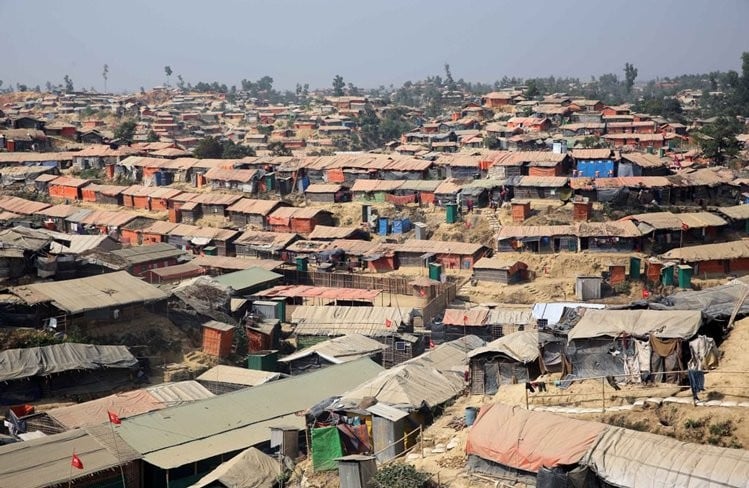
Although the largest influx of Rohingya refugees into Bangladesh began on August 25, 2017, the refugee crisis dates back nearly four decades earlier. In 1977-78, around 200,000 Rohingyas fled Myanmar’s Rakhine State amid a military operation and sought refuge in Bangladesh. Since then, Rohingyas have crossed into Bangladesh at different times. In 2026, after nearly 49 years of the protracted crisis, the number of registered Rohingya refugees in Bangladesh has risen to more than 1.2 million.
The figures were presented at a roundtable titled ‘Rohingya Crisis: Challenges and the Future of the Protracted Crisis’, jointly organised by the Refugee Relief and Repatriation Commissioner’s Office and the Norwegian Refugee Council at the conference room of the RRRC office in Cox’s Bazar on Monday afternoon.
According to the presentation, around 200,000 Rohingyas fled Rakhine State and took shelter in Ukhia and Teknaf in 1977-78. After a long interval, around 87,000 Rohingyas entered Bangladesh again in 2016.
The largest influx began on August 25, 2017. Around 750,000 Rohingyas fled to Bangladesh that year amid a military crackdown and violence by Myanmar’s military. Most of them took shelter in camps in Ukhia and Teknaf in Cox’s Bazar.
There was no major influx for several years. However, renewed fighting between Myanmar’s junta forces and the Arakan Army in Rakhine State in 2024 triggered another movement of Rohingyas into Bangladesh. According to the presentation, around 152,029 Rohingyas have entered Bangladesh since 2024 and up to August 2026.
1.2 million registered Rohingya refugees
According to data provided by UNHCR communications officer Shari Nizman, 1,202,034 Rohingya refugees were registered in Bangladesh as of July 31, 2026.
Of them, 39,856 were registered as refugees in the 1990s, according to UNHCR data. The number of Rohingyas who arrived in Bangladesh after 2017 stands at 1,007,488, while 154,690 Rohingyas have arrived since 2024.
This means that nearly 49 years after the Rohingya refugee crisis began in 1977, there is still no permanent solution. Instead, the number of Rohingyas seeking refuge in Bangladesh has continued to grow as new arrivals have entered the country at different times.
No repatriation in nine years
Although Bangladesh and Myanmar have made several attempts to repatriate the large number of Rohingyas who arrived in Bangladesh in August 2017, not a single Rohingya has so far been formally repatriated to Myanmar.
As a result, hundreds of thousands of Rohingyas have continued to live in the sprawling refugee camps in Ukhia and Teknaf for years. The arrival of new refugees has made the crisis even more protracted and complex.
Refugee expert and University of Chittagong anthropology professor Rahman Nasir Uddin said a permanent solution to the crisis would not be possible unless an environment conducive to the safe, voluntary, dignified and sustainable repatriation of Rohingyas was created.
After nearly five decades, the crisis is no longer merely a bilateral issue between Bangladesh and Myanmar. It has also emerged as a major challenge for regional security, humanitarian assistance and international diplomacy.
However, Foreign Secretary Asad Alam Siam said Bangladesh continued diplomatic efforts at international and regional forums to create pressure for the safe, dignified and sustainable repatriation of the Rohingyas.
He said Bangladesh was working diplomatically to keep the Rohingya crisis on the international agenda and ensure effective action towards a solution despite wars, conflicts and humanitarian disasters in different parts of the world.
By Abdur Rashid Manik
File Photo