
With the monsoon bringing a mix of heavy rain, sudden sunshine and rough seas, tourists planning a trip to Cox’s Bazar need to make some extra preparations to avoid unnecessary hassles.
Mary Dewan, a resident of Khagrachhari Sadar who works for a private multinational company in Dhaka, came to Cox’s Bazar with her family during the four-day break around Eid-e-Miladunnabi (SAW). She took Thursday off to combine it with the weekly holidays on Friday and Saturday.
But rain repeatedly disrupted her plans.
When this correspondent spoke to Mary at the Kolatoli point of Cox’s Bazar beach on Thursday, it had just rained. She had rushed to the nearby information and complaint centre run by the district administration for shelter but was already drenched.
“I checked the weather warnings before coming, but it suddenly rained, and then the sun came out. I got soaked. I wore a white dress because I wanted to take photographs. Now I have to return to the hotel and change,” she said.
Asked what would have helped her most at that moment, she had a simple answer: “An umbrella.”
Monsoon transforms the landscape of Cox’s Bazar. Cloudy skies, drizzle and sudden downpours, rain-soaked beaches, rough waves and the meeting of hills and sea give the popular tourist destination a different character.
As a result, tourist numbers have also been increasing during the monsoon, traditionally considered the off-season.
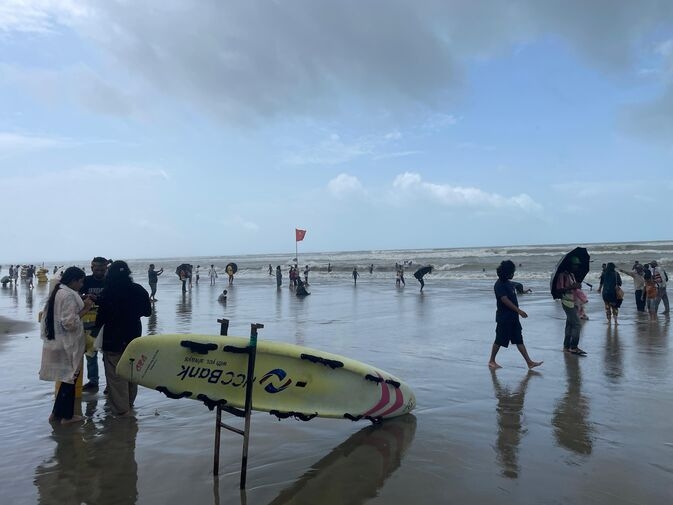
Even recently, tourists have been seen at Laboni, Sugandha and Kolatoli points despite persistent rain and rough seas.
However, travelling to Cox’s Bazar during the monsoon can be as challenging as it is enjoyable. Sudden heavy rain, lightning, gusty winds, rough waves and strong currents can create risks, while waterlogging can disrupt road travel.
Extra caution is particularly necessary when warning signals are in force at the sea ports. In recent days, tourists have been discouraged from entering the sea by red flags on the beach amid adverse weather.
Tour guides and tourism operators say the first step before travelling to Cox’s Bazar during the monsoon should be to check the latest weather conditions. Tourists should check the Bangladesh Meteorological Department’s forecast, seaport warning signals and instructions from the local administration both before and on the day of travel.
Sunny weather does not necessarily mean that the sea is safe. Conditions can change rapidly. When a depression or low-pressure system makes the sea rough, the risk from waves and currents increases. Tourists should therefore avoid entering the sea when warning signals are in force.
Cox’s Bazar Meteorological Office assistant meteorologist Abdul Hannan advised tourists to check weather warnings before travelling. He said local warning signal No. 3 was currently in force at four sea ports, including Cox’s Bazar, and that the weather could alternate between rain and sunshine.
According to Hannan, the latest weather information is available on the Bangladesh Meteorological Department website. Tourists can also dial 1090 from any mobile phone to hear the latest weather forecasts and updates, or call the national information and service hotline 333.
What to pack for a monsoon trip
Mohammad Musa, sports and social welfare secretary of the Tour Operators Association of Cox’s Bazar (TOAC) and a director of the Cox’s Bazar Chamber of Commerce and Industry, said tourists should carry a folding umbrella, raincoat or poncho, waterproof bag or bag cover, and a waterproof mobile-phone pouch.
He also recommended light, quick-drying clothes such as polyester or dry-fit T-shirts and lightweight trousers, along with one or two extra sets.
Other useful items include waterproof or anti-slip sandals, extra socks, a power bank, sunscreen, sunglasses, tissues, hand sanitiser, mosquito repellent, essential personal medicines, a small first-aid kit and a water bottle.
“Carrying these basic items can help tourists avoid many of the difficulties associated with travelling during the monsoon,” Musa said.
Sayeed Alamgir, public relations officer of the star-rated Hotel Ocean Paradise, said tourists now have much greater access to information through technology.
“If anyone asks us, we provide them with various suggestions. They can also search online to find out what preparations are necessary for travelling during the monsoon,” he said.
Women, children and elderly tourists need extra preparation
Tour guide and tourism entrepreneur Nurul Hasan said women should make some additional preparations for monsoon travel.
Besides their regular personal items, women may carry extra clothes and an orna, an umbrella or raincoat, sanitary napkins, tissues and wet tissues, a small towel, personal hygiene products, necessary cosmetics, a comb and hair accessories, and a separate waterproof bag.
“Necessary and regularly used medicines should also be carried. If you plan to stay outside for a long time, it is better to keep a little extra of essential personal items, as rain may make it difficult to obtain them immediately from shops or hotels,” Nurul said.
Dr Shahidul Alam, assistant registrar of the paediatric department at Cox’s Bazar Sadar Hospital, said families travelling with children should make special preparations.
“If a child gets wet, they should be changed into dry clothes quickly. So it is better to carry at least one or two extra sets of clothes for children,” he said.
A child’s bag can include extra clothes, a raincoat or child-friendly umbrella, a small towel, extra nappies, wet tissues, necessary dry food, a water bottle, the child’s regular medicines, sanitiser and a small identification card or piece of paper containing contact details, he said.
Mahabub Alam, a beach worker and supervisor with the Beach Management Committee run by the district administration, said children frequently become separated from their families at Cox’s Bazar beach.
“We help locate them and return them to their parents. Always keep children within sight when taking them to the beach. They should never be allowed to go near the waves alone. For safety, it is better to stay in designated areas monitored by lifeguards,” he said.
Dr Shahidul also advised families travelling with older adults to carry their regular medicines, prescriptions, necessary medical reports and their doctor’s contact number.
“Prolonged exposure to rain or staying in wet clothes should be avoided. Before taking elderly family members to distant tourist spots, it is also important to check the condition of the roads, the weather and the expected return time,” he said.
What to know before entering the sea
One of the biggest risks for tourists at Cox’s Bazar beach is a rip current, locally known as a khal. Getting caught in such a current can be dangerous, and trying to swim directly toward shore in a panic can make the situation worse.
According to beach safety experts, anyone caught in a rip current should stay calm and avoid fighting the current directly. Instead, they should try to move parallel to the shoreline to get out of the current.
The safest option, however, is to avoid entering the sea during hazardous weather and follow lifeguards’ instructions.
Mohammad Osman, a supervisor with Sea-Safe Lifeguard, said rip currents and deeper channels had formed at parts of the beach during the monsoon, increasing risks for tourists.
“Tourists must follow lifeguards’ instructions before entering the sea. They should enter the water only at the designated areas marked with red-and-yellow or yellow flags at Kolatoli, Sugandha and Laboni points. If a red flag is displayed, tourists should not enter the sea,” he said.
Imtiaz Ahmed, field team manager of Sea-Safe Lifeguard, said tourists caught in a rip current or deep channel should not attempt to swim.
“Stay calm, raise your hand and call for help. There may be an opening around five to 10 feet away from the rip current through which you can try to move out,” he said.
With the monsoon bringing unpredictable weather to Cox’s Bazar, a little preparation can make the difference between a frustrating trip and a safe, comfortable one.
Checking the weather, carrying essentials, and following beach safety instructions are the simplest ways to enjoy the rain-soaked beauty of Cox’s Bazar without taking unnecessary risks.
By Abdu Rashid Manik
Cox’s Bazar Life Photo