
Tucked away behind the Cox’s Bazar Sadar Model Police Station stands an old house that has quietly withstood the passage of time. Surrounded by modern multi-storey buildings, the century-old homestead, known as Basantika, remains a silent witness to the town’s history and changing landscape.
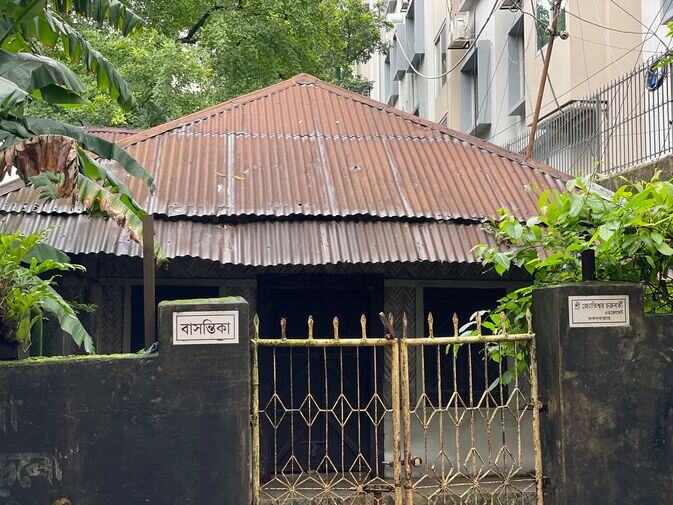
A narrow lane leads to the property, where an aged iron gate bears the name Basantika on one side and the inscription: Sri Jyotishwar Chakraborty, Advocate, Cox’s Bazar on the other. The nameplate immediately sparks curiosity about the history preserved within its walls.
Even from outside, the house reflects the architectural style of an earlier era. Inside the compound, a structure built with brick and bamboo and topped with a corrugated tin roof recalls the simplicity of rural Bengal. The house now stands locked and quiet, yet its surroundings evoke memories of generations past.
Local inquiries revealed that the house belonged to the late advocate Jyotishwar Chakraborty, once a well-known lawyer in Cox’s Bazar. For decades, the residence has been more than a family home; it has remained part of the district’s historical and cultural memory.
Speaking to Cox’s Bazar Life, educator and freedom fighter Someshwar Chakraborty, son of the late advocate, said the existing house was built after Bangladesh’s Liberation War in 1971.
“The present house was constructed after the Liberation War, but our family homestead is nearly 100 years old,” he said.
His brief account reflects the long history of the Chakraborty family. Although the current structure dates from the post-war period, the land itself has been home to the family for almost a century, preserving generations of memories, struggles and heritage.
Amid Cox’s Bazar’s rapid urban expansion, Basantika has become a rare reminder of the town’s architectural and social history. Its old iron gate, brick-and-bamboo construction and tin roof continue to represent a way of life that has largely disappeared.
Local residents say historic homesteads, such as Basantika, are more than just roperties. They are valuable elements of Cox’s Bazar’s cultural heritage and urban history. With proper conservation and maintenance, such sites could help future generations better understand the district’s past.
By Abdu Rashid Manik
Photo: Abdu Rashid Manik