
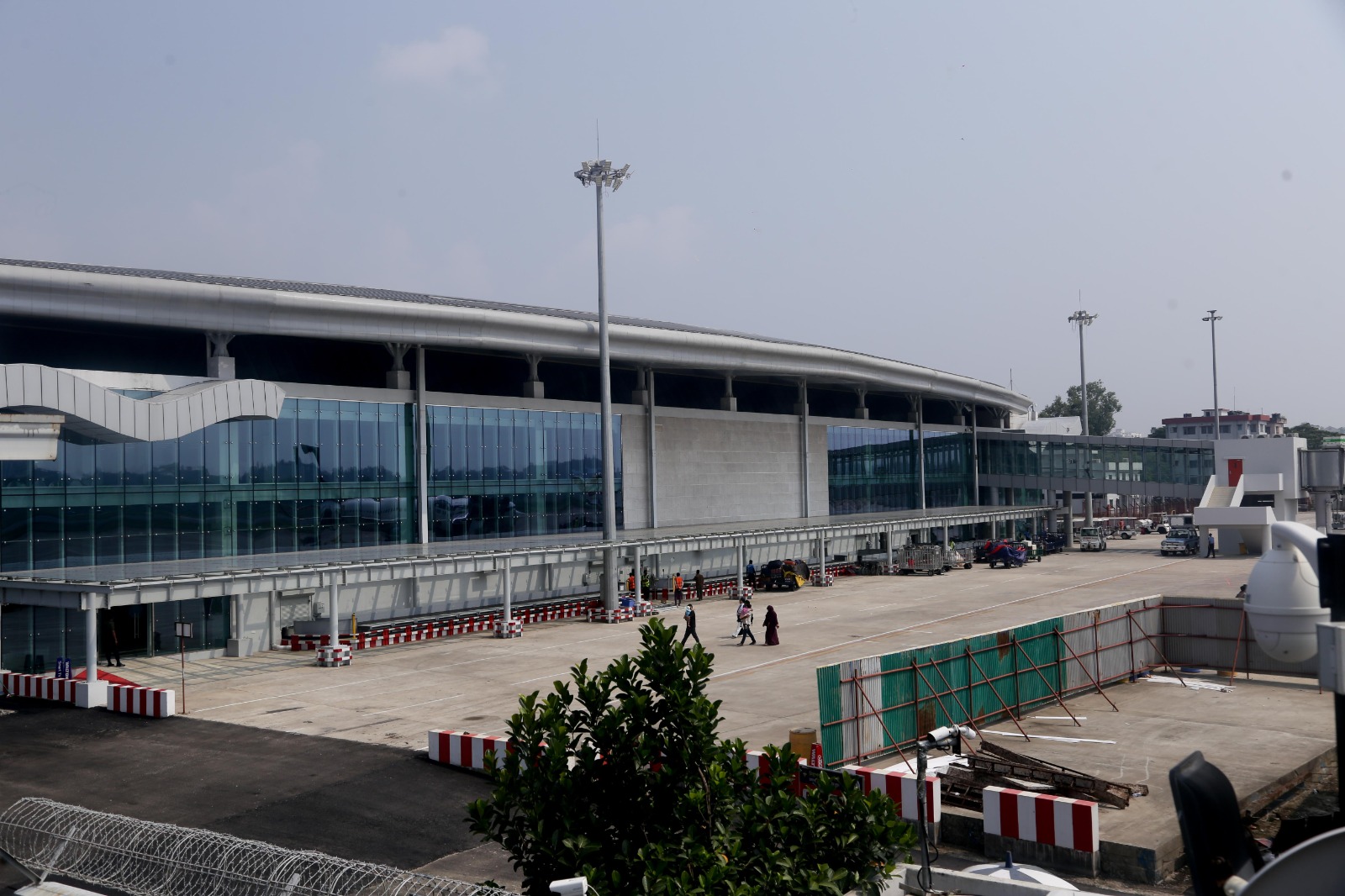
With its shell-shaped roof and wave-like steel structure, the new terminal at Cox’s Bazar airport appears, at first glance, to be an architectural feature inspired by the sea. Yet it is not a tourist attraction, but the airport’s new international passenger terminal.
After years of passenger congestion at the old and limited terminal, the new facility has begun trial operations. The spacious terminal features modern check-in counters, immigration desks, baggage claim belts, security scanners, escalators, lifts, a boarding bridge and an advanced baggage-handling system.
Built on an area of around 17,956 square metres, the terminal can handle about two million passengers a year. The international departure lounge can accommodate 450 passengers at a time. It has 14 check-in counters, 10 immigration desks and two modern baggage claim belts.
For security, the terminal has seven scanners, metal-detection facilities and a separate system for screening hold baggage.
Four escalators and six lifts have been installed to facilitate passenger movement. The terminal also has a boarding bridge, conveyor belts and a modern baggage-handling system. Flight information will be provided through a Flight Information Display System, public announcement facilities and signage.
The terminal includes arrival facilities, immigration desks for both departure and arrival passengers, and duty-free shops.
A large parking area has also been developed in front of the terminal, with space for 35 VIP vehicles and 90 other vehicles.
The new terminal, constructed at an estimated cost of Tk 362.63 crore, has significantly changed the appearance of Cox’s Bazar airport. Officials hope that once fully operational, it will substantially reduce the long-standing difficulties passengers face.
Air Commodore Md Nur-E-Alam, member (ATM) of the Civil Aviation Authority of Bangladesh, told Cox’s Bazar Life that the old terminal often handled 400 to 500 passengers per flight, and sometimes as many as 550, creating pressure beyond its capacity.
“Passengers will have a much larger space, adequate counters and seating facilities at the new terminal,” he said.
The terminal will be formally inaugurated later, he said, adding that trial operations are underway to identify and resolve any operational issues.
Airline operators have also welcomed the new facility.
Mohammad Kamrul Islam, general manager (public relations) of US-Bangla Airlines, said the new terminal offered modern facilities.
“It is positive not only for US-Bangla but for all airlines. Passengers will receive better services and facilities than before,” he said.
However, the terminal’s construction is only part of the preparations to turn Cox’s Bazar into an international airport. Significant changes have also been made to the runway to accommodate international flights.
The airport’s runway was originally 6,000 feet long. It was later extended to 9,000 feet and subsequently lengthened by another 1,700 feet towards the sea, bringing its total length to 10,700 feet.
The extension has enabled the airport to handle wide-body aircraft such as the Boeing 777-300ER.
Several private airlines operated trial flights from the extended runway on September 28.
A Category II airfield ground lighting system has also been installed. The system is expected to assist aircraft operations during adverse weather conditions.
A 2,200-foot-long lighting system for precision approach has been installed towards the sea. It is designed to help guide aircraft safely towards the runway in conditions such as fog and rain.
A protective wall has also been built along the coast to reduce the risks posed by cyclones and tidal surges.
The airport apron covers 36,300 square metres and has parking facilities for two wide-body aircraft and three Class-8 aircraft. Two taxiways have been constructed to connect the runway with the parking area and terminal.
Aviation expert Kazi Wahidul Alam said ensuring international standards of airport safety and security was essential before declaring the airport an international facility.
He, however, sees significant potential in Cox’s Bazar airport. He said the airport should be made attractive to airlines by developing tourism to international standards while reducing operating, maintenance and fuel costs.
Former director of the Cox’s Bazar Chamber of Commerce and Industry and businessman Abed Ahsan Sagar sees even greater potential.
He alleged that a deliberate negative campaign was being carried out against the airport and said its geographical location offered opportunities to develop Cox’s Bazar as a refuelling hub and a broader aviation hub.
To realise that potential, he said the government should pursue bilateral initiatives and offer long-term incentives to international airlines.
Discounts on parking, terminal and fuel charges, along with tax incentives for passengers, could help attract international airlines to Cox’s Bazar, he added.
Plans are already progressing to connect Cox’s Bazar with international destinations. The civil aviation and tourism minister has said Malaysian airline AirAsia has expressed interest in operating direct flights between Cox’s Bazar and Penang.
The government has also announced plans to introduce direct air links between Cox’s Bazar and Kathmandu, as well as Kunming in China’s Yunnan province.
The broader plan includes direct connections between Cox’s Bazar and destinations in Nepal, China and the Middle East. The government is placing particular emphasis on attracting tourists from southwestern and other parts of China to Cox’s Bazar. The government is also exploring opportunities to attract tourists from the Middle East.
The new international passenger terminal is therefore more than a new airport building. It represents a major infrastructure step towards connecting the country’s principal tourist destination with international tourism.
The bigger question now is how effectively we can translate the new infrastructure into regular international air connectivity.
With the runway and terminal ready, Cox’s Bazar airport’s biggest challenges will be attracting international airlines and sufficient passengers while ensuring world-class safety and services, and ultimately turning the airport into a sustainable international aviation destination.
By Abdu Rashid Manik
Photo: Hussain Shetu