
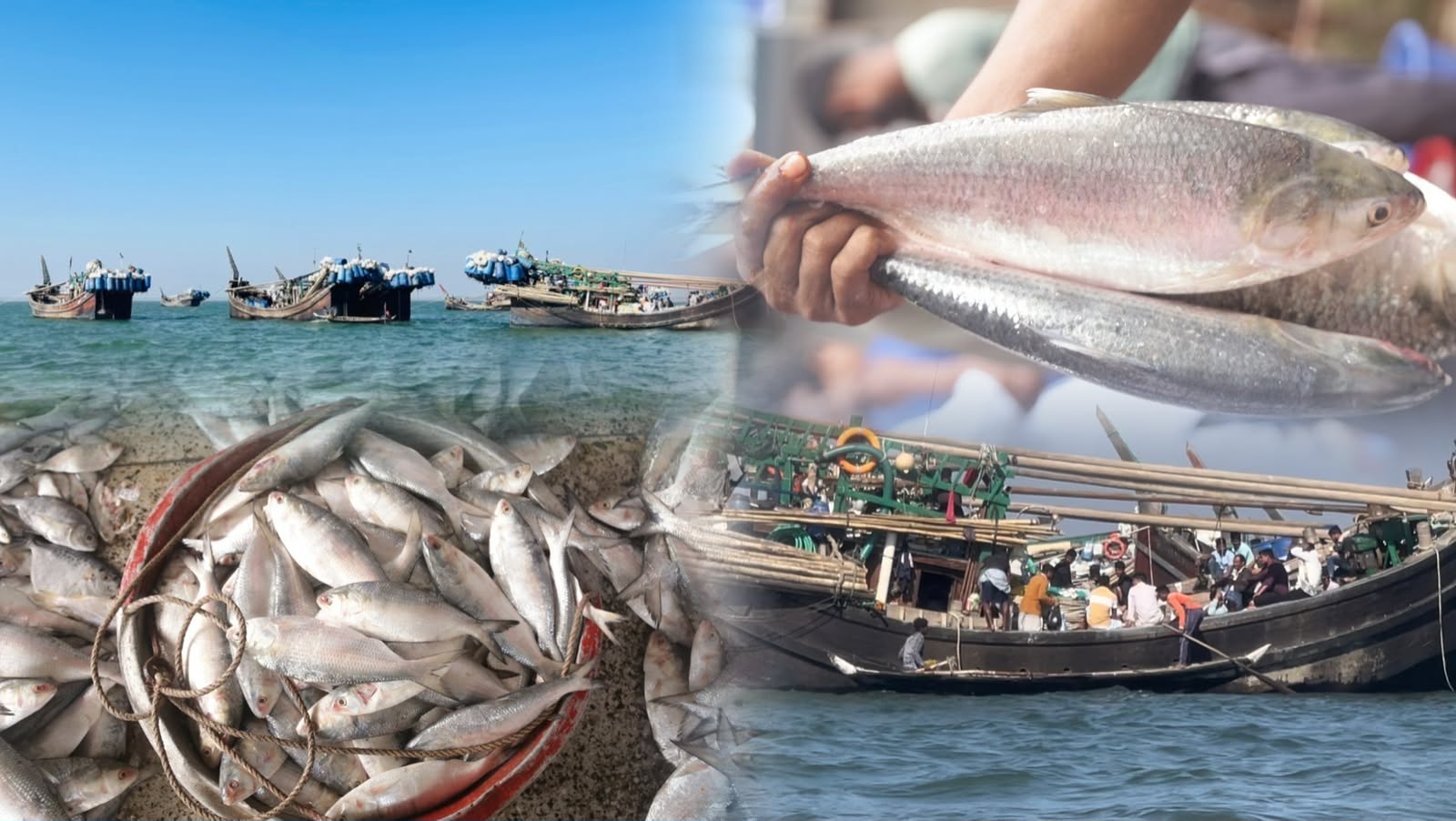
The nets are there, the trawlers are there, and the sea is there — but the hilsa are not as plentiful as before.
Braving rough weather, fishermen from Cox’s Bazar continue to venture into the deep Bay of Bengal in search of hilsa. Yet many trawlers are returning with small catches even after spending several days at sea. Fishermen say not only has the quantity of hilsa declined, but smaller fish also appear to be making up a larger share of their catch.
The situation is particularly concerning as it is now the peak hilsa season. This has raised questions over whether hilsa stocks in the Bay are actually declining or whether the fish are changing their usual habitats and migration routes.
Recent conversations with fishermen returning to Cox’s Bazar Fishery Ghat revealed growing frustration
Fisherman Abdul Khalek said they had returned from the deep sea with only a small quantity of hilsa. They couldn’t tell what was changing in the sea because they weren’t catching as many fish as before.
Cox’s Bazar has around 64,000 registered fishermen. About 6,000 fishing trawlers and boats of different sizes venture into the sea. In addition, more than 100,000 people in the coastal areas are estimated to be involved directly or indirectly in fishing, according to people concerned.
A decline in the availability of hilsa, therefore, affects far more than individual fishermen. Thousands of coastal people rely on the fishery for their livelihoods.
Delwar Hossain, general secretary of the Cox’s Bazar District Fishing Boat Trawler Owners’ Association, said fishermen were now getting about 30 percent less hilsa than before.
He alleged that, alongside the use of illegal monofilament nets, some fishing vessels equipped with advanced technology were identifying fish concentrations and reaching those areas quickly.
He stated that such technology-enabled vessels can identify fish concentrations in the sea from a considerable distance. As a result, traditional wooden trawlers face disadvantages, leading to greater losses for coastal fishermen in Cox’s Bazar.
However, this does not mean hilsa have disappeared from the sea altogether. Several trawlers reportedly caught large quantities of hilsa at different times between August and mid-September.
This suggests that while some areas are yielding substantial catches, fishermen in other locations are spending days at sea without finding the expected quantity of fish.
Hilsa availability has also affected the local market in Cox’s Bazar. At Baharchhara market, hilsa fish are selling for around Tk1,000 to Tk2,200 per kilogram, or even more, depending on their size.
Buyer Hasan said local people couldn’t buy hilsa to meet demand because prices remained high even during the peak season. Fish trader Yunus said they were also having to buy fish at higher prices. A large portion of the hilsa arriving in Cox’s Bazar is quickly sent to different parts of the country, he said, adding pressure to local market prices.
As a result, fishermen are struggling to catch the expected quantity of hilsa, while consumers face prices beyond their reach.
Meanwhile, data from the Department of Fisheries show that hilsa production in Bangladesh fell from 571,340 tonnes in fiscal year 2022–23 to 529,487 tonnes in FY2023–24. Production declined further to 500,288 tonnes in FY2024–25.
Fishermen’s experiences in Cox’s Bazar and the national production figures have therefore renewed questions about the current state of the hilsa fishery.
Cox’s Bazar district fisheries officer Md Nazmul Huda said 10–15 tonnes of hilsa were arriving at the fishery ghat each day, lower than in previous years.
The hilsa season generally runs from June to October, with availability expected to be higher during the monsoon, particularly in Shraban and Bhadra.
But the current season has seen lower-than-expected catches, he said.
Experts, however, say no single factor explains the current situation.
Overfishing, jatka fishing, the use of banned and small-mesh nets, pollution in rivers and the sea, and climate change can all affect the life cycle of hilsa, they said.
Muhammad Arifur Rahman, a research associate at WorldFish Bangladesh, said climate change could alter hilsa’s natural breeding and life cycle.
Rising water temperatures and changes in other water-quality parameters can affect hilsa habitats, breeding grounds and nursery grounds. Such changes can, in turn, affect spawning, feeding during the larval and juvenile stages, and the fish’s normal migration patterns, he said.
Alongside climate change, pollution in rivers and the sea, and excessive hilsa and jatka fishing can disrupt the breeding, growth, and production of the fish, according to Rahman.
Heavy vessel movement in rivers and the sea, as well as the placement of nets along hilsa migration routes, can also interfere with their normal movement and breeding, he said.
A significant part of the hilsa life cycle takes place in the sea. During the breeding season, the fish move towards rivers and estuaries. Changes in river flow, navigability, salinity, water temperature and food availability can therefore influence their movement.
If these changes are compounded by excessive fishing and pressure from illegal nets, they could also affect hilsa breeding and put additional pressure on future generations.
By Mohammad Morshed
Photos: Hussain Shetu and Mohammad Morshed