
Hundreds of young environmental activists, researchers and community leaders pledged to protect the Bay of Bengal at a daylong programme held in Cox’s Bazar on Monday to mark World Oceans Day 2026.
The event formally launched the Bay of Bengal Assembly, a collaborative initiative led by a coalition of environmental organisations, including Waterkeepers Bangladesh, Bon Foundation, Bengal Peace Foundation, Save Our Sea and Mission Green Bangladesh.
Held under the theme “Protecting Marine Biodiversity Through Pollution Mitigation and Coral Ecosystem Restoration,” the programme brought together youth representatives, international researchers and policymakers to address growing environmental challenges facing Bangladesh’s marine ecosystem.
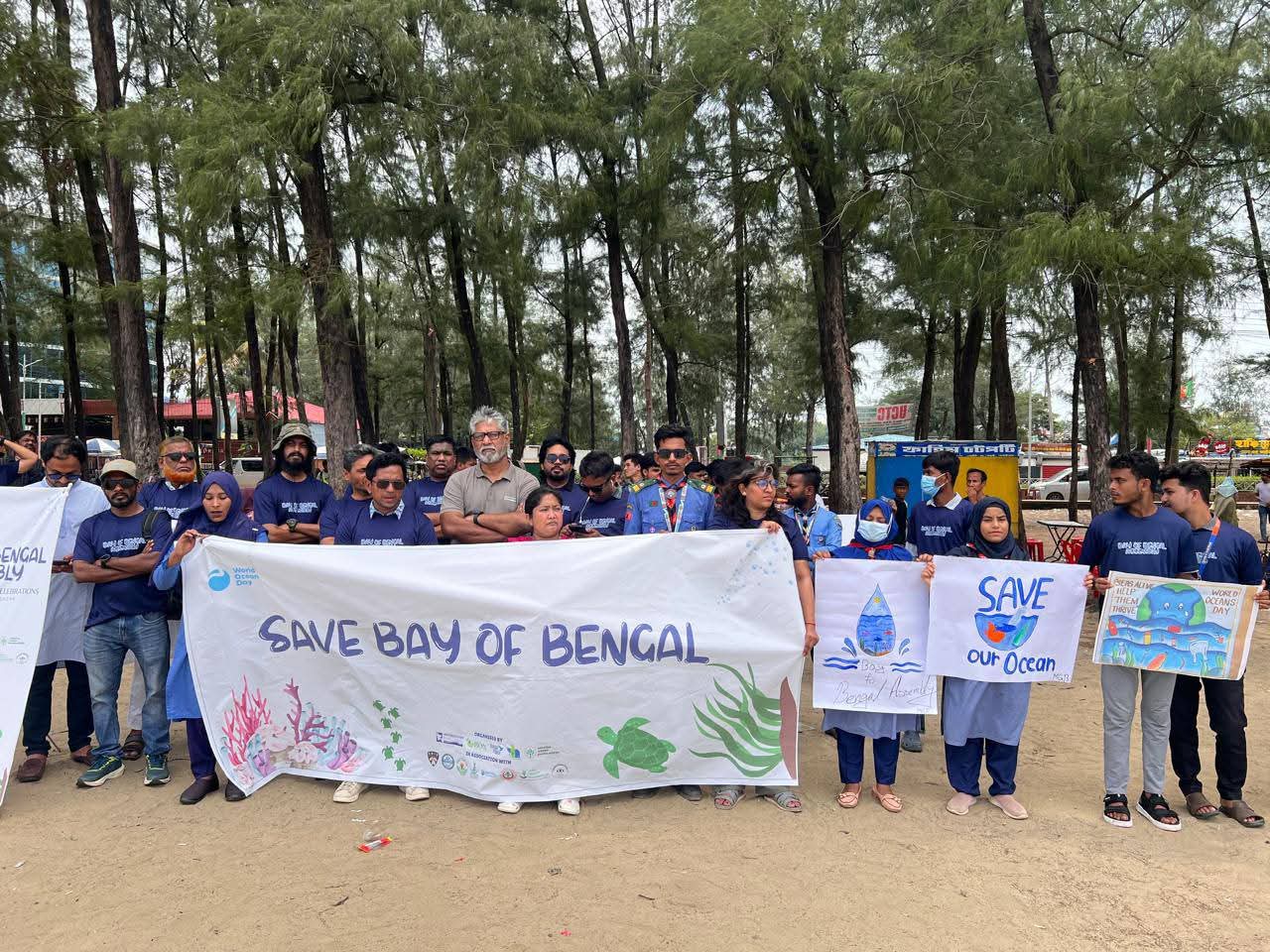
The observance began with a ‘Blue Wave’ action at Laboni and Sugandha beach points, where more than a hundred youth volunteers formed a human chain and collected large quantities of plastic waste from the shoreline.
Participants later joined the World Ocean Day Conference 2026 at the auditorium of Cox’s Bazar International University, where experts discussed a range of marine conservation issues and unveiled the digital Youth4Ocean Platform, aimed at engaging young people in coastal and marine protection efforts.
Speakers highlighted the environmental threats posed by microplastic pollution, the rapid degradation of the coral ecosystem surrounding St Martin’s Island, and the destruction of nesting habitats of endangered olive ridley sea turtles due to uncontrolled tourism and beach pollution.
Addressing the conference, Sharif Jamil, coordinator of Waterkeepers Bangladesh and member secretary of Dharitri Rokkhay Amra (DHARA), stressed the need for urgent policy reforms to safeguard the country’s marine resources.
“The Bay of Bengal is not an unlimited dumping ground; it is the living heart of our nation. We cannot talk about a sustainable blue economy while plastic pollution and weak enforcement continue to suffocate marine life. Protecting our oceans requires stronger law enforcement, immediate pollution control measures and community-led ocean governance,” he said.
Ahsan Rony, founder and executive director of Mission Green Bangladesh, underscored the role of youth in environmental conservation.
“Our volunteers have done more than collect plastic waste today; they have drawn a clear line against environmental destruction. Through the Youth4Ocean platform, we aim to transform young people from observers into active stakeholders in marine conservation,” he said.
Highlighting the scientific and climate-related vulnerabilities of Bangladesh’s marine ecosystem, Roufa Khanam, deputy director of the Centre for Climate Change and Environmental Research (C3ER) at BRAC University, warned that rising sea surface temperatures and localised pollution were pushing the country’s fragile coral heritage towards irreversible decline.
“If we are serious about protecting this rich biodiversity, evidence-based research and climate adaptation models must be incorporated into coastal zoning policies without delay,” she said.
Reflecting on the scale of youth participation, Ikramul Hasan Shakil, founder of Bon Foundation, mountaineer and author, said the initiative demonstrated the power of collective action.
“Just as climbing a mountain requires discipline and shared commitment, protecting the Bay of Bengal demands national solidarity. Today’s programme shows that when young people are given a platform, they can become a powerful force for environmental protection,” he said.
Mohammad Anwarul Haque, secretary-general of Save Our Sea, emphasised the vital role oceans play in sustaining life on Earth.
“Many people know that trees produce oxygen, but few realise that a significant portion of the oxygen we breathe comes from the oceans. Plastic pollution, unregulated tourism and climate change are threatening this critical source of life. Protecting the oceans is essential to protecting the planet,” he said.
The day concluded with ‘Sunset Melodies: Rhythm of Nature’, an acoustic cultural programme held at Bay Lounge of Bay Watch in Inani. The event combined music, environmental storytelling and cultural activism to promote public awareness of marine conservation and strengthen collective commitment to protecting the Bay of Bengal.
Among those attending the programme were Professor Dr Abdullah Harun Chowdhury, environmental researcher at Khulna University; Md Marufat Hossain, superintendent of police of the Tourist Police, Cox’s Bazar Region; Md Shariful Islam, head of influencing at Oxfam in Bangladesh; marine researcher Mir Mohammad Ali of Sher-e-Bangla Agricultural University; disaster response officer Md Tanzimul Alam Arif of FAO’s Rohingya Coordination Platform; policy analyst SM Suja Uddin; freelance journalist Tanbirul Miraj Ripon; Mohammad Abdul Hamid, general secretary of Bangladesh Scouts Cox’s Bazar District Rover; Saifullah Sadeq, founder and director of the Bangladesh Research Society; and Masfikul Hasan Tonni, founder of Bengal Peace Foundation, along with representatives of various youth and environmental organisations.
Cox’s Bazar Life Report
Photo: Courtesy