
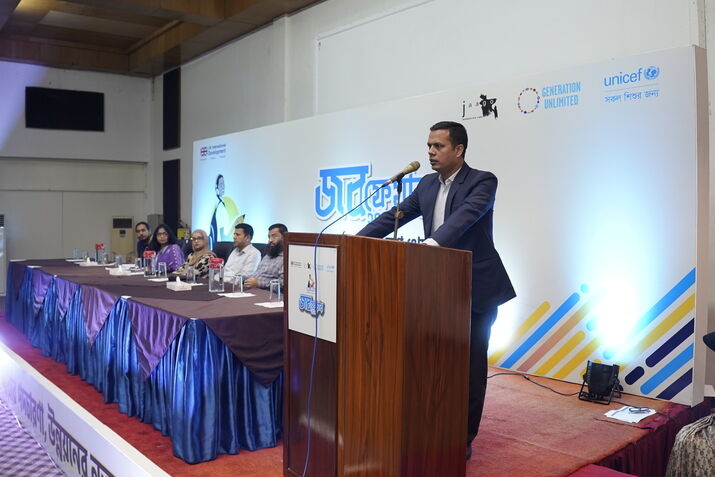
Job Fair 2026 was organised at Hotel Sea Palace in Cox’s Bazar to create employment pathways for skilled adolescent girls and young women by connecting them with potential employers. More than 20 organisations from the tourism, retail, banking, ICT, service, and hospitality sectors participated in the fair.
The event was organised under the Shopner Sharothi — Girls Education and Skills Partnership (GESP) project, jointly implemented by JAAGO Foundation Trust and UNICEF Bangladesh, with funding from the UK’s Foreign, Commonwealth and Development Office (FCDO).
The Cox’s Bazar job fair followed the first event held in Bandarban on 16 June 2026 as part of the same initiative. The fair created a direct platform for trained young women from Cox’s Bazar and surrounding areas to engage with local and national employers, explore career opportunities, and access employment support.
Employers including BDJobs, Shombhob Jobs, HONOR, OPPO, Shopno Super Shop, along with organisations from the tourism, service, and retail sectors, participated in the fair. Through dedicated booths, participants had opportunities to submit CVs, attend direct interviews, receive career guidance, and discuss potential job and internship placements.
Although Cox’s Bazar is one of Bangladesh’s leading tourism and service-sector hubs, many young women in the region continue to face challenges entering the labour market due to poverty, early marriage, social barriers, mobility constraints, and limited access to employment networks. The Shopner Sharothi project has been designed to address these challenges by creating sustainable pathways from “skilling to earning.”
Md. Kamrul Islam, Assistant Commissioner and Executive Magistrate, Cox’s Bazar District Administration, said. “Creating opportunities for girls’ skills development and employment will not only transform their individual lives but also contribute significantly to the progress of their families and communities. Initiatives like this are helping unlock local potential and create new pathways for meaningful opportunities.”
Fahmida Shabnam, Representative of UNICEF Bangladesh, said, “Sustainable change becomes possible when girls have access to skills training, confidence-building opportunities, and real pathways to employment. The Shopner Sharothi project is not only preparing girls for jobs but also encouraging them to recognise their potential and become future leaders.”
Kamrul Kibria Ayon, Assistant General Manager (AGM), JAAGO Foundation Trust, said, “Our goal is not limited to providing training; we are committed to creating real opportunities for trained girls to apply their skills. While a job can transform a young woman’s life, we also want to inspire them to dream beyond employment — to become entrepreneurs and create opportunities for other women from marginalised communities.”
Kohinur Akter, a learner of the Retail Sales Course under the project, said, “Through this training, I have developed my skills and confidence. Today, I have a job and can earn independently. This opportunity has encouraged me to dream bigger and continue working towards a better future.”
Under the Shopner Sharothi project, 4,100 adolescent girls and young women have already received training in market-driven skills including food and beverage services, retail, housekeeping, and ICT. Through mobile training initiatives, 1,320 young women from hard-to-reach areas have gained access to skills development opportunities. In addition, 5,400 students are receiving digital skills and leadership training through the Passport to Earning (P2E) platform.
The organisers highlighted that the job fair is not only a platform for employment opportunities but also an initiative to inspire young women to build confidence, pursue their ambitions, and explore entrepreneurship as a pathway toward economic independence.
JAAGO Foundation Trust and UNICEF Bangladesh believe that with the right skills, opportunities, and supportive environment, girls and young women from marginalised communities can unlock their potential and contribute significantly to Bangladesh’s social and economic development.
Cox’s Bazar Life Desk