

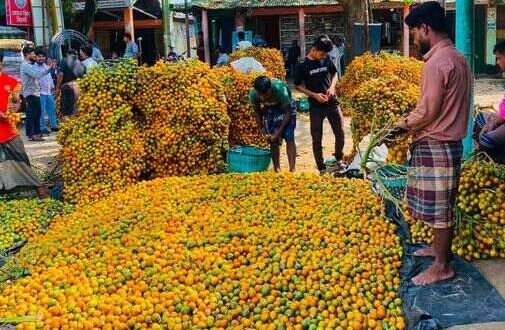
Farmers in the coastal areas of Ukhiya and Teknaf in Cox’s Bazar have reported a bumper betel nut harvest this season, with production up from the previous year thanks to improved orchard management and greater awareness of weather-related risks.
Farmers are following agricultural department advice to prepare planting pits at the proper depth and distance, apply organic and chemical fertilisers, and manage irrigation, drainage, and regular weed removal.
They apply urea, TSP, MOP, and decomposed cow dung based on the trees’ age, along with boron when needed. They also take precautionary measures based on weather forecasts to reduce damage from storms, heavy rain, and excessive heat.
These practices have helped keep trees healthy, improve yields and maintain the quality of betel nuts, increasing farmers’ earnings.
Mizanur Rahman, a farmer from Sonarpara in Ukhiya, said he cultivated betel nuts on four kani of land and had a successful harvest this year. He has also planted saplings on another one and a half kani of land.
“Earlier, adverse weather and salinity damaged the trees in my orchard. Now I follow the advice of agricultural officers. Regular fertiliser application, irrigation and orchard care have improved the yield,” he said.
Irfan Azad, a betel nut grower from Jahajpura in Teknaf, said he had learned about climate-resilient betel nut cultivation and orchard management from media reports and benefited from the advice.
He said he had also encouraged other farmers to follow the recommended practices, including applying fertiliser according to tree age, regular maintenance and necessary irrigation.
“I cultivated betel nuts on four kani of land this year, while my uncle has an orchard on 12 kani. We follow the recommended practices and are getting good yields,” he said.
A pan contains 80 betel nuts, while 16 pans make one hon. A hon is currently selling for Tk8,500 to Tk10,000, depending on quality, he added.
The increase in production has also affected the market. A pan of good-quality betel nuts is selling for Tk800 to Tk900, while lower-grade nuts are priced at Tk400 to Tk600. Traders said betel nuts collected from local orchards were being supplied to markets in different districts.
Farmers said excessive heat, irregular rainfall, floods, tidal water and saline winds from the sea had previously caused tree tops to dry out, leaves to fall and yields to decline.
They have now become more aware of the need to take precautions before storms and rainfall based on weather forecasts, irrigate during dry periods, retain rainwater and ensure proper drainage.
In Teknaf, farmers cultivated betel nuts on 1,280 hectares this season, with 1,260 hectares brought under production. Around 10,240 tonnes were produced from 1,280 hectares of orchards in the previous season.
Teknaf Upazila agriculture officer Humayun Kabir said the production target for the current season was initially set at 11,240 tonnes.
Teknaf trader Abdul Mabud said betel nuts collected from local orchards were dried and processed before being sent to different parts of the country. Cox’s Bazar betel nuts are supplied to markets in Rajshahi, Khulna and Rangpur, among other districts. Prices vary according to quality, with better-quality nuts fetching higher rates.
Moustak Uddin, sub-assistant agriculture officer of the Shamlapur block in Teknaf, said that proper pit preparation and fertiliser application were essential for good yields.
He advised farmers to dig pits one and a half cubits deep and four to five cubits apart. Each pit should be filled with five to 10 kilograms of decomposed cow dung, 100 grams of TSP, 50 grams of MOP and a small amount of doluchun, or lime. Plant saplings 7 to 10 days after preparing the pits.
For trees aged one to three years, farmers should apply five to 10 kilograms of cow dung, 200 grams of urea, 100 grams of TSP and 100 grams of MOP annually in two instalments. Double the amounts for trees aged four years or more, and triple them for those older than 10 years.
He also recommended applying a teaspoon of boron around each tree every two to three years to reduce fruit splitting.
Fertiliser should be applied in a circular trench dug one and a half cubits away from the base of each tree. Farmers should water the trees before and after fertiliser application and keep the orchards weed-free, he said.
Sabran Union has the largest area for cultivating betel nuts in Teknaf, with orchards covering 370 hectares. Baharchhara has 360 hectares, Teknaf Sadar 350 hectares, Hnila 40 hectares, Whykong 50 hectares and Saint Martin’s Island union 10 hectares.
Teknaf Upazila Agriculture Officer Md Humayun Kabir said 1,280 hectares were under betel nut cultivation in the upazila, of which 1,260 hectares were in production.
The average yield per hectare was 13.43 tonnes of betel nuts with husks and 5.5 tonnes of dried nuts without husks. Total production in the upazila stood at 16,922 tonnes with husks and 6,930 tonnes without husks, he said.
Ukhiya upazila agriculture officer Kamnashis Sarkar said betel nut cultivation had expanded by 15 to 20 hectares this year from 970 hectares last year. New harvests had begun in 10 hectares of the expanded area.
Harvesting began in early September and would continue until December, he added.
The Department of Agricultural Extension in Cox’s Bazar reports that around 32,000 small and large betel nut orchards cover 8,670 acres across 71 unions in Teknaf, Ukhiya, Cox’s Bazar Sadar, Ramu, Eidgaon, Chakaria, Pekua, Maheshkhali, and Kutubdia.
The district has set a production target of more than 200,000 tonnes of betel nuts for the current season.
By Tarekur Rahman
Photo: Tarekur Rahman