
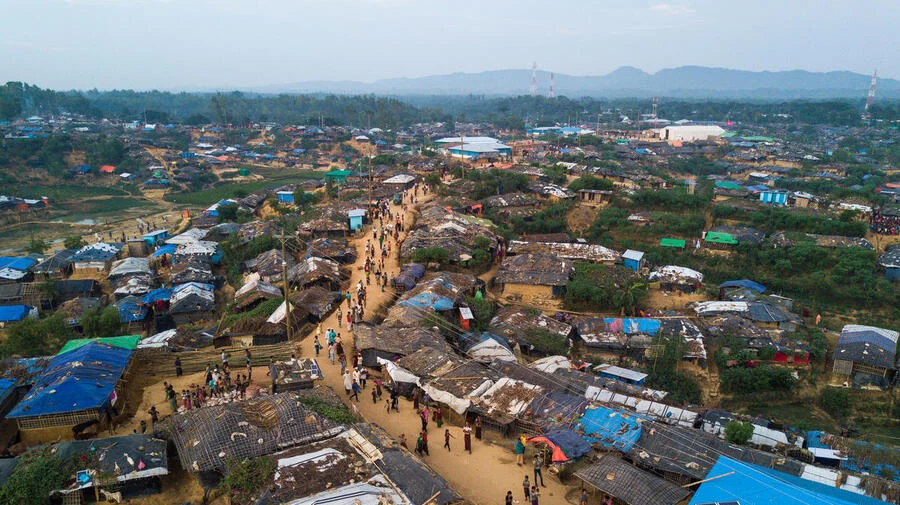
Rohingyas living in camps in Cox’s Bazar are looking towards the International Court of Justice for justice over the atrocities committed against them in Myanmar’s Rakhine State in 2017, as the court is scheduled to deliver its verdict in a genocide case against Myanmar on November 19.
After nearly nine years of displacement, the Rohingyas are hoping that the ruling will ensure accountability for the violence they suffered and create international pressure on Myanmar to ensure their safe and dignified repatriation.
The verdict will be delivered at the court in The Hague, the Netherlands. For the Rohingyas, however, the ruling represents more than a legal decision. They want international recognition of the atrocities committed against their community and effective measures to hold Myanmar accountable.
Master Toha, a resident of block C-7 of Kutupalong Camp-4 in Ukhiya, fled to Bangladesh in 2017 after losing his relatives, homestead and roots in Myanmar’s military crackdown in Rakhine State.
He said that although he hoped Myanmar would be held accountable, punishment alone would not be enough to address the suffering of the Rohingyas.
“If Myanmar is found guilty by the international court, the matter should not end with punishing the country. We want Myanmar to be made suitable for our return and to ensure that we are not subjected to persecution again. We want the court to help ensure our right to live freely in our own country,” he said.
Dr Zubair, chief leader of the Arakan Rohingya Society for Peace and Human Rights, said that Myanmar had subjected the Rohingyas to severe persecution and forced them out of their homeland.
“We are grateful to Bangladesh and those who have supported us in seeking justice. We hope to get justice. With the help of the international court, we hope to return to our homeland from Bangladesh soon. We also want the international community to put pressure on Myanmar to receive us safely,” he said.
Nine years of waiting for justice
Hundreds of thousands of Rohingyas fled to Bangladesh following the Myanmar military’s operations in Rakhine State in 2017, amid allegations of killings, rape, torture and the burning of homes.
Many of those who took shelter in Bangladesh still carry traumatic memories of the violence. Some lost family members, while others lost their homes and livelihoods.
The announcement of the long-awaited ruling has renewed their hopes for justice.
Abdullah Hasan, a resident of Balukhali Camp-19, said that he would never forget the persecution of his family and the loss of relatives in 2017.
“I want justice for the genocide,” he said.
Saleha Begum, another resident of the same camp, said that she had lost her home and property in Myanmar and hoped that the country would be held accountable for the genocide.
Repatriation with rights and security
Alongside justice, the Rohingyas expect the ruling to increase international pressure on Myanmar to ensure their citizenship, security, freedom of movement and fundamental rights.
The displaced people want to return to their homeland, but insist that repatriation must be voluntary, safe and dignified. They are unwilling to return without guarantees of citizenship, security and fundamental rights.
Karim Ullah, a resident of Kutupalong camp, said that they wanted to return to their homeland but would not do so without full citizenship and guarantees of personal security.
“We want to return to our own country, but we will not go back without guarantees of full citizenship and security of life,” he said.
Noor Begum, another camp resident, said they wanted a safe, normal life for their children.
“The security of women and children must be ensured if we return to Myanmar,” she said.
Young generation concerned about future
The prolonged displacement has also affected the younger generation of Rohingyas. Many children and adolescents born and raised in the camps have little familiarity with Myanmar, their ancestral homeland.
They remain concerned about their access to education, employment, citizenship and a secure future.
Abu Bakkar, a resident of Balukhali camp, said that the lack of opportunities for higher education and employment in the camps had made them uncertain about their future.
“We want to return to our country, complete our education and become self-reliant,” he said.
Helal Uddin, a young resident of Lombashia camp, said that they no longer wanted to live without a recognised national identity.
“The rights of future generations and justice must be ensured so that we do not have to live as stateless people,” he said.
Call for international action
The Rohingyas believe that the international community must take effective measures beyond the court’s ruling to ensure their rights and security.
They want global leaders to put effective pressure on Myanmar to ensure accountability for the alleged genocide and create conditions for safe and sustainable repatriation.
Shamsul Alam, a majhi of Balukhali Camp-19, said that the Rohingyas were hopeful about the ICJ proceedings, but that international leaders must take concrete steps to ensure their dignified return.
“We are hopeful about the ICJ process. But beyond the verdict, world leaders must put effective pressure on Myanmar to ensure that we can return home with dignity,” he said.
Gambia filed the case against Myanmar at the ICJ in November 2019 on behalf of the Organisation of Islamic Cooperation, alleging violations of the 1948 United Nations Convention on the Prevention and Punishment of the Crime of Genocide.
The court is scheduled to deliver its verdict on November 19, with the reading set to begin at 10:00 am local time in the Netherlands, or 3:00 pm Bangladesh time. The proceedings will be broadcast live.
By Tarekur Rahman
File Photo