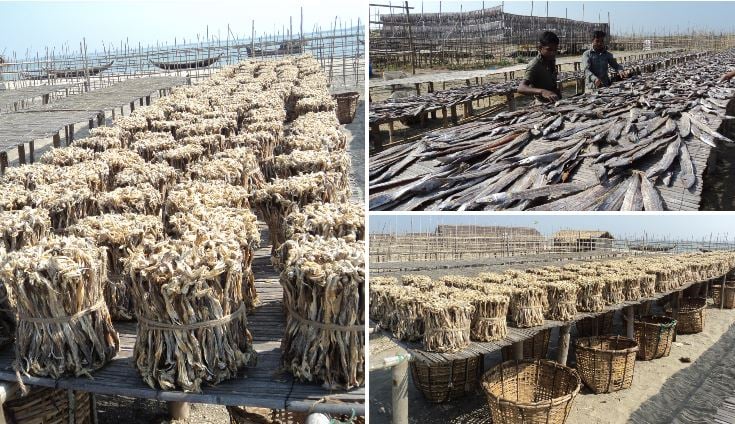
Dry fish production is in full swing along the coastal areas of Cox’s Bazar after fishing resumed following a 22-day ban that ended on October 29, with producers expecting output worth around Tk 500 crore this season.
Nazirartek, the district’s largest dry fish production hub, comprises 18 villages under Wards 1 and 2 of Cox’s Bazar municipality and has around 600 small and large drying yards, locally known as mahals. Dry fish is also produced in Teknaf, Saint Martin’s Island, Maheshkhali and Sonadia Islands.
Traders said more than 800 drying yards across the district were producing over 150 metric tonnes of dry fish daily. They expect production worth around Tk 500 crore this season if weather conditions remain favourable.
During a visit to Niamat Enterprise in Nazirartek on Thursday morning, around 30 workers, including nine women, were found processing fish. Worker Sabekunnahar said production had gained momentum since fishing resumed after the prolonged ban.
At a nearby yard, Kamal Traders, around 50 maunds of dry fish were in stock.
Worker Mamunul Haque said winter brings higher demand for dry fish, while production largely depends on the volume of fish caught at sea.
Md Alam, owner of Alam Enterprise, said workers remained busy from 6:00 am until evening. Many tourists visiting Cox’s Bazar also buy several kilograms of dry fish before returning home, boosting demand, he added.
Traders buy fresh catches brought ashore by fishing boats, clean and wash the fish, and spread them on bamboo racks under the sun. The varieties include Bombay duck, ribbonfish, jewfish, croaker, phaisa, pomfret and other marine fish.
Women constitute a significant portion of the workforce, and for many, dry fish processing is their only source of livelihood.
Worker Rokeya Begum said she has worked at the drying yards for several years to support her three children, two of whom attend school.
“Meeting household expenses is difficult, so I have been doing this work for several years,” she said.
Trader Mostafa Sarwar said around 15,000 to 20,000 workers have been employed in the sector. Although fish supplies are currently low, his business had already reached Tk 1 crore this season, he added.
Aman Ullah, a drying yard owner, said newly produced dry fish commanded higher prices than older stocks, with a difference of Tk 100 to Tk 300 per kilogram. Production will continue until May, he said.
Neyamat Ullah, president of the Nazirartek Dry Fish Traders Cooperative Society, said around 30 truckloads, each carrying 12 to 13 tonnes, had been sent to Chattogram over the past five days. He said prices had risen significantly from last year because raw fish costs were higher.
Market prices ranged from Tk 300 to Tk 3,700 per kilogram, depending on the variety, while retail prices were Tk 50 to Tk 200 higher. Retailers said prices had increased by 30 to 40 per cent
District Fisheries Officer Md Nazmul Huda said the district produced 39,500 metric tonnes of dry fish in the 2025-26 fiscal year, while the target for 2026-27 had been set at 42,000 tonnes. He expressed optimism that the target could be exceeded.
Abdul Shukkur, president of the Bangladesh Dry Fish Exporters Association, said exports of poa dry fish to Hong Kong, Malaysia and Indonesia earned nearly Tk 200 crore last year. He added that export earnings could reach Tk 300 crore this year if conditions remained favourable.
Abu Morshed Chowdhury Khoka, former president of the Cox’s Bazar Chamber of Commerce and Industry, said the district produced dry fish worth around Tk 400 crore last year. He said production would approach Tk 500 crore this season, alongside efforts to ensure a supply of chemical-free dry fish.
Cox’s Bazar Life Desk/BSS