
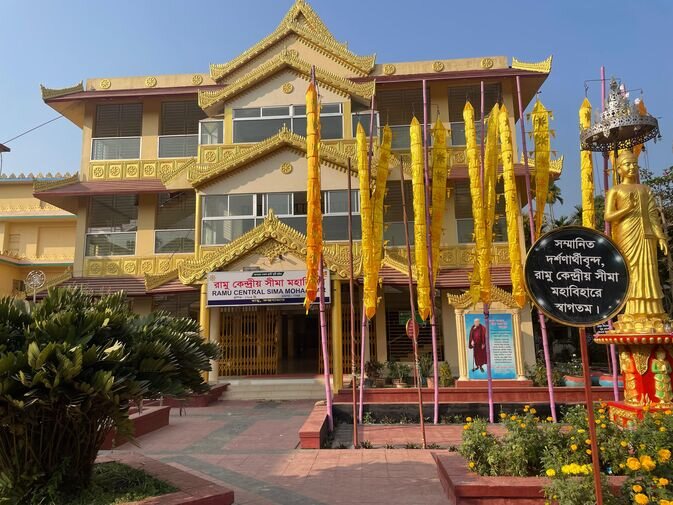
A little beyond Chaumuhani Station, rows of Buddhist monasteries come into view. Their new structures, green surroundings and prayer-filled compounds offer little indication of the violence that swept through Ramu 14 years ago.
The wounds of the 2012 violence have largely healed with time, and relations among people of different faiths have returned to normal in the area. However, 14 years after the attacks, most of the cases filed over the violence remain unresolved.
On the night of September 29, 2012, attacks were carried out on Buddhist monasteries and settlements in Ramu following allegations that a Facebook account had carried a post insulting Islam. Monasteries and homes were vandalised and set ablaze.
In Ramu, attackers damaged twelve Buddhist monasteries and thirty homes. The following day, attacks were also reported on Buddhist monasteries and homes in Cox’s Bazar Sadar, Ukhiya and Teknaf. Several historic religious and archaeological artifacts were also damaged.
The attacks have led to the rebuilding of many affected monasteries. Beyond religious activities, some sites are also drawing increasing numbers of tourists.
Local people say the fear and mistrust that followed the violence have gradually given way to normal social relations.
Shilapriya Thera, director of Ramu Central Sima Mahavihara, said the losses suffered that night could never be completely restored.
“People in Ramu are now living peacefully,” he said, stressing the need to preserve communal harmony in the future.
Pragyananda Bhikkhu, president of the Cox’s Bazar Buddhist Protection Council, said the Buddhist community had received new monasteries and structures after the attacks. Still, questions remained among community members because the trials were not yet complete.
Where is Uttam Barua?
The Facebook post that allegedly triggered the 2012 violence was reportedly posted from an account belonging to Uttam Barua, a resident of Haitupi village in Ramu.
Following the incident, Uttam remained out of public view for a long period. In October 2025, he reportedly revealed his whereabouts by posting photographs with his wife and children on Facebook.
According to his relatives, Uttam left Bangladesh after the incident, travelling through the Chattogram Hill Tracts to India before later moving to France.
According to his relatives, he is currently living in France with his wife and children.
14 cases still pending
A total of 19 cases were filed over the violence in Ramu, Cox’s Bazar, Ukhiya and Teknaf.
The complainant later withdrew one case, and the complainant withdrew four others, while four cases filed in Ukhiya were subsequently withdrawn. According to available information, 14 cases are currently pending.
The cases accused a total of 15,182 people, including 385 individuals specifically named in the complaints.
Police submitted charge sheets in 18 cases, accusing 993 people, according to case records officials cited.
Mohammad Yunus, public prosecutor at the Cox’s Bazar District and Sessions Judge’s Court, said some witnesses had already testified in the cases.
“The trial process is moving slowly because of the reluctance of witnesses to appear,” he said.
Lawyer Sumath Barua raised questions about the lists of witnesses and accused in the cases.
He said, “If any innocent person has been harassed, that should be examined, and those responsible for the violence should be punished.”
Fourteen years after the violence, the Buddhist neighbourhoods of Ramu have largely returned to the rhythm of normal life. The monasteries have been rebuilt, social relations have improved, and communal activities have resumed.
But for those who saw the violence, normalcy has not ended the wait for justice.
Cox’s Bazar Life Report
Cox’s Bazar Life Photo