
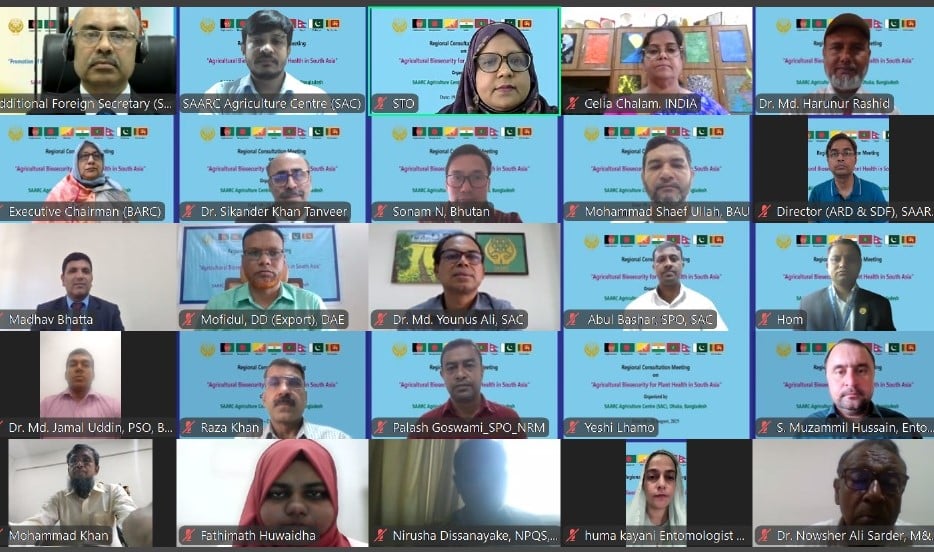
A three-day regional workshop on “Agricultural Biosecurity for Plant Health in South Asia” began today on a virtual platform, organized by the SAARC Agriculture Centre (SAC).
The event brings together experts, policymakers, and researchers to discuss the significant challenges of plant health and transboundary biosecurity in the SAARC states, according to a press release.
Ambassador Abdul Motaleb Sarker, Additional Foreign Secretary (SAARC & BIMSTEC), joined the inaugural session as the chief guest.
He emphasized the importance of collective regional action to safeguard agriculture from pests and diseases that threaten food security and trade across South Asia.
Dr Md Harunur Rashid, Director of SAC, chaired the technical session.
He highlighted SAC’s commitment to strengthening regional cooperation on plant biosecurity and promoting the sharing of knowledge and experience among member states.
He noted that biosecurity is crucial for safeguarding crops against transboundary pests and diseases that pose a threat to food security in the region.
He further emphasized that a unified regional strategy will help SAARC countries build resilience and ensure sustainable agricultural growth.
Dr Nazmun Nahar Karim, Executive Chairman (Routine Charge) of the Bangladesh Agricultural Research Council (BARC), attended as the special guest, stressing the need for stronger research-policy linkages to protect crops.
Guest of Honor Tanvir Ahmad Torophder, Director (ARD & SDF), SAARC Secretariat, Nepal, underlined the importance of harmonized phytosanitary measures for safer regional trade.
Dr V. Celia Challam, Head and Principal Scientist, Division of Plant Quarantine, ICAR-NBPGR, India, delivered the keynote paper on “Plant Biosecurity in South Asia-Status and Challenges”.
She discussed the increasing threats from invasive pests, including wheat blast, Fall Armyworm, and locusts, which are exacerbated by climate change and porous borders. She also highlighted the strength of SAARC member states in biosecurity for plant health.
Presenting the objectives and programme overview, Dr Sikander Khan Tanveer, Senior Programme Specialist (Crops), SAC, explained that the workshop would serve as a consultation platform to identify challenges, prospects, and a collective way forward for SAARC countries.
The technical discussions focused on strengthening regional networks, investing in early warning and surveillance systems, harmonizing quarantine standards, and raising farmer awareness of integrated pest management (IPM). Experts also emphasized the importance of digital tools, biotechnology, and regional funding in addressing future biosecurity threats.
The three-day programme is expected to produce recommendations on establishing a SAARC Plant Health Biosecurity Network, promoting real-time data sharing, and fostering research and development collaborations to build resilient and safe agricultural practices.
Cox’s Bazar Life Desk/BSS