
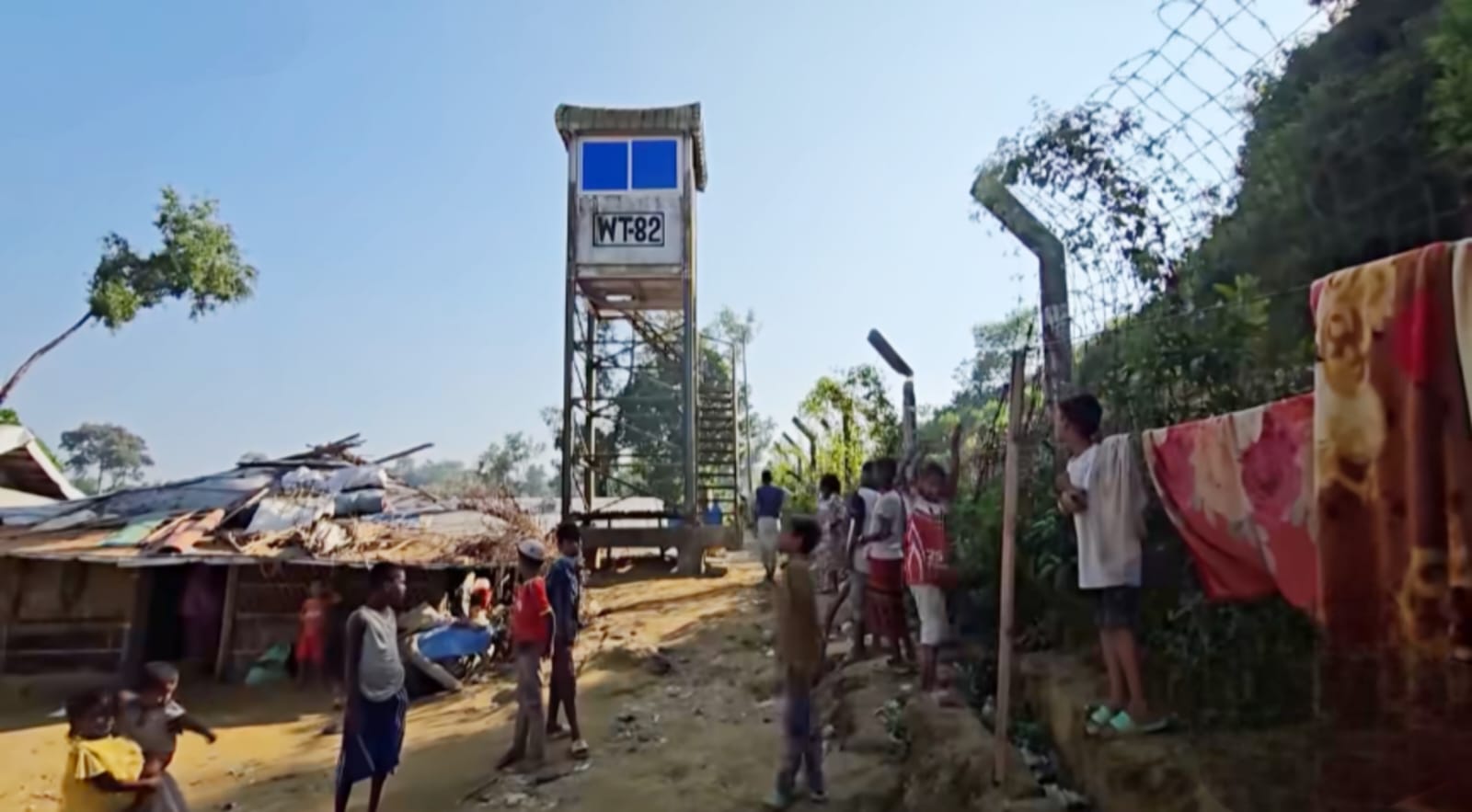
Security infrastructure worth nearly Tk 197 crore, including barbed-wire fences, watchtowers, CCTV cameras and streetlights, at 33 Rohingya camps in Ukhiya and Teknaf of Cox’s Bazar has largely become dysfunctional, leaving the camps vulnerable to criminal activities.
Large sections of nearly 70 kilometres of barbed-wire fencing have been damaged or disappeared. Amid such security lapses, incidents of abduction, robbery, drug trading, human trafficking and gunfights are increasing in the camps and surrounding areas.
A visit to the camps found that most of the streetlights installed for security purposes in Ukhiya and Teknaf had been stolen. As many as 83 dilapidated watchtowers have become virtually unusable, with miscreants removing the roofs from some. More than 700 CCTV cameras are also out of order.
Halima Khatun, a resident of Camp 24 at Leda in Teknaf, said damaged sections of the barbed-wire fence allowed robbers and wild elephants to enter nearby settlements, leaving residents fearful at night.
She said miscreants had also removed the roof of a watchtower installed to ensure their security.
Hashem Uddin, another resident of the same camp, said no law enforcement personnel were assigned to the watchtower, leaving it abandoned and unprotected.
He said electrical wires and other equipment had been stolen, making it difficult to know what happened at night. Residents often learned about thefts only the following morning.
A young resident of the camp, Hizbullah, said patrols and the presence of Armed Police Battalion (APBn) members should be increased to improve security. He added that installing CCTV cameras at key locations would also make crime detection and surveillance easier.
The security situation has also affected nearby local communities. Ismail Hossain, a resident of the Leda area, said robbers frequently moved around the locality, abducting people, stealing cattle and goats, and demanding ransom after torturing their victims.
Rasheda Khatun said residents could not sleep peacefully at night for fear of criminals. Even seeing an unfamiliar person in the area created panic, while gunfire incidents occurred frequently.
Local community leader Mir Kashem said many farmers had reduced their visits to hills for agricultural work because of the risk of abduction.
People concerned said inadequate surveillance was allowing criminals to enter and leave the camps easily. Security risks in remote areas were also making operations difficult for law enforcement agencies.
Supreme Court lawyer Md Touhidul Ehsan said both internal and external security in the camps needed strengthening.
He said barbed-wire fences, CCTV cameras and other surveillance systems should be made functional. Awareness also needed to be raised among Rohingyas about staying within designated camp boundaries and maintaining peaceful coexistence with local communities.
Commanding Officer of the 8 Armed Police Battalion in Ukhiya, Md Riaz Uddin Ahmed, said CCTV cameras in the camps were now virtually non-existent.
He said barbed-wire fences had been cut or damaged in various places, while some camps had no visible fencing at all. The watchtowers had also become unusable. Despite these limitations, APBn members were continuing to perform their duties, he added.
Commanding Officer of the 16 APBn in Teknaf, Mohammad Kawsar Sikder, said APBn members remained on duty around the clock to maintain security in the camps.
However, he said the barbed-wire fences had not been repaired for a long time, leaving cuts and damaged sections at various points. Repairing the fences would make the security system more effective, he added.
Refugee Relief and Repatriation Commissioner Mohammad Mizanur Rahman acknowledged the weaknesses in the security infrastructure.
He said the barbed-wire fences had never been fully functional since their installation, with sections subsequently cut at different locations. The watchtowers were useless because they lacked staff, and the CCTV cameras were broken as well.
However, he said law enforcement personnel were now performing their duties with greater vigilance than before.
He added that a decision had been made to deploy another APBn battalion to strengthen security in the camps, alongside repairing the barbed-wire fences and watchtowers.
By Tarekur Rahman