
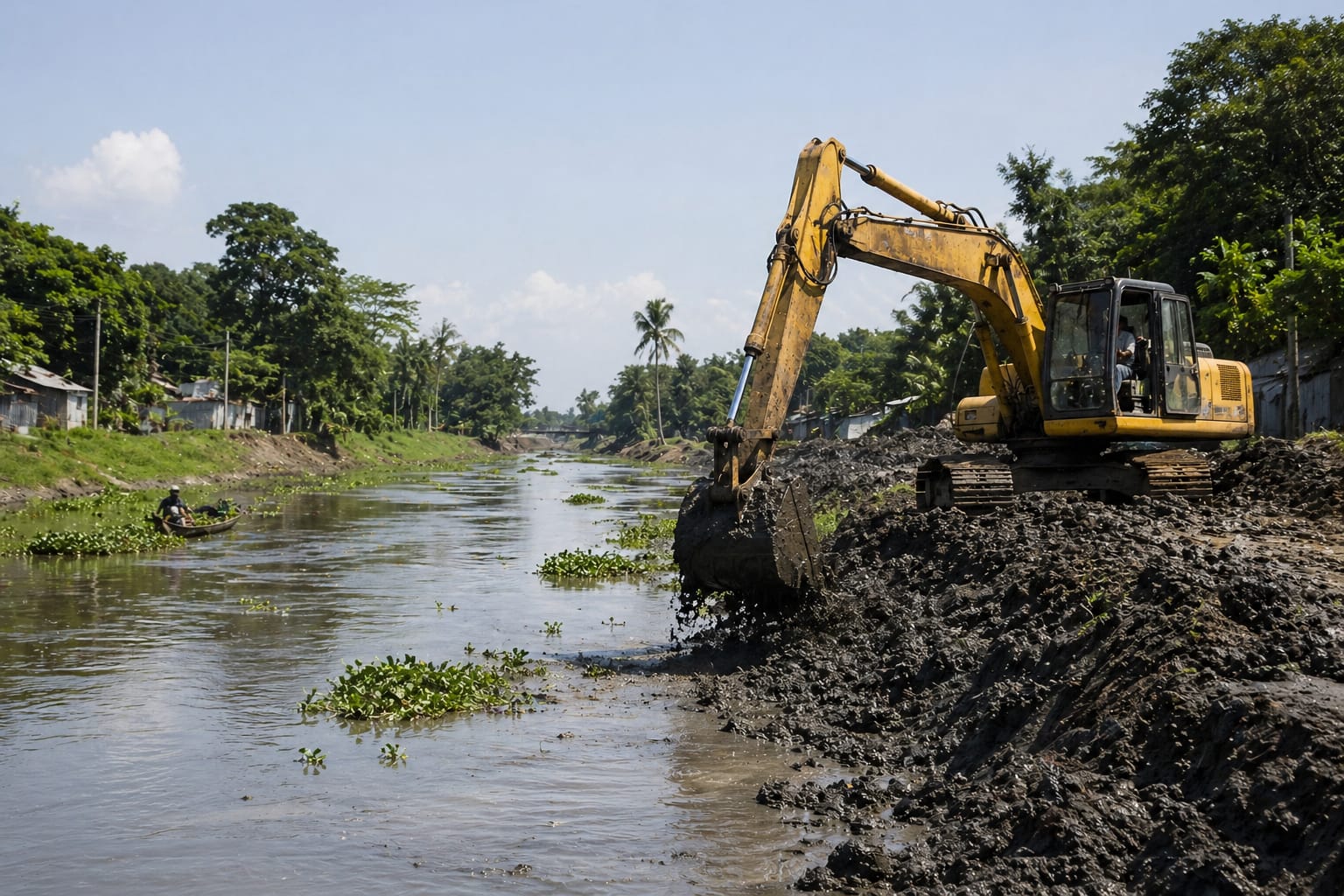
Every monsoon, large parts of Cox’s Bazar town and surrounding areas face the same situation—waterlogging, stagnant water in drains and canals, flooded roads, and widespread public suffering. Yet decades ago, these canals served as the main natural drainage system. Many of them have since been encroached upon, filled in, and lost their navigability, effectively becoming defunct.
In this context, the government has undertaken a large-scale canal excavation and re-excavation programme across the district to restore these waterways. According to estimates by the district administration and relevant agencies, a total of 52 canals—spanning about 218.98 kilometres—have been listed fkilometers—have been listed for reexcavationor re-excavation. The initial cost has been set at over Tk 710 million.
Officials say that once implemented, the initiative will alleviate waterlogging, boost agricultural production, reduce pressure on groundwater, restore natural drainage, and improve ecological balance.
Major expectations around urban canals
Cox’s Bazar Sadar upazila has taken the most significant and coordinated initiative. The authorities plan to re-excavate five canals—Bargoda, Baringa, Katakhali, Ghatikhali, and Patila—directly linked to the town’s drainage system.
Residents consider the 8-kilometre-long Patila canal a ‘lifeline’. During the monsoon, its dysfunction leads to prolonged waterlogging in several areas. Locals believe that full excavation and removal of encroachments could significantly reduce the problem.
Although smaller in size, Bargoda and Ghatikhali canals also play vital roles in internal drainage. Altogether, about 15 kilometres of canals are planned for restoration in the Sadar upazila.
Managing hilly runoff in Ramu
Ramu upazila faces a different challenge due to its hilly terrain. During the monsoon, runoff from the hills floods low-lying areas. Long-neglected canals have worsened the situation.
To address this, re-excavation of Mithachhari and Lamar canals has been initiated. Officials say restoring these canals will help drain water more quickly and reduce the duration of flooding. Some work on the Mithachhari canal has already been completed, resulting in visible improvements.
Canals as economic lifelines in Moheshkhali
In coastal Moheshkhali, canals are not just drainage channels but the backbone of the local economy. Livelihoods depend on tidal flows supporting salt farming, aquaculture, and waterway transport.
The reconstruction of Barodia, Ghatibhanga, and Hamidkhali canals will restore about 8 kilometres of waterways, ensuring proper water flow for these sectors.
Agricultural protection in Chakaria
Chakaria’s agriculture-based areas suffer from waterlogging due to silted canals. Initiatives have been taken to restore Mog canal and several other key canals. Restoration of Mog canal is expected to significantly improve drainage over a large area.
Small canals, big impact in Teknaf
Though smaller in size, canals in Teknaf are crucial for drainage. Re-excavation of the Chhuri and Alikhali canals will help protect homes and farmland from waterlogging and improve mobility in this border region.
Drainage challenges in Ukhia camp areas
Canal restoration in Ukhia primarily targets areas adjacent to Rohingya camps, where the growing population has strained the drainage systems.
Re-excavation of the Palongkhali Chhara, Machhkharia, and Balukhali Chhara canals is expected to improve drainage and sanitation, reducing the risk of flooding during the monsoon.
Safeguarding agriculture in Pekua
Agriculture directly relies on canals in Pekua. Projects to restore Nandirpara, Baimyakhali, Bilachhara, Morarpara, and Fashiyakhali canals will revive around 16 kilometres of waterways, improving irrigation balance and reducing waterlogging.
Coastal protection strategy in Kutubdia
In coastal Kutubdia, canals ensure natural tidal flow. If they become inactive, risks of water stagnation, salinity increase, and environmental imbalance rise.
The re-excavation of the Piltakata, Kumirachhara, Gainkata, Sataruddin, and Foyjani Para canals aims to mitigate these risks.
More plans ahead
Beyond the current list, proposals have been sent for the reexcavation of 18 more canals, covering about 70 kilometres. Several canals—including the South Mithachhari and Ultakhali Rashid canals—have already been restored, resulting in improved drainage.
Challenges remain
Experts say that while the initiative is timely, implementation will be the real test.
Kalim Ullah, general secretary of the Cox’s Bazar chapter of Bangladesh Poribesh Andolon, said that without stopping encroachment and pollution, the benefits will not be sustainable.
Nazim, general secretary of a local civic group, stressed the need for regular maintenance alongside excavation.
H M Nazrul Islam, a civic activist, said the initiative to restore about 219 kilometres of waterways holds major potential, but warned that without ensuring transparency, proper execution, and removal of encroachments, it may fall short like past projects.
Administration hopeful
Deputy Commissioner Md A Mannan said the project will be implemented with coordination among LGED, the Water Development Board, and the Disaster Management Department, subject to ministry approval.
“If implemented properly, this project will bring transformative changes in agriculture and visibly reduce waterlogging,” he said.
By Abdu Rashid Manik
Photo: Abdu Rashid Manik