

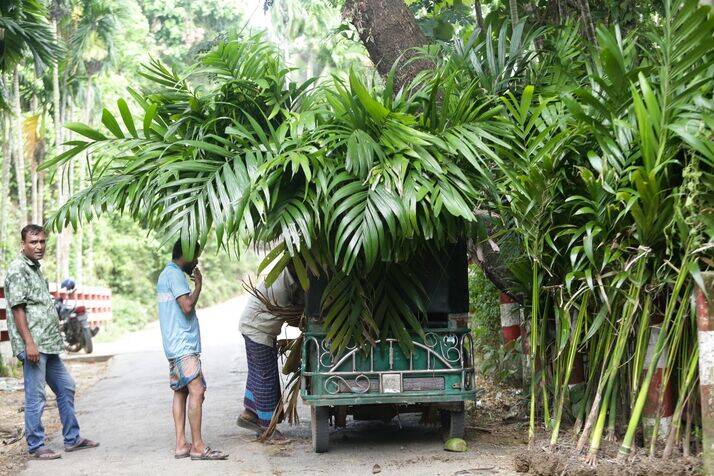
In the hilly villages of Cox’s Bazar, betel nut cultivation is expanding steadily. Local farmers now see betel nut as a new economic lifeline. With the growing demand, not only are more plantations being established, but the production of betel nut saplings is also witnessing a significant rise.
Reports indicate that in the hill tracts of Ukhiya, Teknaf, and other parts of Cox’s Bazar, betel nut cultivation now generates revenues worth crores of taka annually. Cox’s Bazar’s betel nuts are not only popular in domestic markets but are also exported abroad, making a notable contribution to the region’s agricultural economy.
Local farmers point out that with stable market prices and relatively low cultivation risks, many are now turning to betel nut farming. This has given rise to a new industry focused on producing betel nut saplings. Especially in Ukhiya and Teknaf, many entrepreneurs are now commercially producing saplings, selling them at around 50 taka per piece.
One sapling producer from Ukhiya shared, “Once planted, a betel nut tree yields fruit for several decades. That’s why so many farmers are now interested in establishing plantations. Selling saplings is also giving us a good income.”
Experts believe that if this trend of rising demand and production continues, Cox’s Bazar is poised to become one of the country’s leading centers for betel nut production shortly.
Abdur Rashid Manik
Photo: Hussain Shetu