
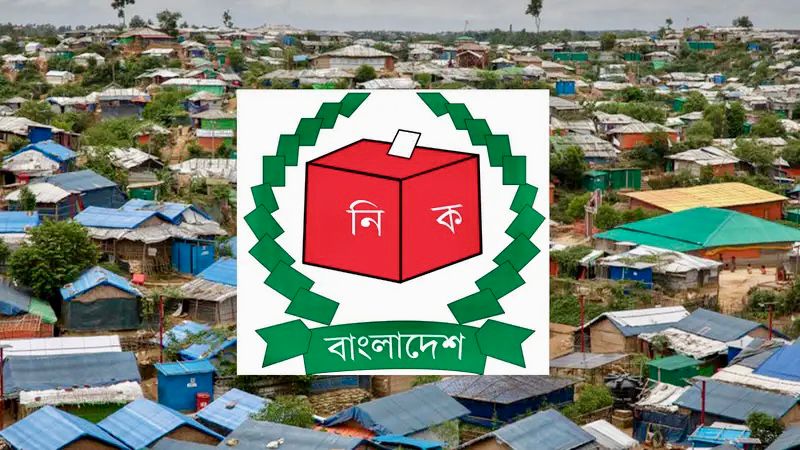
The government is planning to place Rohingya camps under heightened security ahead of the upcoming 13th national parliamentary election to prevent any misuse of the refugee population during the polls. Discussions on the issue have already taken place at the National Task Force on Rohingya Affairs, and the decision is said to be close to final at the policy-making level.
The issue was discussed at the 48th meeting of the National Task Force on Rohingya Affairs, held on Thursday (January 8) at the Ministry of Foreign Affairs, chaired by Foreign Secretary Asad Alam Siam.
According to multiple officials present at the meeting, the central focus was on ensuring that the Rohingya are not exploited in any way during the national election. Preventing illegal infiltration from Myanmar ahead of the polls was also highlighted, with calls for increased vigilance along the border.
Although the idea of completely “sealing” the camps was raised, officials said the plan is not to impose a total lockdown. Instead, strict monitoring will be enforced on all movements in and out of the camps for essential purposes, effectively placing the entire area under a security blanket. A policy decision has also been made not to change the camp-in-charges or the commanding officers of law enforcement units deployed in subcamps during the election period.
Officials noted that attempts by Rohingyas to enter Bangladesh continue on a regular basis. Law enforcement agencies have been instructed to remain alert so that illegal crossings do not increase due to election-related deployments elsewhere. The ongoing biometric registration of Rohingyas will also continue uninterrupted.
A senior government official said no activity by the Rohingyas that could disrupt the parliamentary election scheduled for February 12 will be tolerated. “The government will not make any compromise in this regard,” the official said, adding that measures will be taken to prevent communication between camp residents and Myanmar during the election period.
An interim government official said, “During the election, the border areas and Rohingya camps will effectively remain sealed. Camp-in-charges (CICs) will be given full responsibility, and there are no plans to transfer them. The government is determined to take all necessary steps to ensure a free and fair election and to make sure Rohingyas are not used for any ill motive.”
When asked about the timeline for sealing the camps and borders, the official said there would be no relaxation in monitoring from now through the entire election period, particularly in activities linked to Myanmar.
Election Commissioner Abul Fazal Mohammad Sanaullah has also stressed the need to seal Rohingya camps and border areas ahead of the election. Speaking at a meeting with law enforcement officials at the Chattogram Circuit House on Tuesday, he warned that camp-based activities could pose security risks.
“If weapons are smuggled across the border and concealed inside Rohingya camps, it becomes very difficult to trace them,” he said. “If any group attempts sabotage using weapons, the use of Rohingya camps would make detection extremely challenging. Therefore, Rohingya movements must be strictly controlled, and the camps and borders must be sealed.”
According to the UN Refugee Agency (UNHCR), 139,378 new Rohingya refugees were registered in Bangladesh between December 2024 and November 2025. As of October, the figure stood at 136,640, up from 133,651 in September.
UNHCR data shows that a total of 1,173,171 Rohingya refugees have now been identified in camps across Cox’s Bazar and Bhasan Char. Since August 2017, around 994,937 Rohingyas have taken shelter in Bangladesh.
Cox’s Bazar Life Report
Photo: Collected