
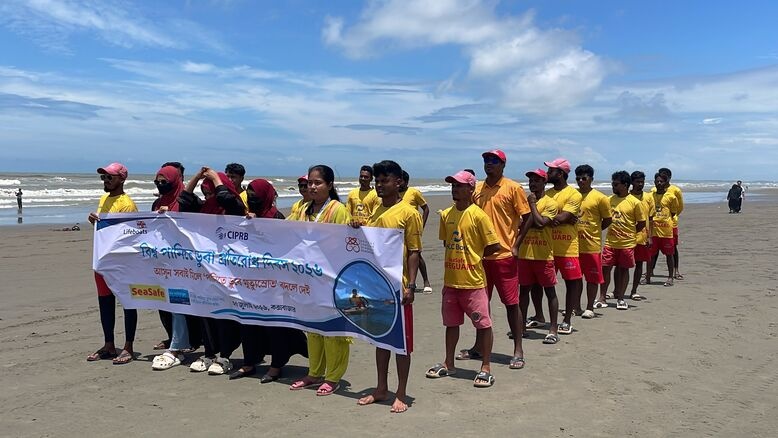
World Drowning Prevention Day was observed at Laboni Point on Cox’s Bazar beach on Saturday under the slogan,”Unite to turn the tide”.
The programme, organised by the Sea Safe project of the Centre for Injury Prevention and Research, Bangladesh (CIPRB), featured lifeguard rescue and first-aid demonstrations, an awareness rally and the distribution of safety messages among tourists.
Speaking at the event, CIPRB Sea Safe Finance and Administration Officer Hafez Ahmed said Sea Safe lifeguards had rescued 1,043 tourists and residents alive from the Cox’s Bazar beach over the past 12 years with financial support from the UK’s Royal National Lifeboat Institution (RNLI) and the Princess Charlene of Monaco Foundation.
He said several hundred thousand tourists visit Cox’s Bazar every year and stressed the need to increase the number of lifeguards at key points along the beach through coordinated government and private initiatives.
‘Strengthening lifeguard services will help reduce drowning deaths while supporting the growth of the country’s tourism industry,’ he said.
Hafez Ahmed said, alongside beach safety services, CIPRB had provided free swimming lessons to about 9,000 children and delivered drowning prevention messages to nearly five million tourists.
According to the Bangladesh Health and Injury Survey 2023, an average of 39 children die from drowning every day in the country, with those aged between one and 10 years facing the highest risk.
To raise global awareness about drowning, described as a ‘silent epidemic’, World Drowning Prevention Day has been observed annually on July 25 since 2021.
CIPRB has been working on locally appropriate drowning prevention measures since 2005. Research conducted by the organisation shows that teaching children aged between six and 10 to swim can reduce the risk of drowning by as much as 96 per cent. It also found that prompt first aid after rescue can significantly reduce fatalities and serious injuries.
Sea Safe lifeguards continue to risk their own safety to rescue visitors from the sea despite rough waves, strong currents and hazardous conditions.
Lifeguard Yusuf Ali said many tourists ventured into deep water without understanding the sea’s depth or currents, increasing the risk of accidents.
He urged visitors to swim only in designated safe areas and to follow lifeguards’ instructions at all times.
However, Sea Safe officials said lifeguards face significant operational challenges.
Hafez Ahmed said the project had been providing beach safety services since 2014. Still, currently only 27 lifeguards work in two shifts across three watchtowers at Laboni, Sugandha and Kolatoli because of workforce shortages.
The current workforce is insufficient, considering the number of tourists. We also face a shortage of modern rescue equipment and often have to carry out rescue operations in rough seas without adequate lifesaving gear,’ he said.
Sea Safe supervisor Saifullah Sifat said many accidents occurred because visitors ignored warning signs and entered dangerous areas despite repeated instructions from lifeguards.
He called for stronger beach safety measures and greater public awareness.
Tourist engineer Sabbir Ahmed Osmani said many visitors overlooked safety in their excitement.
“The sea is as dangerous as it is beautiful.” Tourists should follow lifeguards’ instructions, avoid restricted areas and take responsibility for their own safety,’ he said.
He also urged the authorities to provide lifeguards with more modern equipment and an adequate workforce to improve beach safety.
By Abdu Rashid Manik
Photo: Abdu Rashid Manik