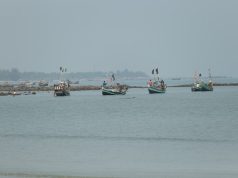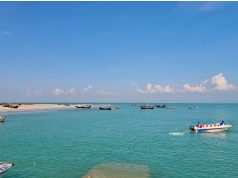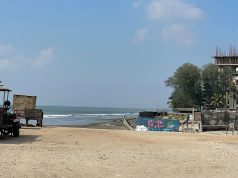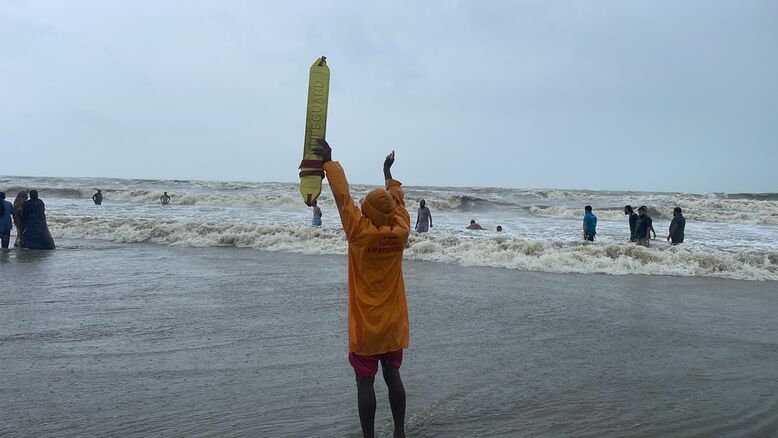
With rough seas triggered by a low-pressure system and Local Cautionary Signal No. 3 in force, concerns are mounting over tourist safety at Cox’s Bazar as only 27 lifeguards are deployed along the 120-kilometre beach, despite millions of tourists arriving every year.
Although red flags have been hoisted at several points to warn against entering the sea, many tourists continue to ignore the warnings and lifeguards’ instructions, increasing the risk of accidents.
People concerned with beach safety said the shortage of personnel and rescue equipment has made it increasingly difficult to respond effectively to emergencies, calling for the recruitment of more trained lifeguards alongside greater public awareness.
Currently, 27 lifeguards under the Sea Safe programme, operated by the Centre for Injury Prevention and Research, Bangladesh (CIPRB), remain on duty from dawn until sunset at Laboni, Sugandha, and Kolatoli points to ensure the safety of tourists.
Senior Sea Safe lifeguard Jahirul Islam said a lack of awareness among tourists remained one of the leading causes of sea-related accidents.
“Many visitors do not pay attention to which areas are safe for swimming, where strong currents or deep channels exist, or which zones are under lifeguard supervision,” he said, urging tourists to identify designated bathing areas and follow lifeguards’ instructions before entering the sea.
Sea Safe supervisor Saifullah Sifat said red-and-yellow flags mark comparatively safe swimming zones monitored by lifeguards, while red flags indicate dangerous areas because of strong currents, deep channels or adverse weather conditions.
“When red flags are displayed, tourists are advised not to enter the water. Our lifeguards remain on duty from dawn until sunset every day to ensure visitors’ safety,” he said.
Tourist Nasir Uddin said that safety measures along the 120-kilometre beach should be strengthened.
“At present, lifeguards are stationed only at Laboni, Sugandha and Kolatoli. The administration, Cox’s Bazar Development Authority, Tourist Police and other relevant agencies should work together to increase the number of lifeguards,” he said.
Another visitor, Abdul Gafur, said following lifeguards’ instructions and safety guidelines was essential to preventing accidents.
“Every tourist should take personal responsibility for their safety while enjoying the sea,” he added.
Hafez Ahmed, finance and administration officer of the Sea Safe project, said Sea Safe lifeguards had rescued 1,043 people from drowning over the past 12 years and delivered water safety awareness messages to more than five million people during the same period.
“Ensuring the safety of millions of visitors with only 27 lifeguards along a 120-kilometre beach is extremely challenging,” he said.
He called for the deployment of several hundred trained lifeguards, the provision of modern rescue equipment and the establishment of a medical sub-centre at the beach to provide immediate treatment for rescued victims.
Those involved in beach safety said greater public awareness, strict compliance with lifeguards’ instructions and prompt action during emergencies could significantly reduce drowning incidents and fatalities at the country’s premier tourist destination.
By Abdu Rashid Manik
Photo: Abdu Rashid Manik