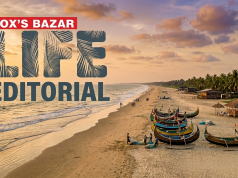


The moon boats of Cox’s Bazar, with their tall, crescent-shaped bows and sterns, are more than fishing vessels. They embody generations of coastal craftsmanship and livelihoods shaped by the Bay of Bengal. Yet rising construction, fuel, and maintenance costs, along with uncertain fishing incomes, threaten their survival. Preserving them requires more than nostalgia; it demands an economic future.
Beaches worldwide share familiar scenery: waves, sand and distant horizons. What distinguishes Cox’s Bazar is the silhouette of its moon boats. Their graceful curves give the coastline a visual signature of its own, giving the destination a distinctive identity and considerable potential for thoughtful, locally rooted tourism branding. Losing these boats would mean losing part of what makes Cox’s Bazar recognisable.
Research into traditional coastal boatbuilding, including work by the Centre for Natural Resource Studies around Teknaf, underscores the value of inherited craftsmanship. Not every sampan is a moon boat, but once specialised skills disappear, reviving them becomes difficult. Preservation is therefore an economic concern as well as a cultural responsibility.
Seasonal fishing restrictions protect marine stocks. In 2026, a 58-day ban ran from 15 April to 11 June, alongside food assistance for coastal fishing communities. Such measures also demonstrate why supplementary livelihoods matter: conservation must advance alongside economic security.
Heritage-based tourism offers one possibility. Consider a pilot involving 30 suitable boats. At five passengers paying Tk 200 each, five trips daily and 20 operating days monthly over nine months, annual gross revenue would total Tk 27 million (Tk 2.7 crore) under these assumptions. This is an illustrative calculation, not a forecast or profit estimate. Demand, costs, weather and regulation would determine feasibility; meaningful community consultation, market research and a proper feasibility study must come before any investment.
Approved coastal routes or suitable stretches of the Reju Canal could be assessed for supervised excursions. Fishing boats must not carry tourists without safety assessments and regulatory approval. Stability, passenger limits, life jackets, trained crews, weather restrictions and rescue arrangements are essential. Tourism must neither damage sensitive waterways nor disrupt fishing livelihoods.
The Bangladesh Tourism Board, local authorities, fisheries and environmental agencies, maritime regulators and private operators should jointly examine a regulated pilot. Affordable finance, training and support for boatbuilding and repairs should ensure owners, crews and craftspeople benefit.
Featuring moon boats in tourism advertising alone will not preserve them. A destination that draws its identity from a living tradition must invest in those who sustain it. Cox’s Bazar can turn this heritage into responsible tourism and local employment. Otherwise, future generations may recognise these extraordinary boats only in old photographs.
By Salam Abu
Editor