
The need for stronger coordination among government officials and other relevant stakeholders has been emphasised to prevent human trafficking and migrant smuggling in Cox’s Bazar, particularly to identify, protect and provide necessary assistance to Rohingya people at risk of trafficking and smuggling.
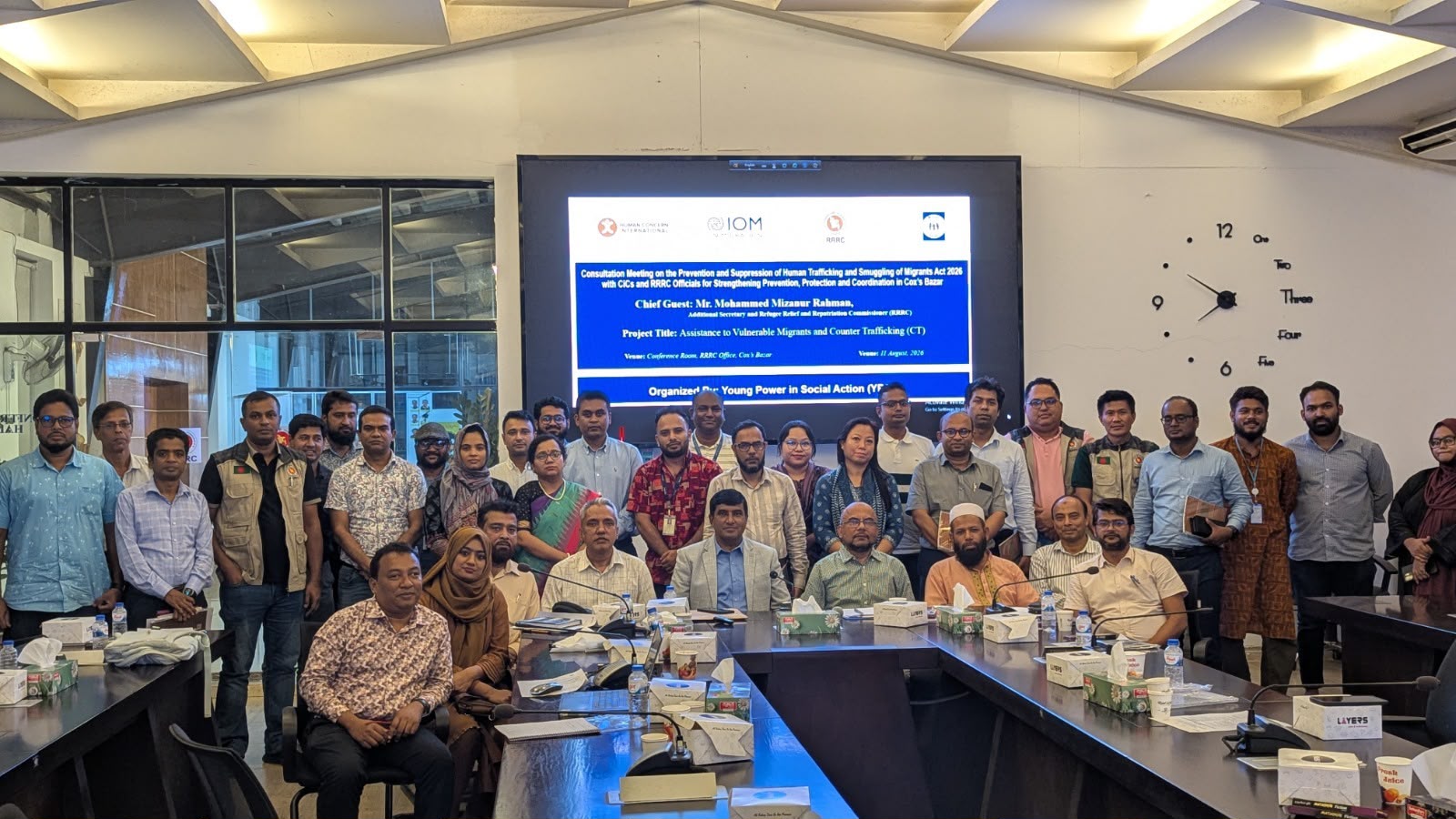
The issue was raised at a consultation meeting on the Human Trafficking and Migrant Smuggling Prevention and Suppression Ordinance, 2026, held Tuesday at the conference room of the office of the Refugee Relief and Repatriation Commissioner (RRRC) on Motel Road in Cox’s Bazar.
Young Power in Social Action (YPSA) organised the meeting under its Assistance to Vulnerable Migrants and Counter Trafficking project, with support from the International Organization for Migration (IOM).
RRRC Commissioner Mohammad Mizanur Rahman attended the meeting as the chief guest.
He said preventing human trafficking and migrant smuggling in a border area like Cox’s Bazar, which hosts a large Rohingya population, requires more than law enforcement.
“An integrated effort involving government agencies, camp administration, development partners and other relevant stakeholders is necessary,” he said.
He also discussed ways to make efforts to prevent human trafficking, identify people at risk, ensure protection and improve coordination of information and activities among relevant agencies more effective.
The programme began with a welcome address by Mohammad Shahidul Islam, deputy director and regional head of YPSA in Cox’s Bazar.
“The main objective of this initiative is to prevent human trafficking in Cox’s Bazar, protect victims and ensure effective coordination among relevant institutions,” he said.
“Alongside law enforcement, coordinated efforts by all concerned parties can help keep people at risk safe,” he added.
IOM counter-trafficking field coordinator Sara Sadia Israt delivered a welcome address, while YPSA assistant director Jesus Barua presented an overview of the project on a large screen.
“Law alone is not enough to stop the dark path of human trafficking. What is needed is a strong wall of coordinated prevention, awareness and protection that stands beside people,” Jesus Barua said.
Professor ABM Abu Noman of the Department of Law at the University of Chittagong discussed the existing legal framework under the new law, the differences between human trafficking and migrant smuggling, victims’ rights and the role of relevant government officials in prevention and protection.
The meeting also focused on the roles of camp-in-charges and officials of the RRRC office in protecting Rohingya people who fall victim to trafficking and smuggling.
Additional RRRC Commissioner Nazmul Islam Bhuiyan, speaking as a special guest, said human trafficking was not merely a crime but was also linked to people’s dreams, safety and future.
“Awareness and institutional cooperation are important to protect people, particularly displaced and vulnerable communities, from traffickers’ inducements, deception and various forms of exploitation,” he said.
He said Bangladesh’s new law also placed emphasis on preventing human trafficking and migrant smuggling, protecting victims and ensuring their rights, as well as promoting safe migration.
Camp-in-charges from different camps and officials from the RRRC office, IOM and YPSA attended the meeting.
Cox’s Bazar Life Report
Photo: Courtesy