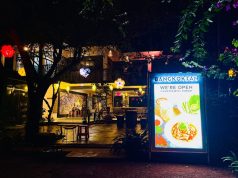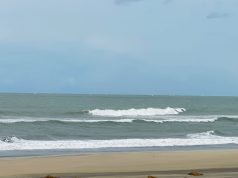

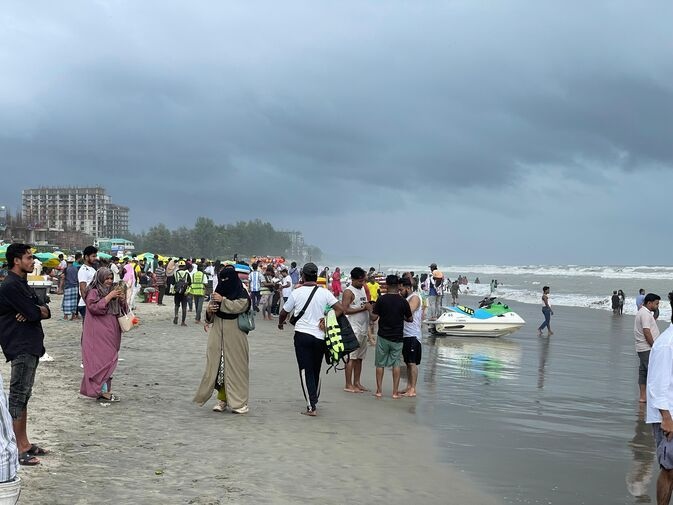
The familiar tourism scene in Cox’s Bazar has changed dramatically in the heart of the monsoon. Dark clouds, persistent rain, a rough sea and the roar of waves now define the world’s longest natural sandy sea beach.
For tourism businesses, the monsoon was once considered a prolonged lean period. Tourist arrivals would drop sharply, leaving hotel and resort rooms vacant. But that picture is gradually changing.
Tourists from different parts of the country are now travelling to Cox’s Bazar to enjoy its rain-soaked beach, cloudy skies and rough waves. Even without public holidays or major festivals, tourists are arriving in the beach town every day, while weekends are drawing particularly large crowds to the beach and other attractions.
Tourism businesses say the traditional idea of a monsoon ‘off-season’ has changed over the past few years. Many tourists no longer restrict their trips to winter. The appeal of the monsoon landscape, lower hotel rates, promotional discounts and the opportunity to experience nature in a different mood are encouraging more people to visit Cox’s Bazar during the rainy season.
Improved connectivity has also played a major role. Since the Dohazari-Cox’s Bazar railway came into operation, travelling to the beach town has become easier. Tourists arrive daily by train, road and air from different parts of the country, creating fresh optimism among businesses dependent on tourism.
Holidays bring a surge of tourists
The biggest tourist influx so far this monsoon was seen around the public holiday marking the August 5 Mass Uprising Day. Although Thursday was not a public holiday, the weekly holidays on Friday and Saturday again brought large crowds to Cox’s Bazar.
The Laboni, Sugandha, and Kolatoli points of the beach, as well as Himchari, Inani, Pechardwip, and other destinations along Marine Drive, saw a significant number of tourists.
Some walked along the beach in the rain, others enjoyed the rough waves, while many spent time taking photographs beneath the cloudy sky.
Tourists, however, are not coming only on public or weekly holidays. Their regular presence on other days has also reduced the uncertainty that traditionally surrounded tourism businesses during the monsoon.
Rail connectivity boosts tourist movement
Tourism stakeholders identify rail connectivity as one of the key reasons behind the increase in tourist arrivals.
The Dohazari-Cox’s Bazar railway line and the international-standard iconic Cox’s Bazar Railway Station were officially inaugurated on November 11, 2023. The Dhaka-Cox’s Bazar intercity Cox’s Bazar Express began operations on December 1 that year.
At present, Cox’s Bazar Express and Tourist Express operate regularly on the Dhaka-Cox’s Bazar route. Local trains Probhat Express and Saikat Express also operate on the Chattogram-Cox’s Bazar route.
Mohammad Zainal Abedin, station master of the Cox’s Bazar Iconic Railway Station, said trains are currently operating on routes including Dhaka and Chattogram.
“Depending on passenger demand, the number of trains on these routes may increase in the future,” he said.
According to him, the introduction of rail services has created a new travel option for tourists, particularly families, for whom train travel has become increasingly attractive.
Cox’s Bazar gains as monsoon risks affect hill destinations
During the monsoon, hill destinations across the country face risks of landslides, flash floods, and excessive rainfall. As a result, many tourists look for destinations that offer relatively easier access and lower travel risks during the rainy season.
Cox’s Bazar is increasingly featuring on that list.
Tourism businesses acknowledge that excessive rainfall can also cause landslides and waterlogging in parts of Cox’s Bazar. However, the beach, hotel-motel areas and most popular destinations along Marine Drive generally remain accessible, making Cox’s Bazar a relatively comfortable alternative for many tourists.
Hotels and resorts offer discounts of up to 50%
Hotels, motels and resorts in Cox’s Bazar are offering a range of promotional deals to attract tourists during the monsoon.
Star-rated hotels, in particular, are offering substantial discounts on rooms, food, and other services, with some offering more than 50 per cent.
Many tourists are taking advantage of the opportunity to stay at quality hotels at lower prices. Room rates are relatively high during the peak of winter but significantly lower during the monsoon, encouraging families and groups of friends to travel on a smaller budget.
Asaduzzaman Noor, financial controller of Sayeman Beach Resort, said the tourism scenario during the monsoon had changed over the past three years.
“People’s perceptions and financial capacity have changed, and so has their attitude towards when to travel,” he said.
He said people previously believed that winter was the only suitable time to travel.
“Now people understand that travelling is possible all year round. Every season offers a different beauty at tourist destinations. That is why, like last year, our hotel has received a good response this monsoon and business has been good,” he said.
Asaduzzaman said his hotel was offering discounts of up to 50% on room rates during the monsoon.
Such discounts are generally not possible during winter, when tourist demand is much higher, he added.
Pechardwip also draws tourists
Mermaid Beach Resort, an eco-friendly resort at Pechardwip along Marine Drive in Ramu, has also been receiving a good response during the monsoon.
Rana Karmakar, the resort manager, said discounts of up to 70 per cent were offered at the beginning of the month. The discount was later reduced to 50 per cent and currently stands at up to 40 per cent.
“Tourists are coming to our resort to experience the different beauty of Cox’s Bazar during the monsoon. We are receiving a good response and, at times, rooms are being booked in advance,” he said.
Rana said every tourist destination in Bangladesh has its own beauty, but given the monsoon risks, Cox’s Bazar is relatively less risky.
“That is why many tourists are choosing Cox’s Bazar for a low-cost holiday,” he said.
The idea of an ‘off-season’ is changing
Sayeed Alamgir, public relations officer of another star-rated hotel, Ocean Paradise, said the monsoon was previously considered Cox’s Bazar’s ‘off-season’.
“But that perception is changing day by day,” he said.
The hotel is now receiving a good response even during the monsoon, he said, adding that many other star-rated hotels in Cox’s Bazar are also offering discounts of more than 50%.
At Ocean Paradise, discounts of up to 40 per cent are available on holidays and up to 50 per cent on other days, he said.
Tourists embrace the monsoon
Tourists visiting Cox’s Bazar during the monsoon say the beach looks entirely different from other times of the year.
Rakib Hasan, who came from Dhaka with his family, said he had wanted to visit Cox’s Bazar during the monsoon for a long time.
“The rain, cloudy sky and big waves make the beach look completely different. Hotel rates are also relatively low. So we came with the family when we got the opportunity,” he said.
Tanzim Ahmed, who came from Chattogram with friends, said Cox’s Bazar is much more crowded in winter, and hotel rates are higher.
“There are fewer tourists in the monsoon, and many hotels offer substantial discounts. I particularly enjoy the atmosphere at the beach in the rain. But tourists must be cautious before entering the sea,” he said.
Nusrat Jahan, who travelled from Rajshahi, said Cox’s Bazar seemed much more vibrant during the monsoon.
“Clouds in the sky, occasional rain, and the vast sea in front of you — it is a wonderful experience. I used to think Cox’s Bazar was only a winter destination. Now I realise that it has a different beauty in every season,” she said.
More tourists needed for a bigger market
Abul Kashem Sikder, president of the Cox’s Bazar Hotel-Motel Guest House Owners Association, said the current number of tourists was still insufficient relative to the level of investment in the sector.
Although tourist numbers are increasing, the figure remains low compared with the capacity of the tourism infrastructure, he said.
“More visible initiatives are needed to develop the tourism sector. Cox’s Bazar needs more tourists. The positive sign, however, is that their number is increasing day by day,” he said.
He said domestic tourism was growing, but the destination had yet to attract foreign tourists in significant numbers.
“Now we need to see how we can move from domestic tourism to international tourism,” he said.
Safety remains a concern at the beach
While Cox’s Bazar beach becomes particularly attractive during the monsoon, rough seas can also make it dangerous. Heavy rain and low-pressure systems can sometimes make the sea turbulent, requiring extra caution from tourists entering the water.
Imtiaz Ahmed, field team manager of Sea-Safe Lifeguard, which provides safety services at the beach, said the sea could take a dangerous turn during the monsoon.
“The beach looks beautiful at this time, but tourists must be cautious when entering the water. They must follow lifeguard instructions before swimming. If a red flag is displayed, they must not enter the water under any circumstances,” he said.
Sea-Safe Lifeguard teams operate at the Kolatoli, Sugandha and Laboni points.
“Tourists should swim only in areas marked as safe and must follow lifeguard instructions even there,” he added.
A new opportunity in the monsoon
The overall tourism picture this monsoon is sending a new message from Cox’s Bazar.
A few years ago, the monsoon meant a long wait for tourism businesses. Now, tourists are arriving almost every day. Improved rail, road and air connectivity, substantial hotel and resort discounts, growing social media interest in the monsoon beauty of Cox’s Bazar and changing travel habits are all contributing to the shift.
The rain-soaked beach, cloudy skies, rough waves, green hills along Marine Drive and the sea together give Cox’s Bazar a distinct appeal during the monsoon.
For nature lovers, the beach town is increasingly becoming a destination worth visiting beyond the traditional peak season.
Tourism stakeholders hope that further improvements in connectivity and tourism infrastructure, stronger safety measures and effective initiatives to attract foreign tourists will help move Cox’s Bazar beyond its winter-centric tourism model.
With the right initiatives, they believe, the world’s longest natural sandy sea beach could remain lively with tourists throughout all 12 months of the year.
By Abdu Rashid Manik
Photo: Abdu Rashid Manik