
Blue waters, coral, sea purslane forests and white sandy beaches have long made Saint Martin’s Island one of Bangladesh’s most distinctive natural landscapes. But before the tourist season arrives, plastic bottles, polythene and other single-use items from beyond Bangladesh’s shores are already washing up on parts of the island.
The discovery has raised concerns that marine currents may be carrying plastic waste from the coasts of neighbouring Myanmar and Thailand to Bangladesh’s only coral island.
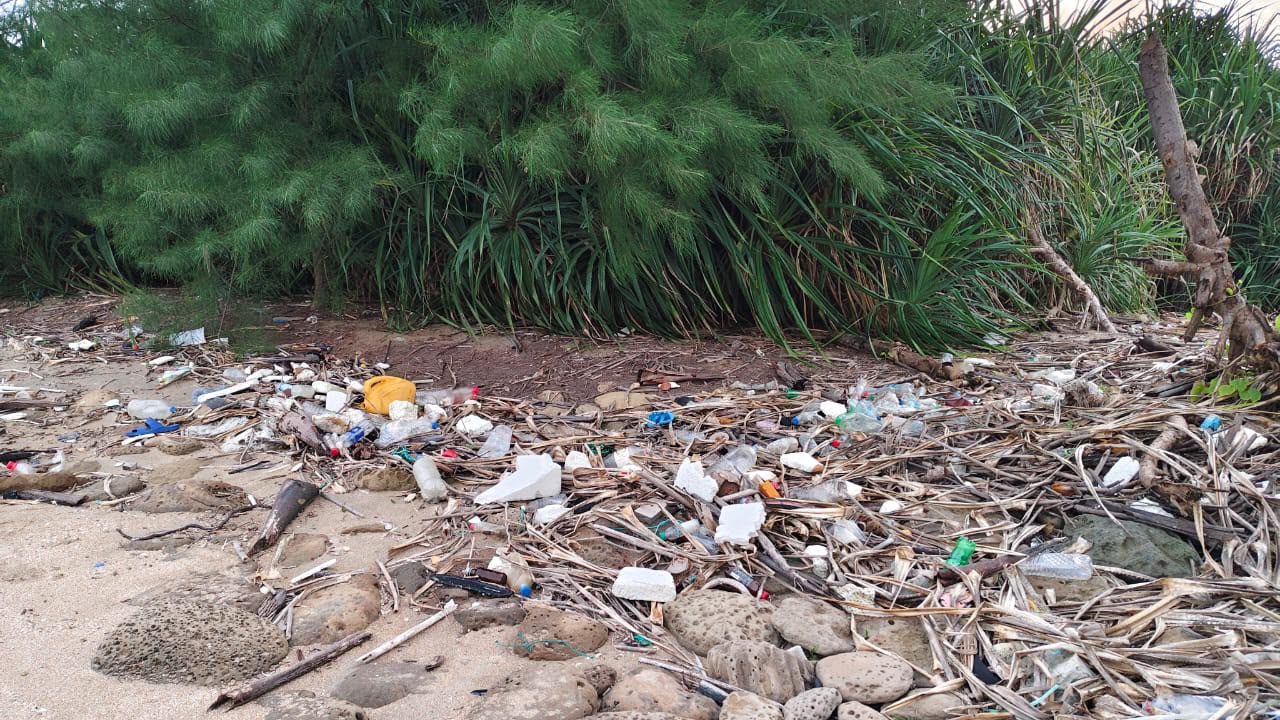
A group of local youths recently found large quantities of plastic bottles and other waste scattered along the beach of Chera Dwip, about 9km from the main island. The amount of waste was particularly striking because the tourism season had not yet begun.
No crowds of tourists or the usual tourism-related activities were on the beach. Yet plastic waste had accumulated in different parts of the area.
Many of the bottles did not carry the names of familiar Bangladeshi companies. Instead, the youths found names and logos of companies from Myanmar and Thailand, while some packets carried writing in foreign languages.
Waste carried across the sea
Taiyubullah, owner of Saint Martin Mermaid Resort, was among the group that visited Chera Dwip.
He said they were surprised to find so much waste on the beach even before the tourism season started. He said they also found similar waste trapped inside the coastal sea purslane forest.
Taiyubullah believes strong monsoon currents and periods of southerly winds could carry waste from the coasts of Myanmar or Thailand toward Saint Martin’s.
This suggests the island’s environmental pollution may not be caused solely by locally generated waste; marine litter may also reach its shores from across the sea.
A new challenge beyond local waste management
BRAC has been working on waste management in Saint Martin’s. Mohammad Rafique, coordinator of the organisation’s waste management programme, said volunteers collect around one tonne of waste each day from the island’s populated areas.
He said they separate waste collected from households and bins and bring it in for management. As a result, the populated areas of the island rarely show foreign waste.
The picture is different, however, when beaches such as Chera Dwip are cleaned.
Rafique said workers had found bottles and plastic waste from other countries during beach-cleaning drives.
“The matter is truly concerning,” he said.
The discovery raises a difficult question: if locally generated waste is being brought under a management system, who will be responsible for plastic waste that reaches the island through the sea?
Foreign identities found on bottles
Mohammad Jamal Pasha, assistant director of the Department of Environment in Cox’s Bazar, has also examined the issue. He said he had checked several logos found on plastic bottles online.
According to him, some of the logos appeared to belong to soft drink companies in Thailand, while some packets carried writing that appeared to be in the Myanmar language.
He believes tidal and marine currents could be carrying the waste from the coasts of neighbouring countries to Saint Martin’s.
However, without scientific investigation, the waste’s actual source and how far it has travelled cannot be established.
That uncertainty also concerns environmentalists.
The plastic visible on the beach may represent only a fraction of the waste entering the marine ecosystem. Currents may be depositing a lot of plastic on the seabed, while other waste may be trapped in coastal plants and other shoreline areas.
Jamal Pasha warned that continued plastic accumulation on the seabed could seriously damage Saint Martin’s coral and marine biodiversity.
Saint Martin’s is not only a tourist destination but also Bangladesh’s only coral island. Its coral, fish, marine organisms and coastal vegetation form a distinctive marine ecosystem.
The full extent of the damage plastic pollution has caused to that ecosystem remains unknown.
Pollution crosses borders
Recently, various measures have been taken to protect Saint Martin’s environment, including restrictions on tourism, limits on tourist numbers, beach-cleaning initiatives and stronger waste-management efforts.
However, these local measures alone cannot address pollution that may originate outside Bangladesh.
Marine currents do not follow international boundaries. Plastic discarded from one country’s coastline can travel across the sea and accumulate on another country’s shores.
The presence of bottles apparently linked to companies in Myanmar and Thailand on Saint Martin’s beaches has brought that cross-border dimension of marine pollution into focus.
Jamal Pasha said efforts to protect Saint Martin’s should therefore go beyond reducing pollution generated on the island itself and include plans to address transboundary marine pollution.
For a fragile coral ecosystem already under pressure, the challenge is no longer only about managing what people leave behind on the island. It is also about understanding what the sea brings to its shores.
By Abdu Rashid Manik
Photo: Courtesy