
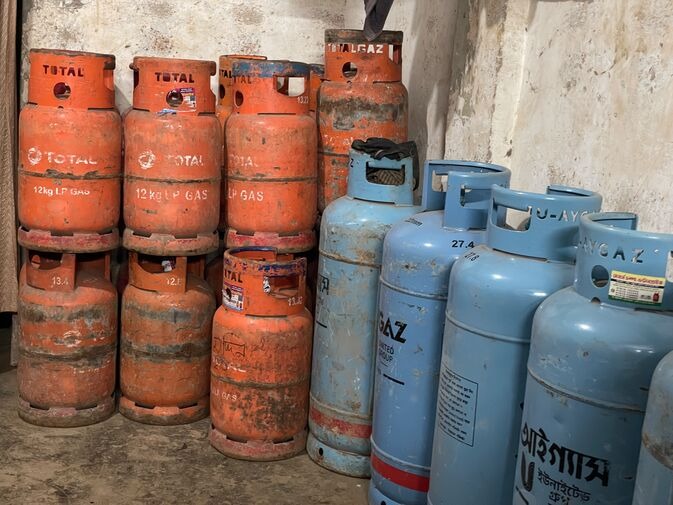
For Arpana Chowdhury, a resident of Stadium Para in Cox’s Bazar town, buying a 12kg LPG cylinder has become a major burden. She bought the same quantity for Tk1,700 two months ago, but when the gas suddenly ran out on Friday, she had to pay Tk2,200 for a new cylinder.
In just two months, she had to pay Tk500 more for the same amount of gas.
“Our income is very limited. If we have to spend Tk2,200 on gas, it becomes very difficult to run the household. It will be difficult to manage even our regular grocery expenses now,” Arpana said.
She is not alone. Many low- and middle-income families in Cox’s Bazar are facing a similar situation, as consumers complain that LPG is unavailable at the government-fixed price and that supply shortages have pushed up cylinder prices.
At 6:00pm on Sunday, October 4, the Bangladesh Energy Regulatory Commission (BERC) raised the price of a 12kg LPG cylinder by Tk252 to Tk1,837. The fixed price had been Tk1,585 in September.
But consumers say LPG is still not available anywhere in Cox’s Bazar at the newly fixed price.
Sijol De, who runs a tea stall on the road behind Cox’s Bazar Sadar police station, bought a 12kg cylinder for Tk2,200 two days ago. He said the higher LPG price was directly affecting the earnings of small businesses.
“If the government cannot enforce the fixed price, what is the point of fixing it? I am a low-income businessman. I cannot suddenly raise the price of tea. As a result, my small profit is being spent on gas,” he said.
Another homemaker, Kamrun Nahar, said the sudden increase in gas prices had made it difficult to manage household expenses.
Consumers report that the shortage has intensified since the announcement of the new price. In different parts of the municipal area, cylinders are reportedly being sold for Tk400 to Tk600 above the fixed price, while in some places consumers cannot find cylinders even after agreeing to pay higher prices.
A visit to Baharchhara, Nuniarchhara, Kalatali, Alir Jahal, Jail Gate, Peshkar Para, Nur Para and the bus terminal areas found complaints of LPG being sold at higher prices and, in many cases, cylinders being unavailable.
Hashem Uddin of Tekpara bought a 12kg AI Gas cylinder for Tk2,100 on September 27. A month earlier, he had bought the same cylinder for Tk1,650.
“On the one hand, gas prices are rising, and on the other, LPG is not available in the market. Ordinary consumers are suffering the most,” he said.
Alhaj Sirajul Haque, president of the Cox’s Bazar LPG Gas Distributors’ Association and proprietor of Messrs Champa Enterprise in Kasturaghat, told Cox’s Bazar Life that he bought LPG from a dealer for Tk2,050 on October 6 and was selling it for Tk2,200.
“I have not sold even two cylinders since morning. We are selling gas at Tk2,200. We cannot afford to sell it for less than that,” he said.
According to Sirajul, Cox’s Bazar needs around 25,000 LPG cylinders a day from Eidgaon to Teknaf, while the government system supplies only around 2,500 cylinders. The rest come from private dealers, he said.
He said several companies, including Mammy Enterprise, Cox’s Bazar Traders, Cox’s Bazar Tradelink, Golam Arif Liton, Omera Masud Traders, K Cool Enterprise, Habib & Brothers and Petrumetro Gas, supply LPG to the district market.
Retailers also say they are struggling to obtain enough cylinders to meet demand.
Sarwar Shaheen, proprietor of Shaheen Traders in the Kalur Dokan area, said supply shortages have made it impossible to meet demand.
His shop stocks cylinders from four companies. He is selling 12kg Beximco cylinders for Tk2,100 and cylinders from AI Gas, Jamuna and Omera for Tk2,050.
“Government LPG is simply not available in the market. Although gas from one or two companies can be found, the supply is far below demand,” he said.
Salahuddin, a retail LPG trader in Baharchhara, said he had stocked 12kg cylinders of ACI and Fresh. After those were sold, he received no new supply.
“As a result, customers are coming to the shop and leaving empty-handed,” he said.
The LPG Traders’ Cooperative Society alleges that importers have reduced supplies by around 80 per cent since September 20. It also claims that several depots stopped supplying after September 25.
Sarwar Alam, president of the district LPG association, said companies were not supplying LPG to dealers at the government-fixed price.
“Although the government fixes the price, companies are not giving gas to dealers at that price. Dealers themselves have to buy gas from the companies at higher prices,” he said.
He also alleged that companies were not providing vouchers for LPG dealers purchased.
“Dealers are buying at higher prices and not receiving vouchers. As a result, they are selling the gas without vouchers,” he said.
Meanwhile, the Directorate of National Consumers’ Right Protection has stepped up monitoring of the LPG market. An institution named Oceanic Trading on Jail Road was fined Tk20,000 for allegedly selling LPG at an excessive price.
Hasan-Al-Maruf, assistant director of the district Directorate of National Consumers’ Right Protection, told Cox’s Bazar Life that market monitoring and drives were being conducted regularly and surveillance of LPG suppliers had also been increased.
“We fined an establishment on Jail Road Tk20,000 last week,” he said.
He said the market had been unstable since a week before the LPG price was officially fixed.
However, consumers say the fines have had little visible impact on the overall market. They continue to face higher prices and shortages.
The consumer rights official said companies were also selling LPG at higher prices and dealers were buying it at higher prices, making it difficult for dealers to sell at the government-fixed price.
“We are also looking into whether anyone is hoarding LPG or creating disruptions in the supply chain,” he said.
The LPG supply shortage is not limited to households, hotels and restaurants. The transport sector has also been affected.
On Sunday, October 4, CNG-run vehicle drivers blocked the Cox’s Bazar-Chattogram highway at the Link Road area for nearly two hours, complaining of inadequate access to gas. Traffic resumed after the administration and police assured them they would take action.
The drivers said the shortage was affecting both their ability to operate vehicles and their earnings.
LPG is widely used for cooking in households, hotels and restaurants across Cox’s Bazar, a major tourist destination. If the supply shortage and high prices continue, consumers fear the impact will spread from household expenses to businesses and transport.
For consumers like Arpana, the question remains simple: if the government-fixed price cannot be enforced in the market, when will they actually get the benefit of the price set by the authorities?
By Abdu Rashid Manik
Photo: Abdu Rashid Manik