

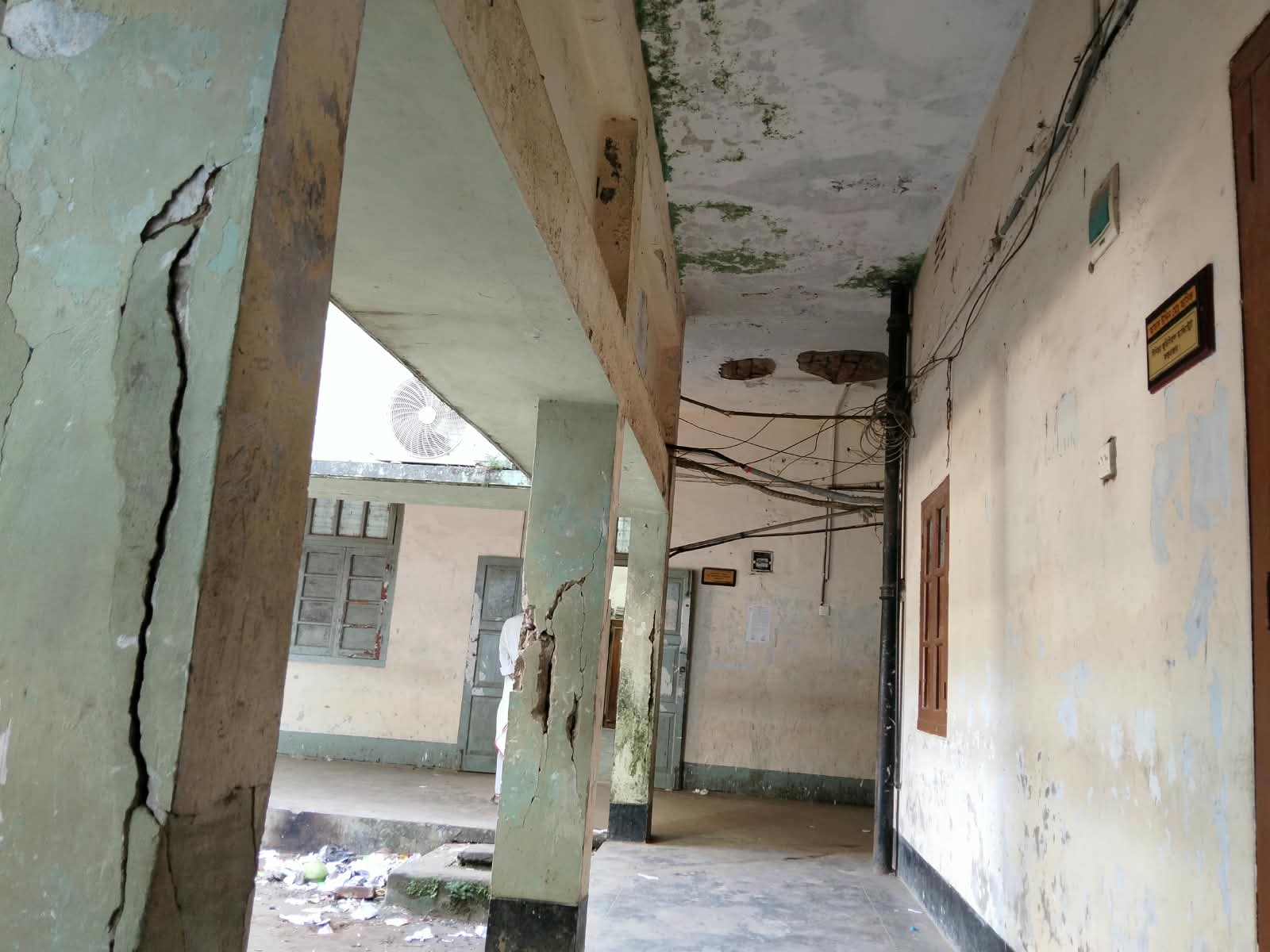
Thousands of people visit the Cox’s Bazar Chief Judicial Magistrate Court building every day, including litigants, lawyers, accused persons, witnesses and court officials. Senior government officials also visit the building for official purposes.
But the more than seven-decade-old building has developed cracks at several places, while plaster and concrete are falling from its ceilings and walls, exposing rusted reinforcement bars.
Despite the risks, judicial and administrative activities continue in the dilapidated building. A government document has also warned that people using the building are at risk to their lives.
Inspectors discovered cracks in nearly all the building’s columns and pillars during a visit on Tuesday. Plaster had fallen off at several places, while parts of the ceiling showed signs of concrete deterioration.
Large areas of damage from falling plaster were also visible above the heads of administrative officials.
The building currently houses judicial activities as well as the Law and Order Disruption (Speedy Trial) Tribunal, administrative section, record room, seresta, treasury, courtrooms, and the copy supply section. Two canteens are also located on either side of the building.
Judges, lawyers also at risk
According to government records, the Chief Judicial Magistrate Court in Cox’s Bazar Sadar has courts headed by the Chief Judicial Magistrate, Additional Chief Judicial Magistrate, two Senior Judicial Magistrates and four Judicial Magistrates.
Judges must work in the building every day to conduct judicial proceedings. The ageing structure also exposes lawyers, their assistants, court officials, employees, and thousands of court visitors to risks.
Government document warns of life risk
The executive engineer of the Public Works Department (PWD) in Cox’s Bazar warned the Chief Judicial Magistrate in a letter sent on February 1 that “the users of the building are at risk to their lives.”
According to the letter, the building was constructed in 1952 and was used as the district court in Cox’s Bazar for many years. Since 2009, the Chief Judicial Magistrate Court has occupied the newly constructed district judge’s court building.
The letter said the building had been repaired several times over the years, but the repairs did not prove sustainable. Concrete had fallen from the ceiling on several occasions, although fortunately it had not hit anyone so far.
Earthquake risk
The PWD has also raised concerns about the building’s vulnerability to earthquakes in addition to its structural weaknesses.
According to the Bangladesh National Building Code (BNBC) 2020, Cox’s Bazar falls under seismic zone-3. The PWD letter therefore also mentioned the possibility of earthquake-related accidents.
Abhijit Chowdhury, the PWD executive engineer, said the building, built during the British period, had weakened in many parts after decades of use.
“An estimate was sent to the district judge in 2023. I do not know how far it has progressed or what its current status is. However, we have received an allocation in the current fiscal year to construct two rooms,” he said.
Alternative building proposal remains unimplemented
There had also been an initiative to arrange an alternative facility for the dilapidated building.
On June 4, 2023, an estimate was sent seeking administrative approval and funding to construct a 6,000-square-foot temporary semi-permanent tin-shed building.
Nearly three years have passed, but the proposal has not been implemented.
Asked about the current status of the proposed alternative building, PWD executive engineer Abhijit Chowdhury said he had no information on the matter.
Lawyers seek judicial complex
Cox’s Bazar Bar Association president Advocate Abdul Mannan said lawyers had to continue working despite knowing about the risks.
“Lawyers are also at risk to their lives. We hope a judicial complex will be constructed here to address the risks,” he said.
A litigant, Shahidul, said the building looked ancient and had visible damage in several places.
“The pillars are also damaged. It would be better if a new building is constructed,” he said.
Cox’s Bazar deputy commissioner Md Abdur Mannan said the district administration had no role in the building as it belonged to the judiciary.
“But I have learned about the matter. I will look into it and inform the higher authorities for necessary action,” he said.
By Tarekur Rahman
Photo: Tarekur Rahman