
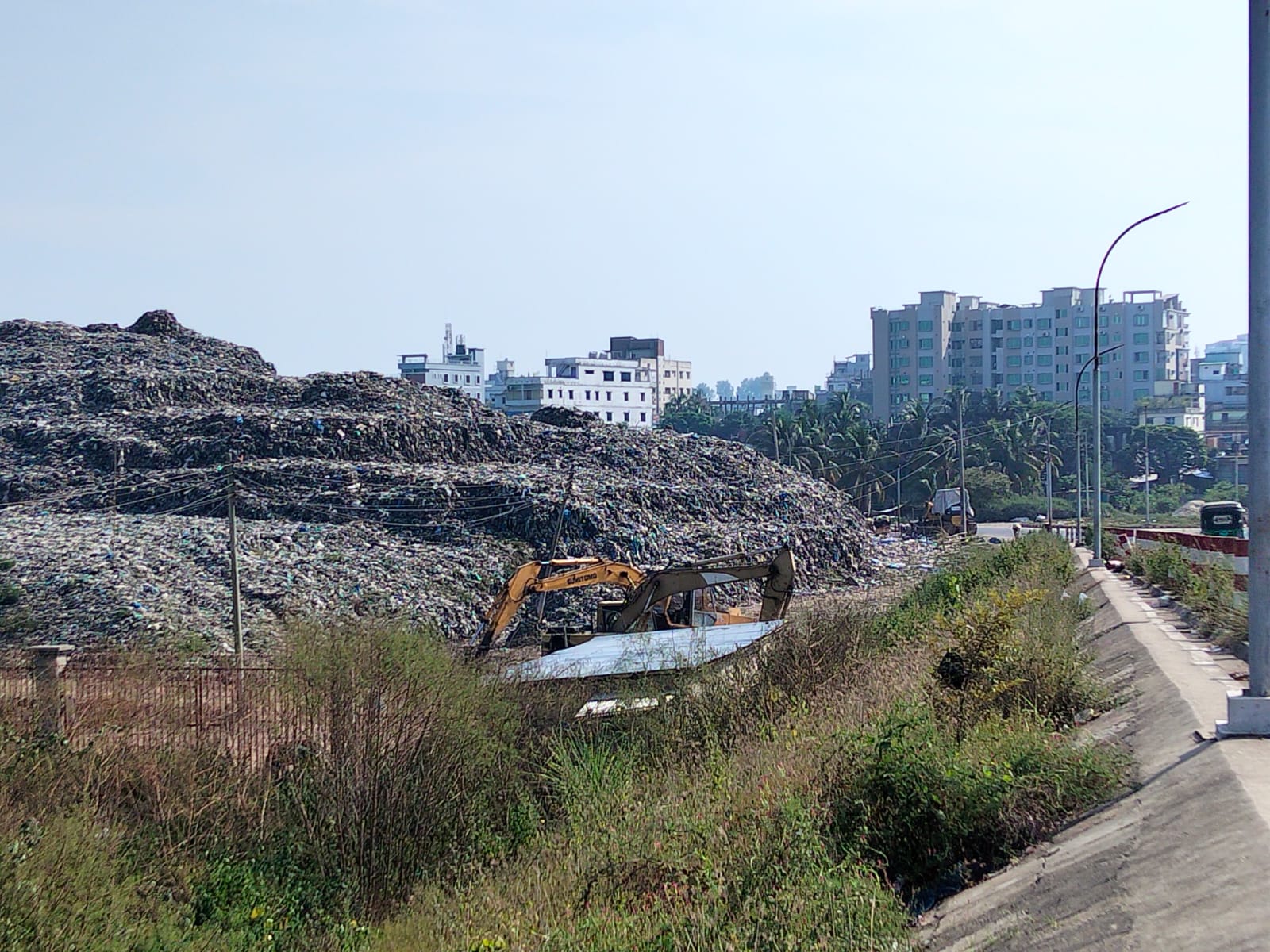
Waste collected daily from Cox’s Bazar beach and different parts of the city ends up at the Kosturghat dumping station on the bank of the Bakkhali River, where a massive pile of garbage has accumulated across nearly 11 acres over the past three decades.
The waste releases foul odours, and contaminated liquid from the dump flows into the river during rainfall, raising concerns about pollution in the Bakkhali River and the surrounding environment.
A five-tonne installation made from plastic waste and bottles, dubbed the ‘Plastic Monster’, has been set up on the beach to raise awareness of plastic pollution in the tourist city.
While tourists take photographs beside the installation, the huge waste pile at Kosturghat, a few kilometres away, exposes the weaknesses in the city’s waste management system.
Some locals have sarcastically begun calling Cox’s Bazar a “waste tourism city.”
Karim Ullah Kalim, a central committee member of Bangladesh Poribesh Andolon (BAPA), expressed frustration on social media after sharing photographs of the waste pile at Kosturghat.
He said the municipality seemed to make issuing licenses for battery-powered three-wheelers, locally known as tomtoms, its top priority.
“A municipality should not have allowed a mountain of waste to build up inside a city over the past 30 years,” he said.
Mizanur Rahman Milky, convener of the Tour Operators Association of Cox’s Bazar (TOAC), said waste accumulation and mosquito infestations were problems around Dolphin Moor.
At the same time, dirty drain water flowed into the sea at Kalatali Point.
He added that garbage was also scattered around Sugandha and Laboni points, key areas frequented by tourists.
“When such mismanagement exists at important tourist spots, calling the city a ‘waste-tourism city’ rather than a tourist city seems justified,” he said.
Waste management problems are not confined to Kosturghat. At the entrance to Kalatali beach, dirty drainage water spills onto the road, with some flowing towards the beach dunes.
Complaints have also been raised about waste accumulating around food stalls and other establishments near Sugandha Point.
Plastic, bottles, polythene bags, and food leftovers are scattered across parts of the casuarina forest adjoining the beach.
Sunanda Bhowmik, a tourist from Barishal, said she saw dirty drainage water flowing into the sea while approaching the water at Kalatali Point.
She said the pollution was damaging both the environment and the area’s appeal to tourists, stressing the need for proper waste management.
Niharika Ranjana, a tourist from Rajshahi, praised the awareness campaign featuring artworks made from discarded materials.
However, she was disappointed to see garbage and plastic waste scattered across the nearby casuarina forest.
She emphasised the importance of pairing awareness campaigns with effective measures to maintain cleanliness in the area.
Environmental activists have expressed concern that contaminated liquid from the waste pile beside the Bakkhali River enters the water during rainfall.
Khandaker Mahmud Pasha, deputy director of the Department of Environment’s Cox’s Bazar office, said contaminated liquid from the dump was entering the Bakkhali River, harming the riverine and marine environments and biodiversity.
He added that the waste was also contributing to air pollution in nearby areas.
He said the department had sent a notice to the municipality seeking an explanation for dumping waste in the open in violation of environmental laws.
However, he alleged the municipality had not responded.
A plan to remove the waste by 2025 was not implemented. Authorities are now talking about completing a new waste management facility by 2028, he said.
According to Cox’s Bazar Municipality, the city generates around 170 tonnes of waste daily, of which 120 to 130 tonnes are collected. Kosturghat receives a significant portion of the collected waste.
The lack of a modern waste management plant has allowed waste to accumulate at the site for years, creating a massive pile.
Parakram Chakma, a municipal engineer, said the municipality is issuing a notice under Section 7 to acquire around 10.5 acres of land at SM Para to establish a permanent waste management facility.
The municipality plans to complete the work before 2028, he added.
Residents have also launched protests demanding the removal of the waste from Kosturghat.
The Eight Neighbourhoods Social Committee organised a memorandum submission and a human chain in front of the municipal office.
Environmentalists warn that pollution will continue to threaten Cox’s Bazar beach, the Bakkhali River and surrounding areas unless a permanent, modern waste management system is established.
They say the city needs not only effective waste collection but also safe disposal methods and measures to prevent contaminated water from flowing into the river and the sea.
By Tarekur Rahman
Photo: Tarekur Rahman