
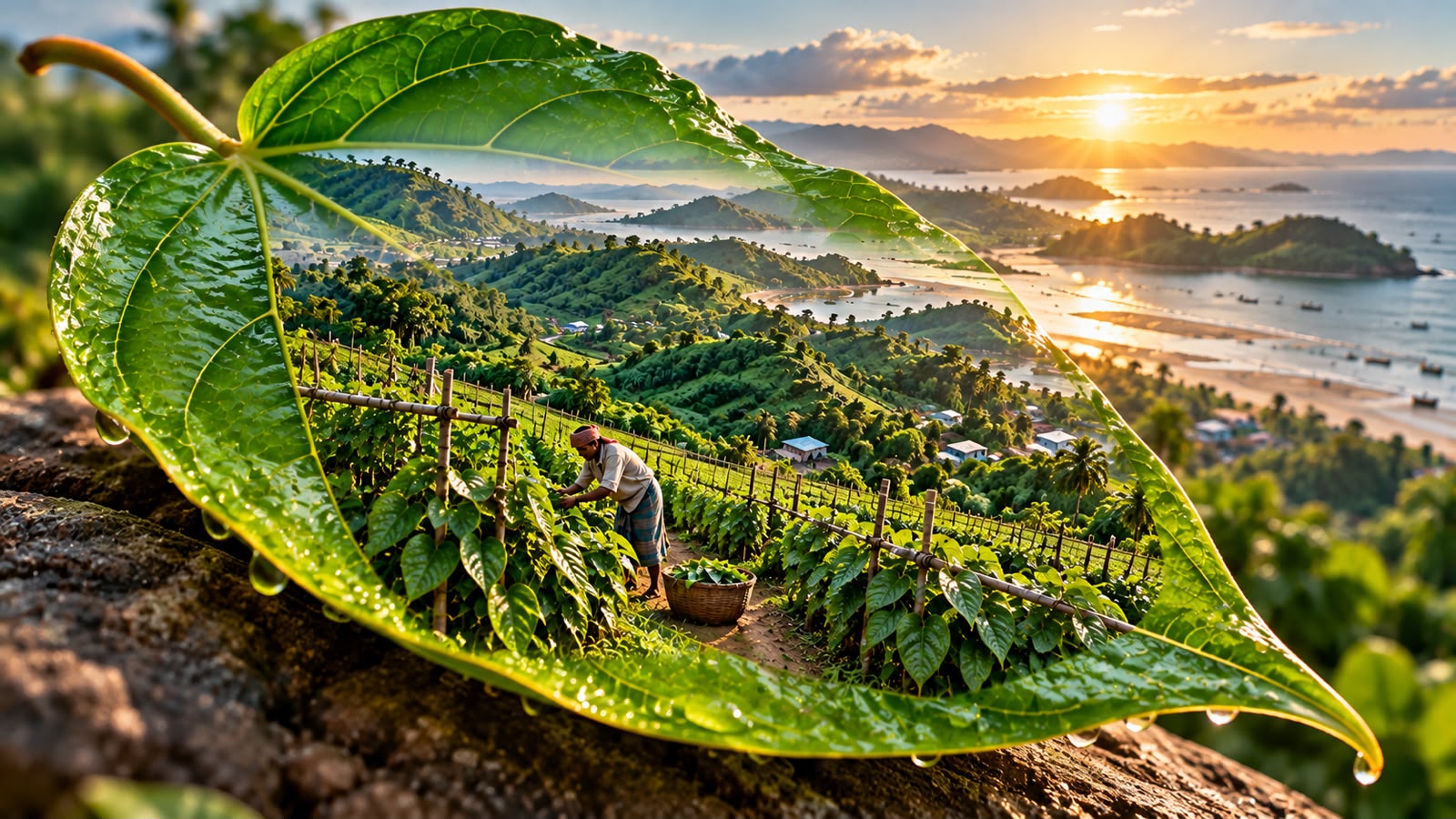
A popular song from Bengali cinema still echoes in our memories: “Jodi sundor ekta mon paitam, Sadarghater paner khili tare banai khowaitam.” It speaks of offering a carefully prepared betel leaf to someone with a beautiful heart. Yet the sweet betel leaf we celebrate today comes not from Dhaka’s Sadarghat, but from Maheshkhali, the mountainous island of Cox’s Bazar. Renowned for its distinctive sweetness and aroma, this humble leaf represents generations of agricultural heritage, cultural identity, and economic opportunity.
Maheshkhali, Bangladesh’s only mountainous island, has cultivated sweet betel leaves for more than two centuries, according to local accounts. Its distinctive landscape and soil conditions support a crop valued for its delicate texture, fragrance, and natural sweetness. Betel leaves remain deeply embedded in Bengali hospitality, weddings, and traditional social gatherings.
Today, betel cultivation supports thousands of farming families. Approximately 40,000 tonnes are produced annually across 1,600 hectares in Maheshkhali. Across Bangladesh, regional production and market estimates suggest that the betel leaf industry generates economic activity worth several thousand crore taka annually. Beyond domestic consumption, Bangladesh exports betel leaves to international markets, including the Middle East.
Yet farmers receive a disproportionately small share of this prosperity. Reports indicate that growers in Maheshkhali receive Tk 200–300 per bundle, while prices in major urban markets reach Tk 500–600. Although transportation and distribution involve legitimate costs, inefficient supply chains and intermediary influence contribute to this disparity. Climate-related disasters, crop diseases, and rising production costs further threaten livelihoods.
Unlocking the industry’s potential requires coordinated action. Direct connections between farmers and exporters could improve returns. Modern cold-chain facilities, better packaging, affordable agricultural credit, and technical assistance would reduce losses and strengthen competitiveness. Compliance with international food safety standards, particularly controls against Salmonella contamination, is essential for maintaining access to regulated markets such as the European Union.
Geographical Indication (GI) recognition also deserves priority. While Rajshahi’s sweet betel leaf has secured GI status, Maheshkhali’s distinctive product warrants separate recognition and international branding.
Competing with producers in India, Sri Lanka, and Thailand will require combining traditional cultivation with modern agricultural practices, improved irrigation, disease management, and environmentally responsible production.
Maheshkhali’s green gold must become more than a profitable commodity. Its future should be measured not merely by expanding markets or export earnings, but by whether the farmers who preserve this centuries-old heritage receive a fair share of the wealth they create.
By Salam Abu
Editor