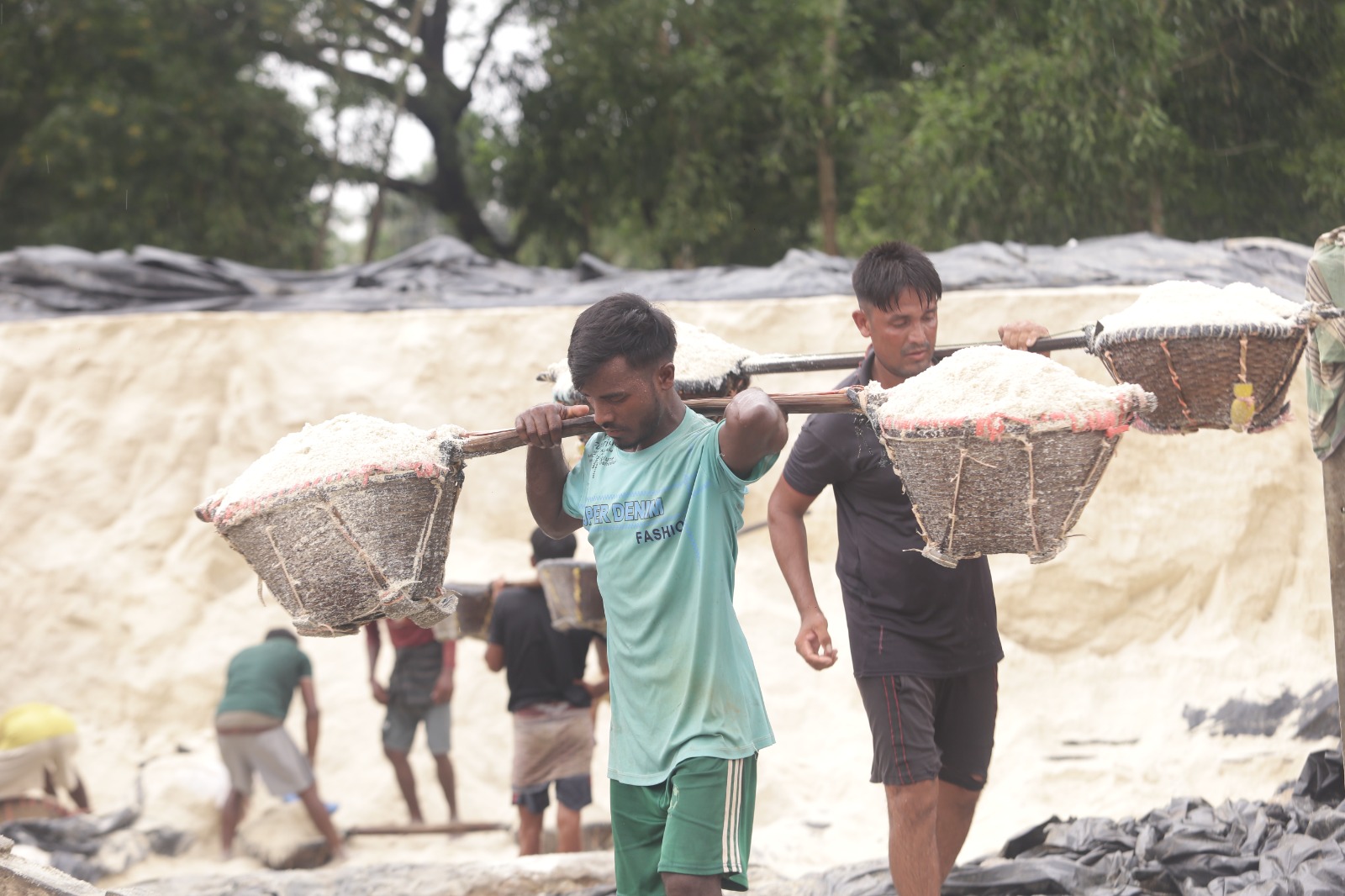
Salt farmers in Cox’s Bazar have welcomed the government’s decision to set the minimum farm-level selling price of raw salt at Tk425 per maund, saying it could help them recover losses from low market prices.
The Ministry of Commerce issued an office order on 19 November setting the minimum selling price of raw salt at Tk425 per maund at the farm level.
According to the order, the price was fixed to protect salt farmers’ interests, account for production and transportation costs, and maintain a stable supply in the market.
The decision followed a recommendation made at a meeting of the Salt Demand Assessment, Salt Policy Implementation and Monitoring Committee at the Ministry of Industries on 18 October.
Thousands of marginal salt farmers in Cox’s Bazar have struggled as production costs rose while market prices remained below their costs. Labor wages, land leases, field preparation, polythene, bamboo, rope and irrigation equipment have all become more expensive this season.
Md Abdullah, a salt farmer from Hnila in Teknaf, said he had previously sold a maund of salt for Tk350-Tk400, while production cost was around Tk240 per maund.
“We are happy with the government’s decision. We have been selling salt without getting a price that reflects production costs. Now that the government has fixed the minimum price at Tk425 per maund, we are hopeful again. If the price is enforced, farmers will be able to make some profit,” he said.
Zamir Uddin, a salt farmer from Whykong, also welcomed the decision, saying many farmers had been cultivating salt on borrowed money and were worried about losses.
“We work in the fields under the scorching sun all day and often have to borrow money to cultivate salt. We were facing the risk of major losses because prices were below production costs. The new minimum price gives us hope that we can reduce our debt burden and continue farming,” he said.
Farmers, however, said setting a minimum price alone would not be enough. They called for regular market monitoring to ensure traders actually pay the prescribed price and prevent middlemen from depriving farmers of a fair return.
According to Bangladesh Small and Cottage Industries Corporation data, about 87 per cent of the country’s total salt production comes from nine upazilas of Cox’s Bazar. The rest is produced in Banshkhali, Chattogram.
Despite rising production to meet domestic demand, many farmers have struggled because of falling prices, rising production costs, and mounting debt.
Ali Ahmed of Kalarma Chhara Union in Moheshkhali cultivated salt for around 20 years with his two sons on 2,000 শতক, or 20 acres, of leased land. He left the profession two years ago because of rising costs and losses and opened a grocery shop at a local market, while his two sons now drive auto-rickshaws.
“If the price rises and we get a good return, we will return to the fields with our sons. The government repeatedly considers importing salt. We can produce enough salt so that the government does not have to think about importing it,” Ali Ahmed said.
Farmers hope effective enforcement of the new minimum price and regular market monitoring will revive the salt-farming sector and encourage those who left the profession because of losses and debt to return.
Abdu Rashid Manik
Photo: Hussain Shetu