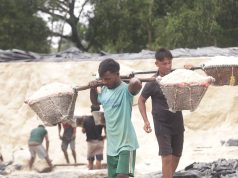

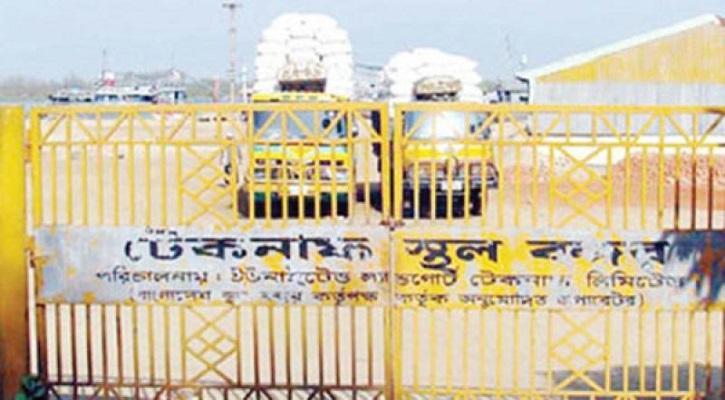
Cement exports from Bangladesh to Myanmar’s Rakhine State have resumed through the Teknaf land port after a nearly two-year suspension, raising hopes among local traders despite heavy losses from stock damaged during the prolonged halt.
Three traders exported 870 bags of cement on Thursday, port officials said. However, 22,850 bags stored in several port warehouses were damaged after remaining unsold for an extended period, causing substantial financial losses for traders.
The last shipment of cement from Bangladesh to Rakhine was made in late March, after which exports were suspended amid various restrictions. Traders said Myanmar authorities had tightened import restrictions amid concerns that Bangladeshi cement could be used to build bunkers or tunnels in Rakhine.
The restrictions left large quantities of cement stranded at the port. Much of the stock deteriorated after being kept in warehouses for a prolonged period.
The resumption followed a new directive from the Ministry of Commerce. In a letter signed by Deputy Secretary Mohammad Abdus Sadek of the ministry’s Export-2 branch on Nov 10, the ministry said cement was freely exportable under the Export Policy 2024–27 and did not require a separate export permit.
M R Zaman Badhan, a customs officer at Teknaf land port, said cement exports had resumed after the ministry issued the directive.
“On the first day, 870 bags of cement were sent to Myanmar. Exports are continuing,” he said.
He said import-export activities with Maungdaw were continuing on a limited scale amid the conflict in Myanmar, while commercial communication with Yangon remained suspended.
Customs officials and traders said 22,850 bags of cement had been damaged in several warehouses at the port during the prolonged suspension. Of the total, 8,800 bags belonged to a single trader. They said traders had suffered significant losses, while the government had also lost revenue because of the decline in trade through the port.
Omar Faruk, proprietor of Messrs Faruk Traders, said more than 22,000 bags, including his 8,800 bags, had been damaged due to the suspension.
“Many traders like me have suffered huge losses. However, cement exports have resumed following the ministry’s directive. Some cement belonging to Chattogram-based Ne Tong Traders has already been exported through my C&F firm, Messrs Jawad Enterprise,” he said.
He said regular cement exports could increase foreign exchange earnings and help traders recover their losses. The initiative could also help curb cement smuggling through waterways, he added.
Jasim Uddin Chowdhury, general manager of United Land Port Teknaf Ltd, the port operator, said cement-laden vessels were now being allowed to leave after receiving clearance from customs.
“A vessel carrying 870 bags of cement has already left the port. Several more trucks carrying cement reached the port on Sunday,” he said.
Teknaf Upazila Nirbahi Officer Anik Chowdhury said he had heard about the resumption of cement exports.
Port officials said the commercial route through Yangon was disrupted after the Arakan Army established control over a 271-kilometre stretch of Myanmar’s border in December 2024. In January last year, the group detained four cargo vessels travelling from Yangon towards Teknaf and demanded payments, after which Myanmar’s junta government announced the suspension of trade between Bangladesh and Myanmar through Yangon.
At present, limited import-export activity is continuing with Maungdaw, which is under the control of the Arakan Army.
The resumption of cement exports has renewed optimism among Teknaf traders. However, ongoing conflict, the volatile border situation, and uncertainty about commercial routes raise concerns about the ability to maintain regular, large-scale exports.
Abdu Rashid Manik
Photo: Courtesy