
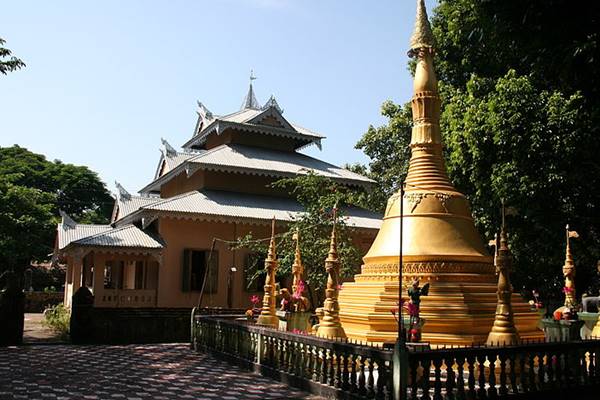
Located in the coastal town of Cox’s Bazar, Aggmeda Khyang Monastery is one of Bangladesh’s oldest and most significant Buddhist temples. It is significant for both the Rakhine and Buddhist communities. The monastery is part of the Central Mahasing Dogri Buddhist Temple complex and is one of the country’s largest and most ancient religious institutions.
The monastery’s structure is crafted using precious teak and ironwood from Arakan, adding strength and beauty. In the temple courtyard, five memorial pillars stand on the left side, along with a 250-year-old Shilkoroi tree revered by the local Rakhine community. This tree is considered sacred, as it is believed that two monks attained enlightenment beneath its shade; thus, it is worshiped as a Bodhi tree.
Historical and Religious Significance
A memorial pillar was erected in 1956 at the monastery’s entrance to commemorate its 250th anniversary, further solidifying its historical and religious significance. On the right side of the main temple, the Ching Ghar or Seema Ghar houses numerous small statues and several large statues, contributing to the spiritual atmosphere of the site.
To the southeast of the monastery lies the Angmangala Pagoda, built nearly 200 years ago by a Rakhine woman named Nanfru. This pagoda continues to serve as a peaceful and spiritually uplifting space for devotees.
For the Rakhine community and Buddhists, Aggmeda Khyang Monastery is not just a religious structure but an integral part of their cultural heritage and spiritual life. The monastery symbolizes peace and wisdom and is a vital attraction for visitors seeking to experience the region’s rich Buddhist traditions.
By Rajin Saleh
Photo: Rajin Saleh