

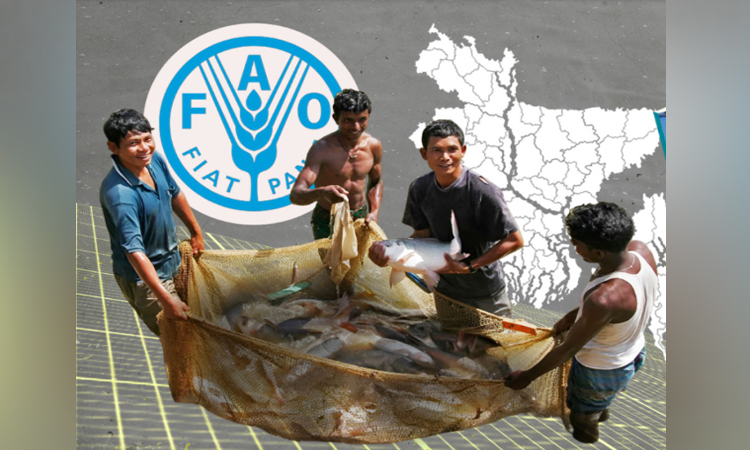
Bangladesh ranked among the world’s top five aquaculture-producing countries in 2024 and retained its position as the second-largest producer of inland capture fisheries, according to a recent report by the Food and Agriculture Organization (FAO).
The report titled ‘The State of World Fisheries and Aquaculture 2026’ said global fisheries and aquaculture production reached a record 235 million tonnes in 2024, comprising 195 million tonnes of aquatic animals and 40 million tonnes of algae. The figure marked a 5.2 per cent increase from 2022, with the total first-sale value estimated at $565 billion.
According to the report, 67 per cent of total production came from marine waters, including 51 per cent from capture fisheries and 49 per cent from aquaculture, while inland waters accounted for the remaining 33 per cent, of which 84 per cent originated from aquaculture.
Asia remained the dominant producer, accounting for 76 per cent of global fisheries and aquaculture output, followed by Latin America and the Caribbean with 8 per cent, Europe with 7 per cent, Africa with 6 per cent, North America with 2 per cent, and Oceania with 1 per cent.
Production of aquatic animals reached an all-time high of 195 million tonnes in 2024, with aquaculture contributing 53 per cent and capture fisheries 47 per cent. The first-sale value of aquatic animal production was estimated at $545 billion.
Marine areas produced 118 million tonnes, representing 61 per cent of total aquatic animal production, while inland waters contributed 77 million tonnes, or 39 per cent.
In inland capture fisheries, India and Bangladesh ranked first and second, respectively, with catches of 2.2 million tonnes and 1.4 million tonnes in 2024.
The report said global aquaculture production climbed to a record 142 million tonnes in 2024, valued at an estimated US$ 391 billion. The total included 103 million tonnes of aquatic animals worth US$ 371 billion and 39 million tonnes of algae valued at US$ 20 billion.
Asia accounted for 92 per cent of global aquaculture output, followed by Latin America and the Caribbean, Europe, Africa, North America and Oceania.
The top five aquaculture-producing countries — China, Indonesia, India, Viet Nam and Bangladesh — together generated 84 per cent of global aquaculture production.
Aquaculture production of aquatic animals also reached a record 103 million tonnes in 2024, underscoring the sector’s growing role in meeting global demand for aquatic food.
The report identified China as the largest producer, accounting for 56 per cent of global aquaculture animal production, followed by India (12 per cent), Indonesia (6 per cent), Viet Nam (5 per cent) and Bangladesh (3 per cent). Together, the five countries contributed 82 per cent of total output.
Nearly two-thirds of aquaculture animal production was farmed in inland waters, with finfish dominating, accounting for 89 per cent of production. Crustaceans represented 9 per cent, while aquatic turtles and frogs, molluscs and other invertebrates made up the remainder.
Marine and coastal aquaculture produced 38 million tonnes of aquatic animals, with molluscs at 53 per cent, finfish at 24 per cent, crustaceans at 22 per cent, and other marine invertebrates at 2 per cent.
Cox’s Bazar Life Desk/BSS