
The politics of Maulana Abdul Hamid Khan Bhashani was centred on establishing people’s rights without seeking personal power or position, speakers said at a discussion in Cox’s Bazar marking his 50th death anniversary.
They said Bhashani spent his life fighting for the rights of farmers, workers and ordinary people. His role in defending the country’s independence, dignity and sovereignty remains an example for the present generation.
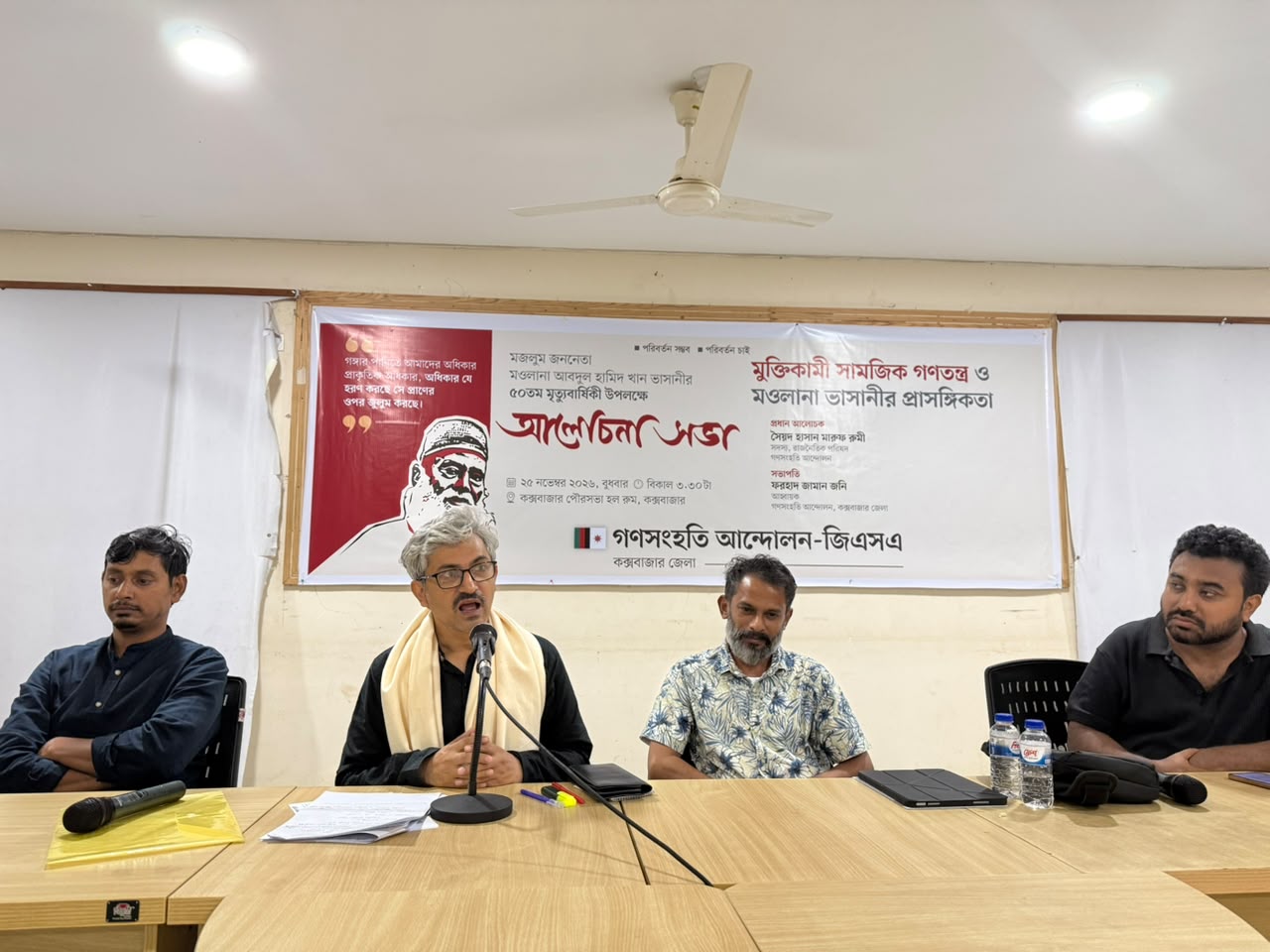
The Cox’s Bazar district unit of the Ganosamhati Andolan organised the discussion at the Cox’s Bazar Municipality Auditorium at 3:30pm on Wednesday. District organiser Al Rahat moderated the event, which district convener Farhad Zaman Jony chaired.
Hasan Maruf Rumi, a member of the political council of Ganosamhati Andolan, attended as the chief guest.
Writer and artist Yasir Arafat, Bangladesh Chhatra Federation Chattogram district convener Ariful Haque Arif and Cox’s Bazar district organiser of the federation Touhidul Islam were also present.
Speakers said Bhashani was a rare politician who resisted the lure of power. Throughout his life, he rejected ministerial positions and political power and stood alongside oppressed farmers, workers and ordinary people.
They said his uncompromising position on the country’s independence, dignity and sovereignty remained the defining feature of his politics.
The speakers also said that after the partition of the subcontinent in 1947, Bhashani witnessed discrimination against East Pakistan and, at the 1957 Kagmari Conference, declared “Assalamualaikum” to Pakistan, which they described as the beginning of the movement that eventually led to the establishment of Bangladesh.
They said his struggle for Bangladesh’s sovereignty and dignity remains relevant even today.
In his speech, Hasan Maruf Rumi said Bhashani’s politics was about establishing people’s rights. Whenever people were deprived of democratic rights, he organised them and built movements to secure them.
He said Bhashani’s history of struggle stretched from the anti-line system movement at the All-India Salem Conference in 1928 to the historic Farakka Long March in 1976 demanding a fair share of the Ganges water.
“Throughout his life, Maulana Bhashani remained outside the politics of power and fought for the rights of working people, farmers and workers,” Rumi said.
He said Bhashani’s historic “Assalamualaikum” declaration at the 1957 Kagmari Conference sowed the seeds of Bengali self-determination and independence.
Rumi said his uncompromising stance against imperialism and domination would remain an enduring part of history.
He also said Bhashani set an important example in protecting Bangladesh’s sovereign interests through the Farakka Long March in 1976, when he led the demand for the country’s fair share of Ganges water.
“Following his ideals is essential for building a democratic and humane state,” Rumi said.
Cox’s Bazar Life Report