
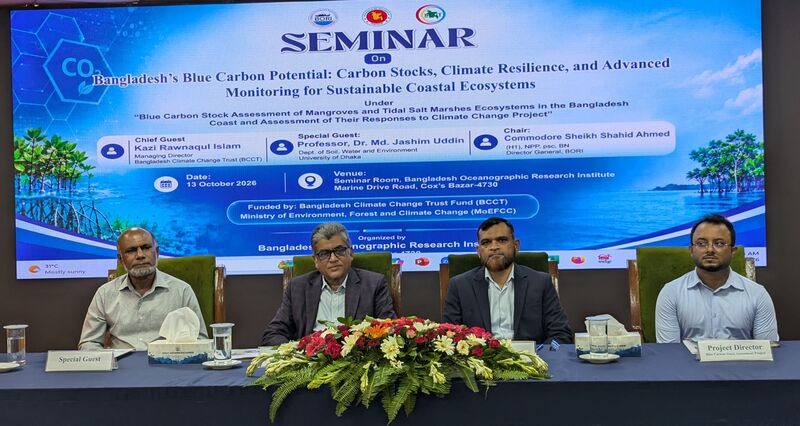
Bangladesh’s coastal ecosystems could offer significant opportunities for climate finance and carbon credits through the scientific measurement and conservation of blue carbon, a seminar in Cox’s Bazar was told on Tuesday.
The seminar, titled ‘Bangladesh’s Blue Carbon Potential: Carbon Storage, Climate Resilience and Advanced Monitoring for Sustainable Coastal Ecosystems’, was organised by the Environmental Oceanography and Climate Division of the Bangladesh Oceanographic Research Institute (BORI).
Held at BORI’s conference room near Marine Drive, the event was part of a research project funded by the Bangladesh Climate Change Trust (BCCT) under the Ministry of Environment, Forest and Climate Change.
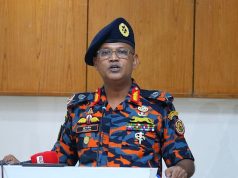
BORI director general Commodore Sheikh Shahid Ahmed chaired the seminar, while BCCT managing director Kazi Raonakul Islam attended as the chief guest. Professor Dr Md Jashim Uddin of the Department of Soil, Water and Environment at Dhaka University was the special guest and keynote speaker. Project director and BORI scientific officer Mir Kashem presented the research findings.
Professor Jashim said Bangladesh’s blue carbon potential should be considered alongside the blue economy and ocean governance.
He said protecting coastal and marine ecosystems was important not only for carbon storage but also for fisheries, biodiversity, coastal tourism, local livelihoods and long-term economic development.
He stressed the need for integrated coastal zone management, marine spatial planning, science-based policymaking and stronger coordination among government agencies, research institutions, universities, local communities and the private sector.
Presenting the project’s progress, Mir Kashem said researchers were measuring carbon stocks in the Sundarbans using scientific data rather than estimates.
For the first time in the country, the project is using an RTK-enabled multispectral unmanned aerial vehicle (UAV), capable of centimetre-level positioning, to prepare three-dimensional canopy models and digital maps showing chlorophyll activity.
Researchers are also collecting soil cores from depths of up to three metres despite difficult conditions involving mud and tidal water. The samples are being examined in laboratories.
The mapping covers 441,455 hectares of mangrove forest, accounting for 79.8 per cent of the identified coastal blue carbon ecosystems, and 111,585 hectares of tidal salt marshes, accounting for the remaining 20.2 per cent. The research aims to develop an internationally standardised digital database.
Research findings presented at the seminar indicated that mangrove soils could store three to five times more carbon per hectare than tropical upland forests, keeping it underground for centuries.
Speaking as chief guest, Kazi Raonakul Islam said blue carbon research should be incorporated into national climate policy, the greenhouse gas inventory and international climate diplomacy.
‘At the COP and other international climate negotiations, Bangladesh can strengthen its position not only as a climate-vulnerable country but also as an active partner in nature-based solutions,’ he said.
He thanked BORI and the project director for the initiative and assured continued BCCT support for evidence-based climate research.
Commodore Sheikh Shahid Ahmed said protecting coastal areas meant safeguarding people’s lives and livelihoods, the economy and future generations, not merely conserving trees.
He said combining field-based scientific research with advanced drone technology could help shape the future of marine and coastal research in South Asia.
During an open discussion, government and private-sector officials, scientists, academics and researchers noted the growing importance of ocean- and coast-based climate action in international climate commitments, including the 2025 nationally determined contributions (NDCs).
They said the research could help Bangladesh move towards readiness for participation in global carbon markets.
Cox’s Bazar Life Report
Photo: Courtesy