

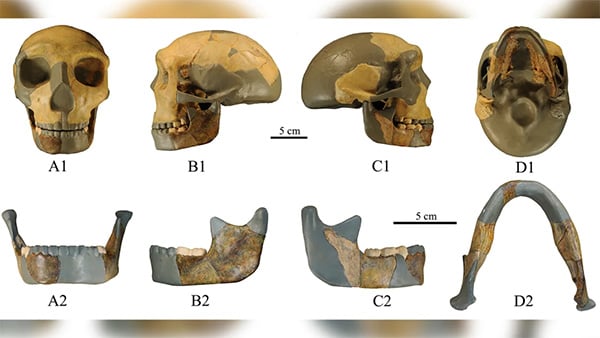
Chinese scientists have discovered dozens of human fossils dating back 300,000 years, which are the earliest ones found in East Asia in terms of the evolution process towards Homo sapiens, the species to which all modern human beings belong.
Human fossils, many fossilized animal bones, and stone tools have been unearthed at the Hualongdong site in Dongzhi County, east China’s Anhui Province.
Chinese researchers reported their latest discoveries and studies concerning the Hualongdong ancient human site at an academic conference in Dongzhi County from Friday to Sunday. Nearly 100 researchers and scholars, including over a dozen international experts, attended the event.
Discovered in late 1988, the Hualongdong site has yielded remarkable finds during continuous excavations since 2013. Approximately 20 individual ancient human fossils, including a relatively complete skull, over 400 stone artifacts, numerous bone fragments with evidence of artificial cutting and chopping, and more than 80 vertebrate fossils have been unearthed at this site.
From April to November 2024, an archaeological team conducted a new round of excavations covering an area of 40 square meters. A total of 11 human fossils were unearthed, including one well-preserved foot metatarsal bone, one broken frontal bone, one middle femur fragment, and eight skull fragments.
Cox’s Bazar Life Report/Xinhua