
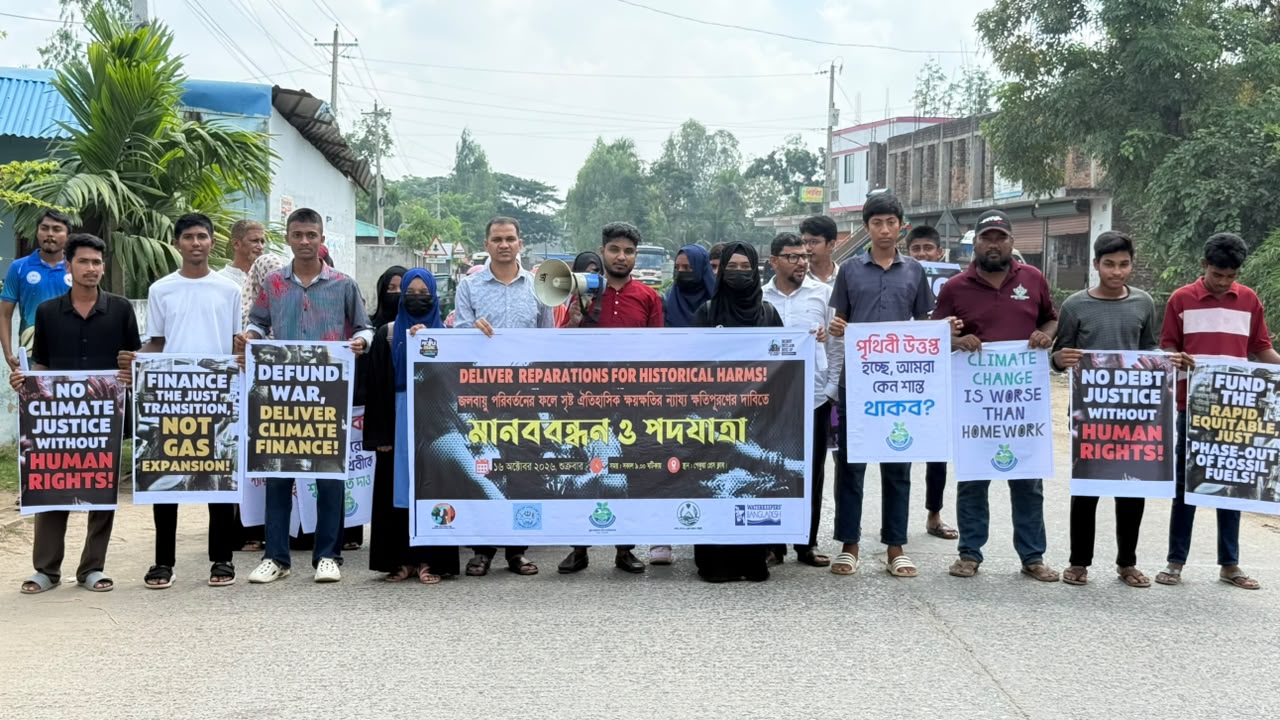
Environmental activists on Friday called for fair compensation and grants for countries most affected by climate change, saying they should not be burdened with new loans for adaptation.
They also said countries and corporations with the greatest historical responsibility for the climate crisis must ensure fair financing to help affected nations and communities address their losses and damage.
They said industrialised countries and multinational corporations have made huge profits for decades from fossil fuel-dependent economies, while vulnerable countries such as Bangladesh have paid the heaviest price for climate change.
Farmers, fishermen, salt workers, coastal communities and other working people are bearing the brunt of cyclones, tidal surges, river erosion, floods, salinity, droughts and crop losses, which damage homes, livelihoods and farmland every year.
They formed a human chain and procession in Pekua, Cox’s Bazar under the slogans ‘Climate finance, not loans: compensation now’ and ‘Do not trap climate-vulnerable countries in debt in the name of adaptation’.
Environmental organisation Dharitri Rokkhyay Amra (DHORA) and local groups jointly organised the programme along the Chowmuhani–Submarine Naval Base Road in Pekua.
It was held ahead of the annual meetings of the International Monetary Fund and the World Bank, scheduled for Bangkok, Thailand, from October 12 to 18, 2026, with a focus on the question: ‘Whose interests should the global economy serve?’
Speakers said people in climate-vulnerable countries were suffering not only from the immediate consequences of climate change but were also being forced to take on more debt to finance measures to address the crisis. While climate disasters destroy people’s assets and livelihoods, the cost of adaptation and reconstruction adds to their debt burden, they said, calling the situation contrary to climate justice.
They also said cyclones, tidal surges, river erosion, floods, and salinity were increasingly threatening farmland and livelihoods in Bangladesh’s coastal areas.
Many fishermen, salt workers, farmers and day labourers were losing their ability to recover from repeated disasters.
The speakers called for climate adaptation measures to go beyond infrastructure development and project-based interventions.
They said such efforts must prioritise restoring affected people’s livelihoods, ensuring safe housing and access to food and water, and protecting local communities’ rights and participation.
They stressed that climate finance must be grant-based rather than debt-dependent. They also called for a fair, environmentally sustainable transition away from fossil fuel-dependent economies, alongside environmental protection, climate justice, and community ownership.
Those who addressed the human chain and procession included Delwar Hossain, an environmental activist and Pekua upazila coordinator of DHORA; Mujibul Haque Chowdhury, headteacher of Pekua Central School and College; and M Amjad Hossain, president of the Noor Ayesha Khan Foundation.
Pekua Correspondent