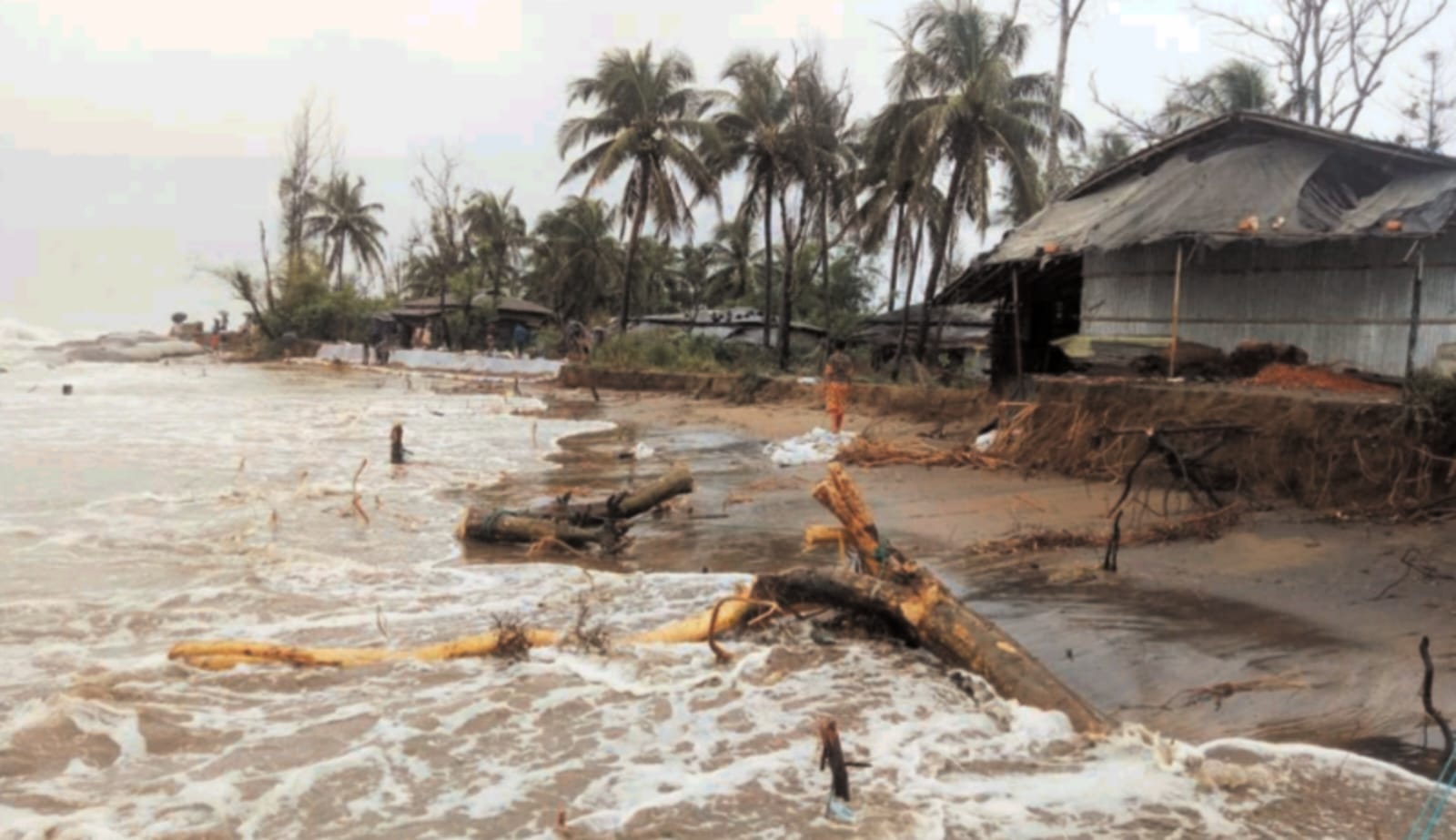
Repeated cyclones, tidal surges, and erosion along rivers and the sea have forced many residents of Teknaf’s coastal areas in Cox’s Bazar to lose their homes time and again. For some, their ancestral villages have disappeared into the sea; others have moved elsewhere for shelter.
Many, despite losing almost everything, continue to cling to their ancestral homesteads. Even after rebuilding their homes, they remain at risk of losing them again in the next disaster. As the crisis continues, the number of climate-displaced people is growing, while durable embankments and planned resettlement remain largely absent.
From the devastating cyclone of November 12, 1970 to Cyclone Mocha in 2023, Teknaf has endured repeated disasters. Strong winds, tidal surges and erosion have damaged homes, roads, farmland and livelihoods.
Sultan Ahmad, a senior resident of Shahporir Dwip, said they lived in Badr Mokam village in 1970. The island, which once covered about 10 square kilometres, was home to more than 20,000 people.
Erosion after the cyclones of 1991 and 1994 gradually wiped out the settlement, forcing residents to relocate in several phases.
Nur Mohammad, 81, a former resident of Badr Mokam, now lives on Shahporir Dwip, while Hasina Khatun, 75, has taken shelter in Kutupalong in Ukhiya.
According to locals, nearly 2,000 families in Sabrang and Shahporir Dwip have been displaced by natural disasters and erosion since independence.
Between 2012 and 2020 alone, around 1,000 families on Shahporir Dwip lost their homesteads after embankments collapsed. Many later settled in Ukhiya, Naikhongchhari, Lama and Alikadam.
Nurul Islam of Shahporir Dwip said his home had been washed away three times. After losing his homestead for the last time in 2016, he left the coast and moved to Painyashah in Ukhiya. He alleged that displaced families had received no government assistance for rehabilitation.
River erosion along the Naf has also steadily reduced settlements. Abdus Salam, a member of Jaliapara Union Parishad, said more than 500 families once lived there, but only around 150 remain. Over the past three decades, many families have left after losing their homes to river erosion.
Teknaf’s coastal infrastructure has been damaged by several disasters, including Cyclone Aila in 2009, Komen in 2015, Mora in 2017, Sitrang in 2022 and Mocha in 2023.
A study published in 2025 found a trend of land erosion along the Marine Drive from Shahporir Dwip, Sabrang and Teknaf Sadar to Baharchhara between 1989 and 2024.
A 2022 World Bank report also highlighted the need for long-term investment to address coastal risks.
Santosh Kumar Shil, a professor at Teknaf Government College, said the coastal settlements are economically important for tourism, agriculture, salt production and fisheries. “Durable, international-standard embankments are urgently needed to protect these areas,” he said.
Shawkat Ibn Shaheed, executive engineer of the Cox’s Bazar Water Development Board, said sea levels had risen due to climate change.
He said embankment rehabilitation on Shahporir Dwip had cost around Tk 150 crore, but tidal surges had caused blocks to collapse at several points. Repair work is underway, he said, adding that measures are also being taken to curb erosion along the Naf River.
Coastal residents say durable embankments alone will not be enough. They also want shelters in high-risk areas, natural green belts and safer communication networks.
Planned resettlement, alternative housing and livelihood opportunities are also needed for communities living in areas that are no longer safe.
They have also demanded official recognition of November 12 as Coastal Day.
By Tarekur Rahman
Photo: Collected