
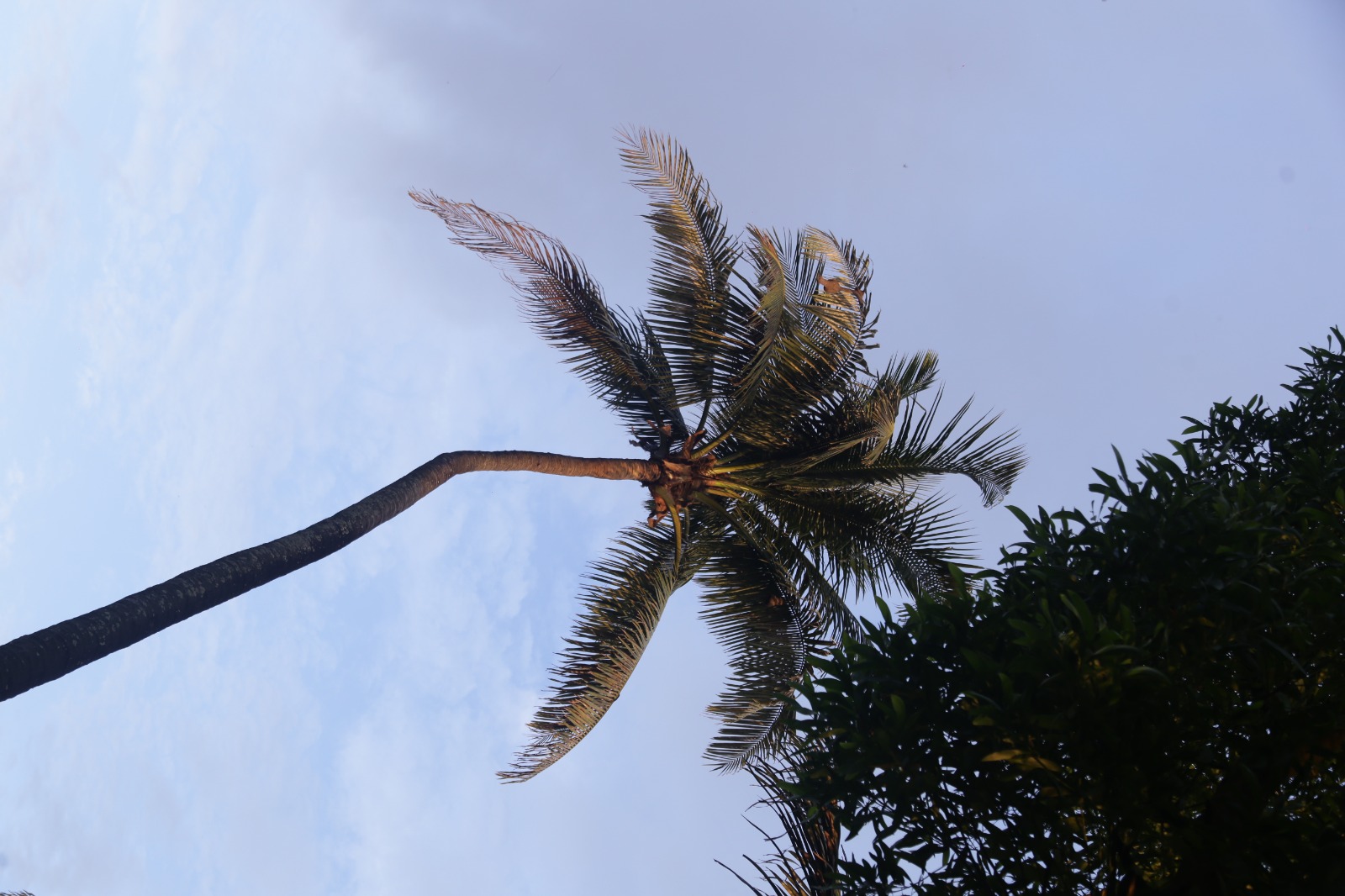
The coconut trees in Rafiqul Islam’s garden in Shilkali, Baharchhara union, Teknaf, were once lush and productive. More than 50 trees stood on his 120-decimal plot, bearing plenty of green coconuts and providing additional income for his family.
However, repeated floods and saline seawater intrusion over the past six to eight years have changed the situation. Floodwaters washed away soil from the bases of many trees and damaged their roots. The trees gradually thinned, and production declined.
Abdul Majed of Sonarpara in Ukhia has also been struggling with falling production from his 75-decimal orchard for the past decade. Strong winds and cyclones have caused many trees to lean, reducing their productivity.
Many growers in the coastal areas face similar problems. Excessive rainfall, waterlogging, floods, tidal surges, saline-water intrusion, irregular rainfall, temperature changes, and strong cyclone winds are affecting coconut tree growth.
In 2023, cyclones Mocha and Hamoon hit coastal areas of Cox’s Bazar, including Maheshkhali, Kutubdia, Chakaria, Teknaf and Saint Martin’s Island, which is known for coconut production.
Strong winds and tidal surges damaged and uprooted many trees. Agriculture officials believe the damage has had a long-term impact.
Experts say climate change, natural disasters, rising salinity, diseases and pest attacks, unplanned construction, inadequate care of old trees and the failure to plant new ones are gradually reducing production.
Old trees, lack of care
Humayun Kabir, the agriculture officer of Teknaf upazila, reported that Teknaf produced 6,405 tonnes of coconut on 256 hectares, but the productivity remained low.
Most of the trees in the area are 40 to 50 years old, he said. Many are around 50 feet tall, so spraying pesticides is also difficult. Higher temperatures also cause coconut flowers to fall.
“A coconut tree takes 10 to 12 years to start bearing fruit. Good production continues until around 20 to 25 years of age, but yields begin to decline after 40 to 50 years,” he said.
New saplings therefore need to be planted alongside old trees, he said, adding that many farmers wrongly believed coconut trees did not require fertiliser. “This is not correct,” he said.
This year, 5,550 saplings have been distributed among farmers and educational institutions in Teknaf.
Mustak Uddin, a sub-assistant agriculture officer at the Shamlapur block in Teknaf, said coconut had become a promising crop because of strong demand among tourists.
However, yields were declining partly because many farmers did not apply balanced fertiliser at the right time, he said.
Each tree should receive balanced fertiliser at least twice a year, varying with its age, he said. For trees younger than 10 years, farmers can dig a trench two to three cubits from the base and apply decomposed cow dung, DAP, MOP and gypsum, first in April-May and again in September-October.
For older trees, the amount should be increased according to age. Farmers should contact sub-assistant agriculture officers or the upazila agriculture office if they notice diseases or pest attacks, he added.
788 hectares in district
According to the Department of Agricultural Extension in Cox’s Bazar, coconut is cultivated on 788 hectares in the district, producing 15,980 tonnes.
Teknaf accounts for 6,405 tonnes from 256 hectares, Ramu 3,560 tonnes from 150 hectares, Chakaria 2,625 tonnes from 105 hectares, Pekua 1,165 tonnes from 55 hectares, Ukhia 1,120 tonnes from 140 hectares, Cox’s Bazar Sadar 600 tonnes from 24 hectares, Maheshkhali 425 tonnes from 50 hectares and Kutubdia 80 tonnes from eight hectares.
The department said local supply remained inadequate compared with demand, which rises particularly during the tourist season and hot weather.
Government initiatives
Bimal Kumar Pramanik, director of the department’s Cox’s Bazar office, said drought intensity was increasing during the dry season because of climate change. He also said limited irrigation, squirrel attacks, and wild animal disturbances in hilly areas are affecting production.
Despite these challenges, he said there is considerable potential to raise production through proper care, adequate irrigation and appropriate agricultural management.
The Ramu Horticulture Centre produces 7,000 to 7,500 saplings every year, which are sold at government-fixed prices. In the last financial year, 35,000 saplings were distributed among farmers through the upazila agriculture offices under a government agricultural incentive programme.
Following the department’s advice, Rafiqul Islam plans to care for his old trees while planting new ones.
“I want to consult agriculture officials about which varieties are suitable for the coastal area and how to protect the trees from salinity and adverse weather. I hope production will increase again if the new trees grow properly,” he said.
Decline inland too
The decline extends beyond coastal areas. Although salinity is less of a problem inland, excessive heat, prolonged drought, irregular rainfall, waterlogging, strong winds, diseases and inadequate care are affecting yields. Many old trees are producing less, while the rate of new plantation remains low.
Faizul Hakim of Rajarkul in Ramu said extreme heat and irregular rainfall were weakening the trees. On the advice of the agriculture office, he is applying urea and TSP fertiliser, watering regularly and planting new saplings alongside the old trees.
Ershad Ullah, an orchard owner in South Mithachhari of Ramu, said his area did not face salinity problems but temperatures had increased significantly. “Flowers and young coconuts fall during storms. These problems were not so severe before,” he said.
Agriculture officials say balanced fertiliser, irrigation when necessary, proper drainage, disease and pest control, and regular planting of new saplings are needed to maintain production.
Supply short of demand, prices rise
The decline is also affecting the market. Coconuts are currently selling for Tk170 to Tk220 each, depending on size and quality, against Tk50 to Tk100 several years ago.
Shah Uddin, a coconut seller at Laboni Point on Cox’s Bazar beach, said local supplies had fallen. “Previously, we could collect many coconuts from local orchards. Now we have to bring them from outside. Higher transport and other costs have pushed up prices,” he said.
Another trader, Arafat, said demand rose sharply during hot weather and the tourist season. Demand also increases during dengue outbreaks, as patients are often advised to drink coconut water.
As local production declines, the resulting shortage is putting further pressure on prices.
By Tarekur Rahman
Photo: Hussain Shetu