
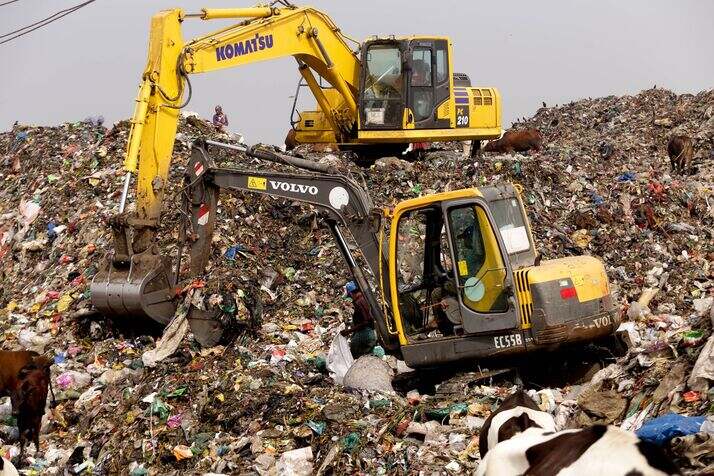
Cox’s Bazar’s waste management crisis has persisted for more than three decades, with the city’s garbage being dumped along the banks of the Bakkhali River, creating a huge garbage mountain about 35 to 40 feet high.
The waste has piled up over the years, causing severe odour and attracting mosquitoes, flies, crows and stray dogs. Residents, particularly those of Ward 3 of the municipality, say they have to endure the nuisance every day.
Local residents allege that the site receives not only household waste but also waste from more than 450 hotels, motels, and hospitals in the city at different times. Polluted liquid from the waste flows directly into the Bakkhali River and is eventually carried toward the sea, posing a serious threat to the river, environment, and biodiversity.
Residents also say the prolonged accumulation of waste beside an important city road has created risks to both the environment and public health.
A major initiative is now being taken to address the longstanding crisis. An integrated waste management plant is planned on 2.2 acres of municipal land at Alir Jahal in Cox’s Bazar at an estimated cost of around Tk100 crore.
The proposed plant will use modern methods to manage the city’s waste and is also expected to produce organic fertiliser and electricity.
Cox’s Bazar-3 lawmaker Lutfur Rahman Kajal recently wrote to the prime minister seeking the construction of the waste management plant. Following the request, the Prime Minister’s Office instructed the Department of Public Health Engineering to take the necessary measures.
Preparatory work on the project documents has already begun.
Lutfur Rahman Kajal said consent had been obtained after discussions with the municipality to allocate 2.2 acres of land at Alir Jahal for construction of the plant.
“The Department of Public Health Engineering will now take the necessary steps to construct the plant,” he said.
Mohammad Narullah, executive engineer of the Department of Public Health Engineering, said Dhaka had instructed them to prepare to build the integrated waste management plant.
The large-scale facility will manage waste generated in Cox’s Bazar city and surrounding areas, as well as waste from more than 500 hotels, he said.
The plant could also produce a large quantity of organic fertiliser and more than one megawatt of electricity from waste, Narullah said.
HM Nazrul Islam, organising secretary of the Cox’s Bazar district unit of Bangladesh Poribesh Andolon (BAPA), said a modern waste management system should have been introduced in the tourist city 25 to 30 years ago.
“Although it is happening after a long delay, if the initiative is finally implemented, it will help protect the environment and create employment through waste recycling, recycling plants and compost production,” he said.
A clean and organised waste management system would also improve the city’s appearance and ensure a healthier living environment, he said.
Modern technology could also generate electricity from waste, creating economic benefits, while recyclable materials such as plastic, paper, glass and metal could be converted into new products, reducing pressure on raw materials and conserving natural resources, Nazrul said.
Proper waste management would help prevent soil, water and air pollution and help maintain ecological balance and protect biodiversity, he added.
College student Hasanul Karim said he travelled along the road every day and found it difficult to pass because of the stench from the garbage pile.
“City residents will benefit if a proper waste management plant is built,” he said.
Cox’s Bazar Municipality chief executive Parakram Chakma said the municipality currently could not manage the city’s waste properly because of inadequate manpower and equipment.
He said a large pile of waste had accumulated because people were dumping garbage in an open area at Kasturaghat.
A small waste management plant in Cheinda, Ramu, also has limited capacity. He said its capacity is exhausted after managing waste from only around 20 hotels.
“We hope the new plant will help resolve the city’s major waste management crisis once it becomes operational,” Parakram said.
City residents, meanwhile, complain that waste is regularly scattered in different parts of Cox’s Bazar, not only at Kasturaghat. Collected waste is also kept at various locations inside the city, increasing environmental and public health risks.
They say removing the longstanding garbage mountain and introducing a modern waste management system is now urgent.
If the proposed plant is implemented, residents hope it will bring a major change to waste management in Cox’s Bazar while helping protect the Bakkhali River and the wider coastal environment.
By Mohammad Morshed
Photo: Hussain Shetu