
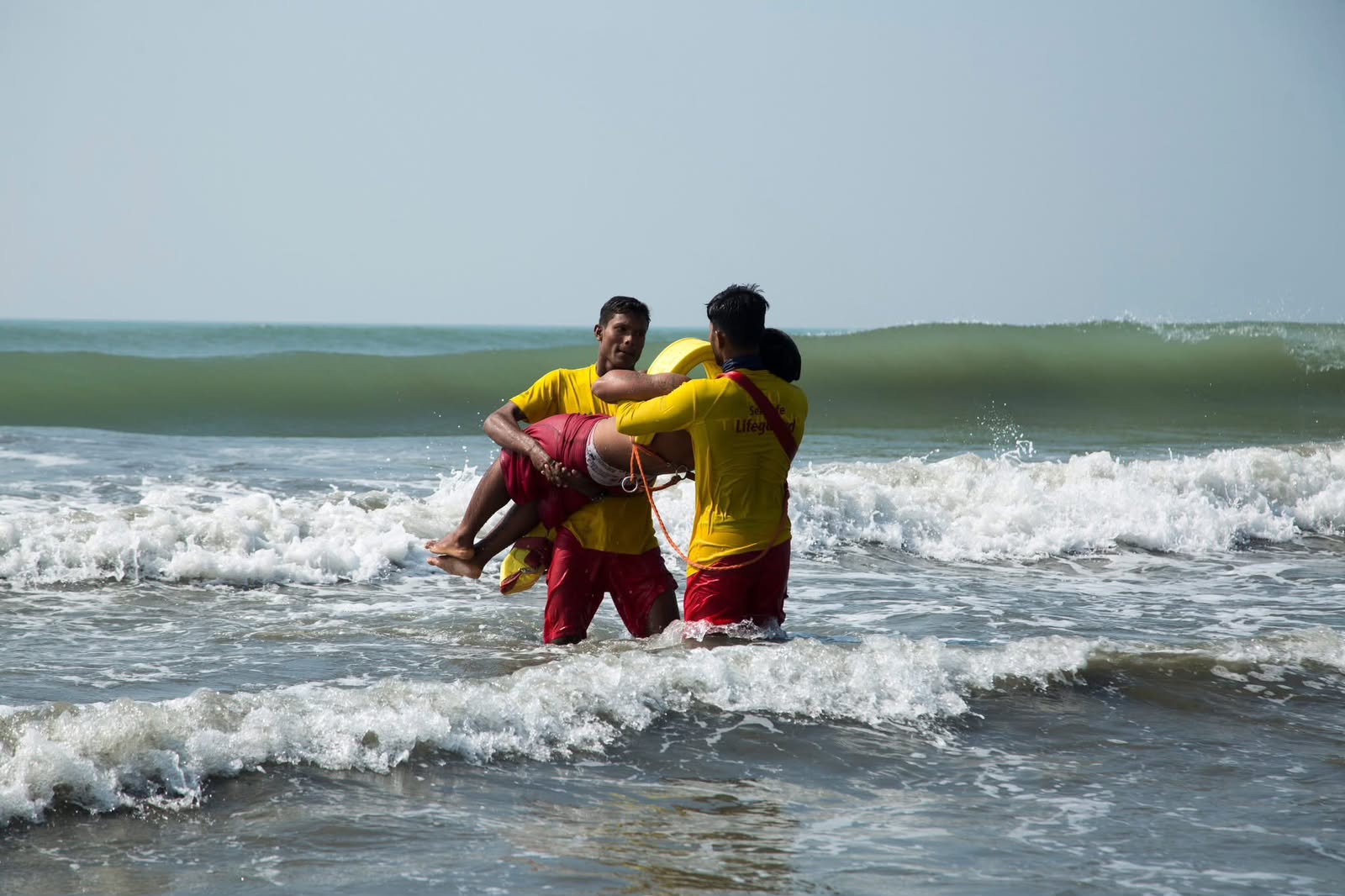
The waves of Cox’s Bazar sea beach may look beautiful, but they can quickly turn deadly, claiming the lives of tourists who enter the water for recreation. The recent deaths of five tourists in the sea off Pechar Dwip near Himchhari have renewed concerns over beach safety, with questions being raised about whether lifeguard coverage and surveillance are adequate amid growing tourist numbers.
According to Sea Safe Lifeguard, 86 people have drowned over the past 12 years in areas outside its coverage, while lifeguards have rescued 1,120 people swept away by the sea during the same period.
The beach has been crowded with tourists during the Durga Puja holidays and weekly break, with swimming continuing from morning until evening at Laboni, Sugandha and Kolatali points. Sugandha has drawn the largest crowds, with more than 100,000 tourists reportedly entering the water there daily, while only eight lifeguards are on duty.
Mohammad Imtiaz Ahmed, project officer at Sea Safe Lifeguard, said the organisation had rescued 1,120 people swept away by the sea over the past 12 years. During the same period, 86 people drowned in areas beyond its coverage. Lifeguards also provided first aid to 104 people, and records show that in 2025 and 2026, they located and reunited 108 missing children with their families.
Statistics show that 10 people drowned in 2015, six in 2016, two each in 2017 and 2018, three in 2019, two in 2020 and three in 2021. The death toll rose to six each in 2022 and 2023, 12 in 2024 and 20 in 2025. Another 14 deaths have been recorded so far in 2026.
The sharp rise in fatalities in 2025 and a series of incidents this year have heightened concerns about the safety of tourists visiting the beach.
Only 27 lifeguards, tourists at risk
Despite crowds stretching along the beach, tourists complain that adequate safety arrangements are not available at every point. Some said they had noticed insufficient lifeguards, warning signals and surveillance in certain areas, forcing them to enter the water without adequate safety support.
Underwater trenches and channels, sudden currents, powerful waves and changing tides can put swimmers at risk, particularly those unfamiliar with sea conditions. Currents can pull even those bathing close to the shore into deeper water. Ignoring lifeguards’ instructions and warning flags further increases the risk of accidents.
Zainal Abedin, a senior member of Sea Safe Lifeguard, said lifeguards were currently deployed at only three points along the beach. Their numbers were inadequate given the large number of tourists entering the sea each day, he said, calling for more lifeguards to be recruited.
He added that lifeguards often had to take sick tourists to hospital and sometimes faced difficult circumstances and hostile remarks while carrying out their duties. Despite these limitations, they continued working to protect tourists, he said, stressing the need for effective government action and support from the relevant authorities.
Tourist Rodela Hasan said people came to Cox’s Bazar from different parts of the world, making it the authorities’ major responsibility to keep them safe. She called for stronger beach security and more lifeguards.
Recent deaths renew safety concerns
In the latest incident, currents swept away several tourists while they were bathing at Pechar Dwip beach near Himchari Museum. Five tourists’ bodies were recovered, while lifeguards, the Fire Service, Coast Guard and Tourist Police took part in rescue operations. A young man who joined the rescue effort also died, according to reports.
Mahbubur Rahman, supervisor of beach workers deployed at Cox’s Bazar beach, said several people from two groups had been swept away while swimming at Himchhari, about 10–12 kilometres from the main beach. One person was rescued alive, while the bodies of missing tourists were subsequently recovered.
He urged tourists to check whether beach workers and lifeguards were available before entering the sea. He said they should never swim in areas without such safety services.
Tourism stakeholders said rescue operations after accidents alone would not prevent further deaths. They called for hazardous areas to be identified, more trained lifeguards to be deployed, continuous surveillance to be ensured and rapid rescue arrangements to be strengthened.
They also stressed the need to deploy additional lifeguards during holidays, when tourist numbers surge, and to increase the availability of rescue equipment.
Other proposed measures include installing warning signs and red flags at dangerous points, making regular public announcements, and sharing safety instructions with tourists. Better coordination among lifeguards, the Fire Service, Coast Guard, Tourist Police and local administration was also deemed necessary.
Authorities and safety workers have urged tourists to follow lifeguards’ instructions, avoid swimming in hazardous areas and deep water, and keep children under close supervision.
Cox’s Bazar is one of Bangladesh’s leading tourist destinations, attracting large numbers of visitors every year. However, failing to ensure their safety risks not only further loss of life but also damage to the tourism industry’s image.
The deaths of 86 people over 12 years, along with recent deadly events, have led to new calls for a full review of beach safety measures. The central question remains: why have lasting solutions yet to emerge despite repeated tragedies?
Ensuring that tourists can enjoy the sea without losing their lives will require effective, sustained measures rather than responses prompted only by individual accidents.
By Mohammad Morshed
Photo: Lifeguard