

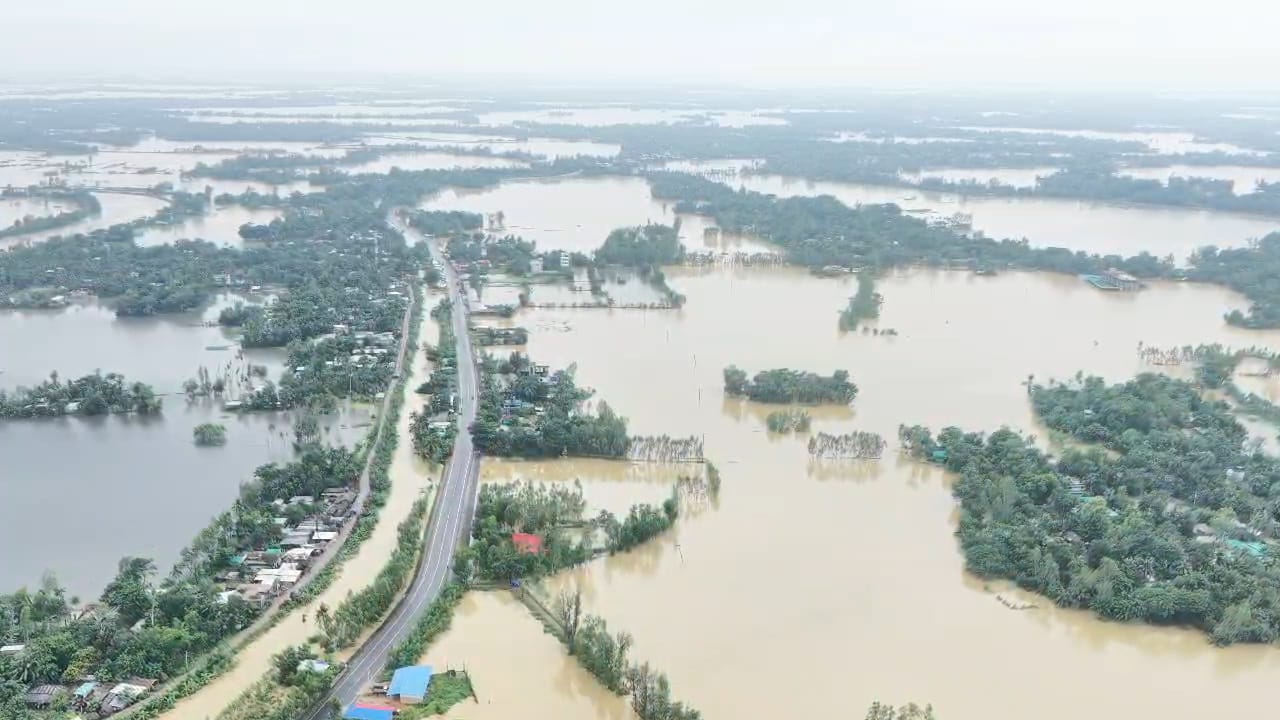
Floodwaters have begun to recede across Cox’s Bazar after two consecutive days of significantly reduced rainfall, bringing some relief to thousands of people stranded by more than a week of torrential rain that has claimed 30 lives.
Although water levels have begun falling in inundated areas and the district’s two major rivers — the Matamuhuri and the Bakkhali — are returning to normal, the humanitarian crisis is far from over. Families returning home are finding widespread destruction, with food stocks, furniture, clothing and household belongings ruined by floodwaters. Many residents also complained that relief assistance had yet to reach their areas.
No rainfall was recorded in Cox’s Bazar on Monday, following only brief showers on Sunday afternoon. As a result, floodwater has gradually drained from low-lying areas, rural roads and residential neighbourhoods.
Assistant Meteorologist Abdul Hannan of the Cox’s Bazar Meteorological Office said only 4 millimetres of rainfall had been recorded in the 24 hours until 3:00pm on Monday, compared with 47 millimetres during the previous 24-hour period.
“There is no forecast of another prolonged spell of heavy rain for now,” he said. “Some rainfall is possible on Thursday or Friday, but it is unlikely to continue for several days.”
River levels fall below danger mark
Executive Engineer Md Nurul Islam of the Bangladesh Water Development Board’s Cox’s Bazar office said water levels in the district’s rivers had dropped sharply over the past two days.
At 3:00pm on Monday, the water level in the Matamuhuri River near Chakaria and Pekua stood at 3.33 metres, well below the danger level of 5.80 metres, he said.
Only two days earlier, at 6:00 am on July 11, the river had reached 6.56 metres, exceeding the danger mark.
“The reduction in rainfall has also reduced upstream flows. As a result, river levels are falling rapidly and floodwaters are receding from surrounding areas,” he said.
He added that authorities were closely monitoring sluice gates and warned that legal action would be taken against anyone found illegally blocking them.
Widespread devastation
According to the district administration’s latest flood situation report, released on July 13, flooding affected 70 of the district’s 71 unions and all four municipalities, inundating nearly 49 per cent of Cox’s Bazar.
The disaster has killed 30 people so far, including a significant number of women and children. Thirteen of the victims were Rohingya refugees, while one person remains missing.
Authorities prepared 618 emergency shelters across the district, with about 1,580 people currently staying in 22 of them.
The floods damaged 1,613 houses and 30 educational institutions. They also destroyed around 1,624 kilometres of earthen roads, 201 kilometres of paved roads, and 220 kilometres of HBB roads, and damaged 79 bridges and culverts.
Relief falls short of demand
The district administration said it had distributed 7,790 dry food packages and 298 metric tonnes of rice among affected families.
Government warehouses currently hold 3,635 additional food packages and 233 metric tonnes of rice.
However, officials estimate that the district still requires about 57,000 food packages, Tk 249 million in emergency funding, 530 metric tonnes of rice, 4,883 bundles of corrugated iron sheets and 95,000 water purification tablets to meet humanitarian needs.
Nine days of rain nearly equal July average
The district administration said Cox’s Bazar normally receives around 924 millimetres of rainfall throughout July. Between July 4 and July 12 alone, however, the district recorded 823 millimetres of rain, with exceptionally heavy rainfall combined with upstream runoff triggering the devastating floods.
Recovery remains a long way off
Despite improving conditions, many families say the worst is not over.
Returning to his home in Lakkhyarchar of Kakara union, Nurul Islam found nearly everything destroyed.
“We fled to save our lives because floodwater had risen to neck level. Three days later we came back and found our furniture, important documents and stored rice completely ruined. We don’t know how to start again,” he said.
Another flood victim, Mohammad Bappi, said the flood had swept away almost everything his family owned.
“The current was extremely strong. We returned after four days to find our house devastated. Furniture, food, children’s books — everything has been destroyed. We rushed to a shelter with our eight-member family to survive. We haven’t received any assistance from either the government or any private organisation,” he said.
Residents in several flood-hit areas alleged that relief supplies had yet to reach many affected communities. The district administration, however, said government assistance would be distributed to all eligible victims in phases.
Government pledges continued support
State Minister for Disaster Management and Relief M Iqbal Hossain said the government would continue providing food, medical care and other essential assistance until the crisis subsides.
Speaking to reporters after distributing relief at a shelter in Ghunia village of Chakaria’s Fasiakhali union on Sunday, he said no flood victim would be left out of government assistance.
“The government will provide whatever support is necessary for as long as people remain affected. Additional allocations will be made whenever required,” he said.
He added that the government was also preparing plans for post-flood rehabilitation, infrastructure repair and the recovery of affected families.
By Abdur Rashid Manik
Photo: Collected