
The government is planning to build another international airport in Cox’s Bazar in response to the expected growth in international air passenger traffic, Civil Aviation and Tourism Minister M Rashiduzzaman Millat said on Saturday.
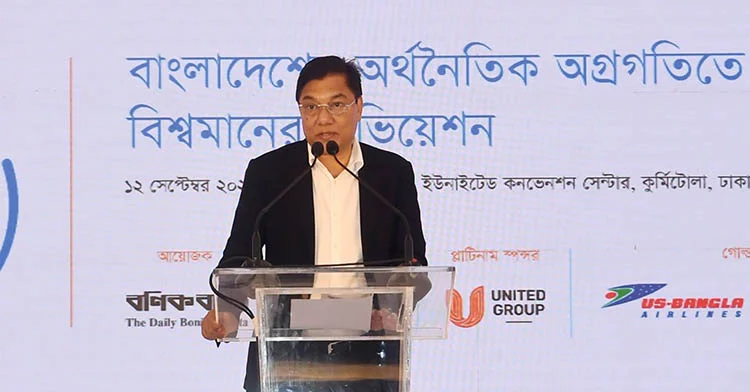
Speaking at a policy dialogue titled “World-class aviation for Bangladesh’s economic progress”, the minister said annual international passenger numbers in Bangladesh could exceed 24 million in the future and potentially reach 30 million.
“More international aircraft will come to Bangladesh in the future. There will not be enough space for all aircraft at the existing airports. We will have to think about a new airport,” he said.
Daily Bonik Barta organised the policy dialogue at the United Convention Centre in Kurmitola, Dhaka, on Saturday afternoon. It brought together policymakers, aviation experts, diplomats, entrepreneurs and representatives of local and international organisations to discuss the prospects, challenges, investment opportunities, infrastructure development and policy reforms needed for the country’s aviation sector.
As the chief guest, Millat said the government wanted to develop Bangladesh as an aviation hub.
He said airport and cargo facilities would need to meet international standards, while aircraft turnaround time — the period between landing and the next take-off — should be reduced to 25 minutes.
“Bangladesh also needs to develop a system that can provide services at lower costs,” he said, calling for greater participation by the private sector and foreign investors in the aviation industry.
The minister said the government had initiated steps to amend the 42-year-old civil aviation regulations, which he said had created obstacles for stakeholders in the sector.
“The government’s goal is to create opportunities for stakeholders and develop Bangladesh as an aviation hub,” he said, adding that the government was focusing on international-standard airports, passenger and cargo facilities and expansion of the country’s aircraft fleet.
Foreign Affairs State Minister Humayun Kabir, speaking as a special guest, said Bangladesh would need to increase its aircraft fleet, ensure international-standard ground handling, expand routes and flight frequencies and improve cargo transportation capacity to become a regional aviation hub.
He also stressed the need to establish aircraft repair and maintenance facilities and local training centres to produce a new generation of pilots, airline engineers and ground staff.
Kabir described the third terminal at Hazrat Shahjalal International Airport as a major opportunity for the country’s aviation sector.
He said discussions by the government-formed committee on the terminal had progressed rapidly and that the process of finalising the agreement in the national interest was nearing completion. Bangladesh’s share of revenue under the proposed arrangement would be significantly higher than under the previous system, he said.
Kabir stated that the terminal might have a soft opening in December and become fully operational by March or April. It would have the capacity to handle 12 million passengers a year.
He said Bangladesh should seek to tap the potential of the international aviation market, estimated at Tk700 billion, by expanding connectivity with East Asia, including China, Japan and South Korea, and strengthening regional connectivity with South and Southeast Asia.
Abdullah Al Mamun, managing director of US-Bangla Airlines and US-Bangla Group, highlighted several major challenges facing the country’s aviation industry.
He said airlines had to pay various taxes and charges, which increased ticket prices and reduced their business capacity. Aircraft also had to spend long periods taxiing on airport runways, adding fuel costs.
He alleged that airline operators’ requirements and views had not been adequately considered before major infrastructure projects, including the third terminal, were undertaken.
He said policy complexities related to ground handling, aircraft parts imports, and maintenance were also contributing to higher business costs.
To help Bangladeshi airlines compete with carriers from neighbouring countries, Al Mamun called for reducing the tax and charge burden on airlines, reforming policies and improving coordination with operators.
Presenting the keynote paper on “World-class aviation for Bangladesh’s economic progress”, former Civil Aviation Authority of Bangladesh chairman Air Vice Marshal (retd) Mahmud Hossain said the biggest crisis facing Bangladesh’s aviation sector was not aircraft but a shortage of skilled manpower.
He said demand for aviation services was increasing, but Bangladesh faced shortages of pilots and licensed aircraft maintenance engineers.
He said a lack of infrastructure for pilot training, declining training-institution capacity, and various regulatory barriers prevent the country from producing the required workforce.
For sustainable sector development, Hossain stressed building an integrated aviation ecosystem involving the regulator, airlines, educational institutions, and entrepreneurs, alongside developing skilled manpower.
Air Commodore Nur-E-Alam, member (ATM) of the Civil Aviation Authority of Bangladesh, said initiatives were being taken to improve Cox’s Bazar Airport and gradually bring unused or underutilised airports back into operation alongside launching the third terminal at Hazrat Shahjalal International Airport.
He said Bangladesh currently had air service agreements with 56 countries. Thirty-four foreign passenger airlines, seven cargo airlines, and four domestic airlines operated regular flights in the country.
The third terminal would significantly increase passenger-handling capacity at Hazrat Shahjalal International Airport, he said.
He added that feasibility studies were being conducted for unused or underutilised airports in Bogura, Lalmonirhat, Thakurgaon, Ishwardi, Shamshernagar and Cumilla.
According to Nur-E-Alam, expanding the capacity of these facilities and utilising investment opportunities would be essential to meet future demand.
KM Mojibul Haque, chairman of the Board of Trustees of the University of Asia Pacific, and Dhaka Bank chairman Abdul Hai Sarker also spoke at the dialogue.
Bonik Barta Editor and Publisher Dewan Hanif Mahmud moderated the event.
Air Asia was the event’s principal partner, while United Group was the platinum sponsor.
Cox’s Bazar Life Desk