
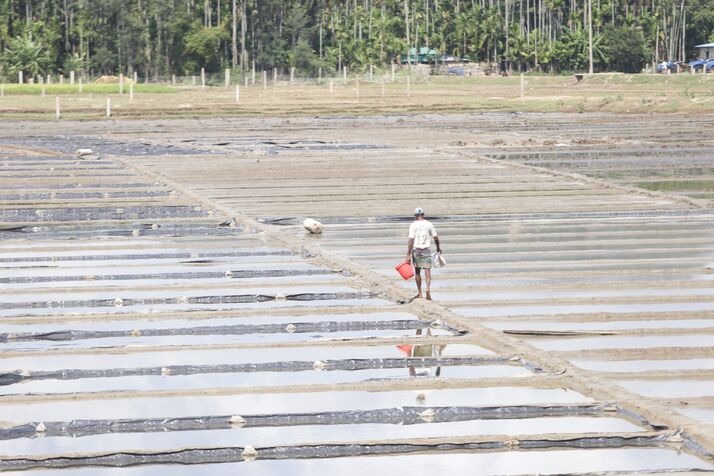
Vast salt fields in Cox’s Bazar have been severely damaged by two days of Kalbaishakhi (Nor’westers) storms accompanied by strong winds and heavy rainfall. The adverse weather that swept through the region on the nights of April 7 and 8 has caused significant losses for marginal salt farmers, as large quantities of harvested and semi-processed salt dissolved in rainwater.
According to farmers, salt fields in several areas were affected, including Chowfaldandi and Eidgaon in Cox’s Bazar Sadar; Magnama and Rajakhali in Pekua; Kutubjom and Bara Moheshkhali in Moheshkhali; and wide stretches of Kutubdia.
The sudden rainfall melted the crystallised salt—often referred to as “white gold”—while prepared salt beds were also damaged, requiring at least five to seven days to resume production.
Liaquat Ali, a salt farmer from the Shatghona area in Magnama, said he had been working tirelessly toward the end of the season in hopes of higher returns. “But just an hour of rain washed away several hundred maunds of salt. Now we have to rebuild the fields, which is very costly,” he said.
Manjur Alam, a farmer from the Koriardiya area in Uzantiah, echoed similar concerns. “Salt prices are already low. This storm has wiped out everything. I took loans to lease the fields—now I don’t know how I will repay them,” he said.
Another farmer, Anchar Ullah from Harighona in Bara Moheshkhali, said that a short spell of rain destroyed hundreds of maunds of salt, adding to their financial burden. Gias Uddin, a farmer from Ghotivanga in Kutubjom, said they were already struggling due to low market prices. “Now everything is gone. Managing the loan burden has become a major concern,” he added.
The Bangladesh Small and Cottage Industries Corporation estimates the country’s salt demand for the 2025–26 season at around 2.715 million metric tonnes. To meet this demand, more than 41,000 farmers are engaged in salt cultivation across nearly 69,000 acres of land in Cox’s Bazar and Banshkhali in Chattogram.
In Moheshkhali alone, about 17,000 acres of land are under salt cultivation this season, producing an average of 250,000 to 350,000 metric tonnes in favourable weather—accounting for roughly 25 percent of the country’s total production.
Deputy General Manager of the Cox’s Bazar Salt Industry Development Office under BSCIC, Md. Jafar Iqbal Bhuiyan, said that several thousand acres of salt fields have been affected by the recent rainfall. “Due to dilution of saline water, farmers will need additional labour and fuel to restart production. This has created uncertainty over achieving the national production target,” he said.
Farmers noted that while the production cost per maund of salt ranges between Tk 250 and Tk 280, they have already been incurring losses due to low market prices. The recent storm has further aggravated their situation, making recovery even more challenging by damaging crops and infrastructure and increasing financial strain on farmers.
By Abdu Rashid Manik
File Photo