
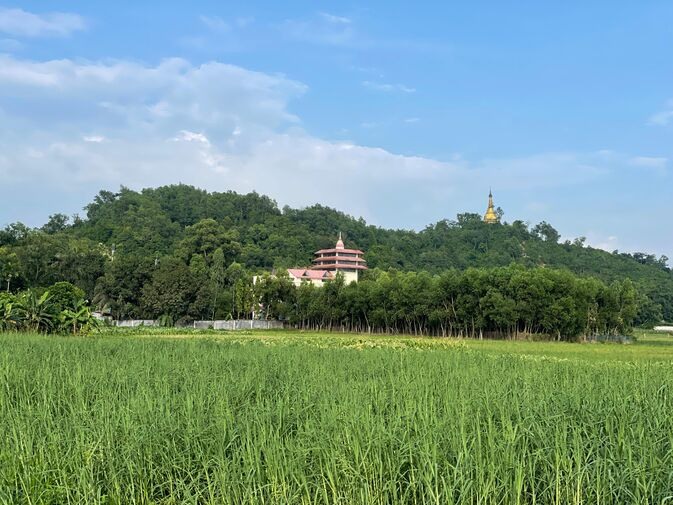
Green stretches in every direction. The Bakkhali River flows below, while paddy fields, hills, and rows of trees form a vast landscape in the distance.
As the winding path gradually climbs the hill, a different scene unfolds.
Standing atop a hill nearly 300 feet high, an ancient Buddhist monument rises from the heart of the green landscape like a witness to history.
About two kilometres from Ramu upazila headquarters, along the banks of the Bakkhali River and along a winding road, lies Jadipara on the Ramu-Naikhongchhari road. From a distance, the hill beside the road rises above the surrounding landscape.
At its summit stands Laoe Zadi, also known as Laoe Pagoda, believed to be around 250 years old. The hill came to be known as Jadi Pahar, or Pagoda Hill, and the surrounding area gradually became known as Jadimura.
Located in Kauarkhop union of Ramu, the zadi is more than an ancient monument. With its hilltop setting and surrounding landscape, it also attracts nature lovers and tourists.
From the top, Ramu’s sprawling green landscape unfolds in almost every direction. The Bakkhali winds through the landscape on one side, while paddy fields and tree-lined villages stretch across the other. On a clear day, Cox’s Bazar town can also be seen in the distance.
Standing there, with the wind blowing and the landscape below, it’s easy to pause and take in the place’s quiet beauty.
This blend of nature and history isn’t found everywhere. For those looking to escape the bustle of daily life and spend time amid the silence of green hills, Jadimura could be a distinctive destination.
The landscape becomes particularly striking during the monsoon, when the hills turn deeper green. Paddy fields, trees, and the river come together to give the area a different character.
Laoe Zadi in the pages of history
Alongside its natural beauty, Laoe Zadi carries a history stretching back several centuries. According to local accounts, the zadi was built in 1710 during the reign of Arakan king Chandra Bijaya. However, accounts of its construction and history differ.
Lawyer Shirupan Barua, who has long researched the zadi, said Burmese King Bodawpaya captured Arakan in December 1784. The last independent king of Arakan, Maha Thamada, was taken prisoner. At the same time, his younger brother Laoe Murong crossed the Naf River and sought political asylum from the East India Company in Teknaf.
Angered by the shelter given to Laoe Murong, King Bodawpaya sent troops to Teknaf around January 1794 to capture him, according to Barua. Laoe Murong then fled towards Ramu with his family.
A British military camp was also in Ramu at the time. A report by Captain Hiram Cox reportedly mentioned Laoe Murong leaving Teknaf and moving further north.
Against this historical backdrop, it is believed that there may be a connection between the construction of the zadi and the period when Laoe Murong took shelter in Ramu.
A monument at risk of disappearing
Despite standing for centuries as a witness to history, Laoe Zadi is now facing the risk of deterioration. The ancient monument has gradually fallen into disrepair due to a lack of proper conservation and restoration.
Resident Pulak Barua said the historic structure that gave the hill and surrounding area its name was now being neglected.
“If the zadi is restored and the hill is protected, it could create new tourism opportunities here,” he said.
Local elderly resident Mozzafar Ahmed said generations of his family had heard about Laoe Zadi’s history and heritage from their ancestors.
He said the monument was deeply connected to Ramu’s history and culture. Preserving it could support education, research, culture, and tourism.
Could Jadimura become a new tourism destination?
Cox’s Bazar is known not only for its sea beach. Its hills, rivers, forests,s and history are also important tourism assets, and Jadimura could show how these elements can come together in one place.
An ancient Buddhist monument on a hilltop, a river below, lush greenery all around, and a distant view of the town give Jadimura considerable tourism potential.
Realising that potential, however, would require planned initiatives. Conserving the ancient zadi, protecting the hill, improving access roads, providing safe climbing arrangements, and adding basic tourist facilities could help turn Jadimura into one of Ramu’s notable attractions.
Amid the surrounding natural beauty, Laoe Zadi is more than an old pagoda. It is a living reminder of Ramu’s past.
Standing silently atop the green hill, it has witnessed centuries of change. Now it needs protection and preservation.
Perhaps one day, tourists will travel from far and wide to experience the meeting point of history and nature here — to see the Bakkhali River, the green landscape of Ramu, and Cox’s Bazar town in the distance.
Then Jadimura may come to be known not merely as the name of a locality, but as a distinctive destination where the history and natural beauty of Cox’s Bazar meet.
By Abdur Rashid Manik
Photo: Abdur Rashid Manik