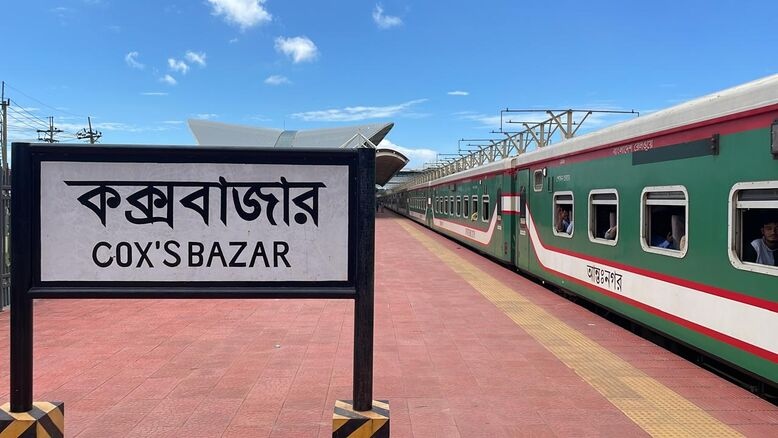
The Mahanagar Express has received a strong response from passengers since its route was extended to Cox’s Bazar, earning Tk2.07 crore in its first 14 days while carrying more than 54,000 passengers.
According to Bangladesh Railway ticket sales data, the intercity train earned Tk2,06,95,565 from 54,479 passengers during the first two weeks of operation on the Dhaka-Cox’s Bazar route.
The train’s destination was extended from Chattogram to Cox’s Bazar on October 26, creating a direct rail link to the coastal tourist city for passengers from Dhaka as well as Narsingdi, Brahmanbaria, Cumilla, Feni and other areas along the route.
Revenue in the first 14 days was nearly 88 per cent of the Tk2.36 crore the train earned throughout September on its previous Dhaka-Chattogram route. In September, the train carried 84,604 passengers and earned Tk2,36,08,922.
Railway data showed that 29,380 passengers travelled from Cox’s Bazar to Dhaka on Mahanagar Express train 721 during the first two weeks, generating Tk1,02,70,000 in revenue. On the Dhaka-Cox’s Bazar route, train 722 carried 25,099 passengers and earned Tk1,04,00,000.
The route extension has particularly benefited passengers from districts between Dhaka and Chattogram. Previously, Cox’s Bazar Express and Tourist Express ran directly from Dhaka to Cox’s Bazar without stopping at most intermediate stations, limiting direct rail access for passengers from those areas.
Mahanagar Express now stops at several stations in Narsingdi, Brahmanbaria, Cumilla, Feni and Chattogram, creating a new direct travel option for passengers from these districts.
Station-level data showed that 8,392 passengers boarded the train at Chattogram during the first two weeks, while 2,686 boarded at Feni, 4,125 at Cumilla and 2,718 at Bhairab Bazar. Together, the four stations accounted for 17,921 passengers.
Hafizur Rahman, a Feni resident, said the new service had made travel to Cox’s Bazar much easier.
“Previously, there was no direct train from Feni to Cox’s Bazar, so we had to rely on other modes of transport. Now we can travel directly by train, which is particularly convenient when travelling with family,” he said.
Obaidur Rahman, a resident of Cumilla, said the service had created another option for people looking to avoid road congestion and long journeys.
“Many people prefer trains to avoid traffic congestion and the hassles of long road journeys. But ticket availability needs to be ensured according to passenger demand,” he said.
Sujit Kumar Biswas, chief commercial manager of Bangladesh Railway’s Eastern Zone, said passenger demand on the Cox’s Bazar route was high and the Mahanagar Express had received a positive response in both passenger numbers and revenue.
“There is strong demand on the Cox’s Bazar route. If more trains are introduced, passengers will be available and railway revenue will increase,” he said.
He said trains on the route were currently operating at full capacity, with some passengers even travelling standing.
“Previously, Mahanagar Express generated around Tk8 lakh a day. Now its daily revenue has risen to Tk14–15 lakh,” Biswas said.
Railway officials said four pairs, or eight trains, previously operated on the Cox’s Bazar route. With the addition of Mahanagar Express, the number has increased to five pairs, or 10 trains.
Officials said growing passenger demand has also strengthened the possibility of introducing more trains on the route in the future.
Cox’s Bazar Life Report
Cox’s Bazar Life Photo