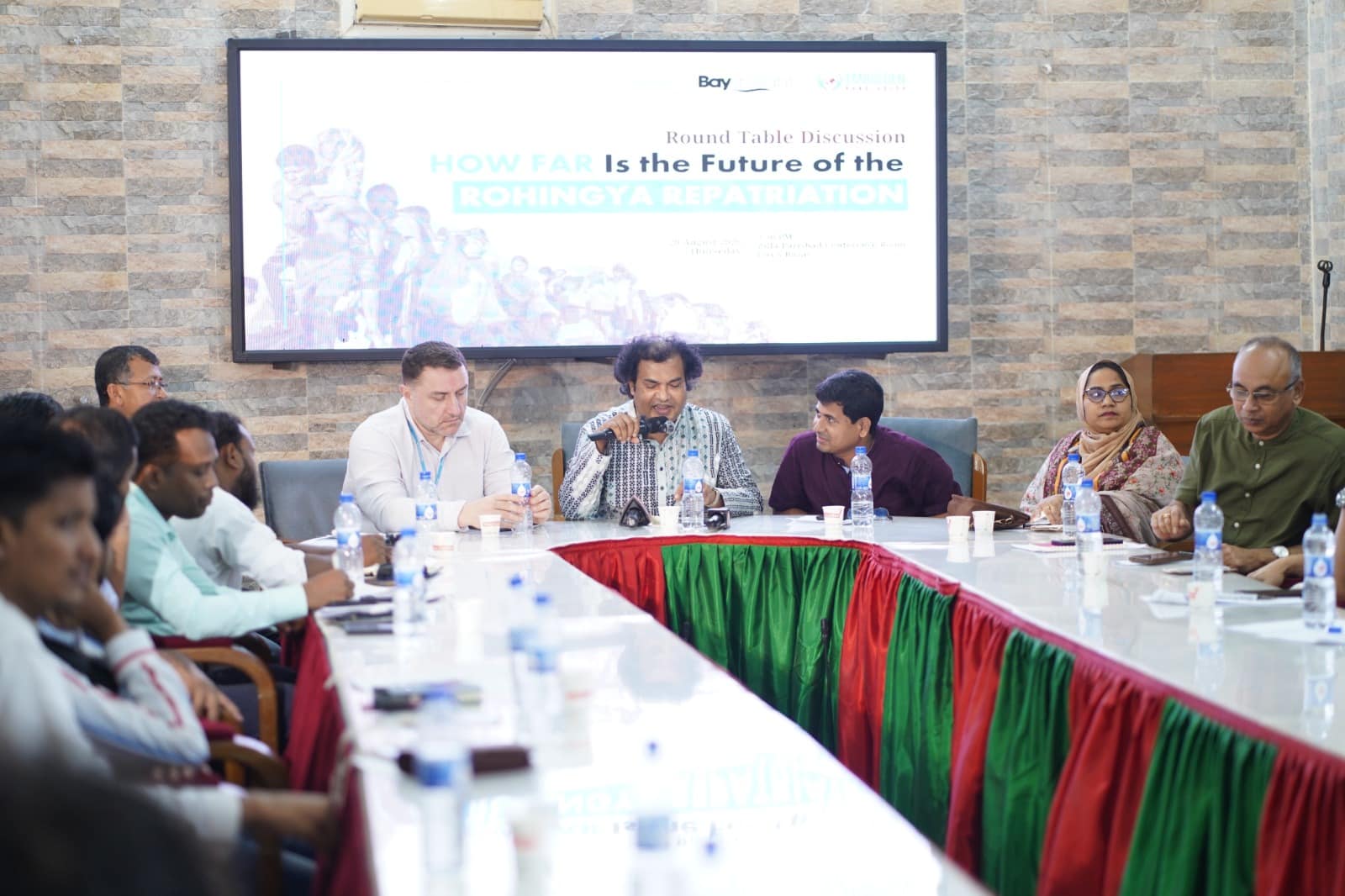
Nine years into the Rohingya crisis, there is still no clear roadmap for their repatriation to Myanmar, speakers said at a roundtable discussion in Cox’s Bazar on Thursday.
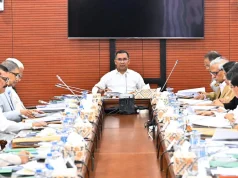
The discussion, titled “How Far Is the Future of Rohingya Repatriation?”, was organised jointly by Bay Insight and Embolden Bangladesh at the Cox’s Bazar District Council auditorium.
The discussion focused on the ongoing conflict in Myanmar, the changing political and military situation in Rakhine State, questions surrounding Rohingya identity and citizenship, and the protracted refugee crisis.
Refugee expert and University of Chittagong anthropology professor Dr Rahman Nasir Uddin was the keynote speaker. Government officials, UN representatives, development organisations, civil society members, local representatives and Rohingya representatives also took part.
Speakers said repatriation remained the most sustainable solution to the Rohingya crisis, but it could not be achieved through declarations or diplomatic talks alone.
A clear strategic plan, consideration of the current situation in Myanmar, engagement of regional and international powers, and guarantees of security, citizenship and dignity for the Rohingya were essential.
Syed Ullah, president of the United Council of Rohingya, said repatriation required specific steps and actions that called for a strategic plan.
“Repatriation cannot be achieved through words alone. Since 2018, we have been hearing that repatriation will happen today or tomorrow. But we have seen no reflection of those words in reality,” he said.
He said future action should be based on the prevailing situation, taking into account changes in national and global policies as well as Myanmar’s policy direction.
“The Rohingya crisis is not only Bangladesh’s problem. First, it is Myanmar’s problem, then Bangladesh’s and, thirdly, a problem for other countries as well,” he said.
Syed Ullah also expressed concern over Myanmar’s continued portrayal of the Rohingya as “Bengalis”, saying Myanmar was attempting to create an international perception that the Rohingya were originally from Bangladesh.
“The Rohingya should not be treated as part of any political game; they should be treated as human beings. We are not putting any pressure on Bangladesh. We only want peace,” he said.
Rohingya youth leader and president of the Arakan Football Federation Mujibur Rahman said the Rohingya crisis was not Bangladesh’s problem alone but an international and global issue.
He said no repatriation plan could be formulated without taking into account the current reality in Rakhine, or Arakan.
According to him, the Arakan Army currently controls around 90 per cent of the area in Arakan.
He called for necessary agreements and initiatives involving regional powers such as China and India to facilitate repatriation.
Mujibur also criticised recent statements from Myanmar that he said portrayed the Rohingya in a derogatory manner.
“We are not beggars. We are people of Arakan, the homeland of our fathers, grandfathers and generations before us,” he said.
He expressed deep concern over the positions of Myanmar and the Arakan Army towards the Rohingya and urged Bangladesh to ensure that anti-Rohingya sentiment did not grow among the host community.
Rahman Nasir Uddin said repatriation was the best solution, but refugees could not be sent back without first creating conditions conducive to a safe return.
He said any repatriation plan should take into account the current control structure in Rakhine and the capacity of Myanmar’s central government.
He stressed the need to guarantee Rohingya citizenship, security, land and property rights, social protection and human dignity.
“Having come here to escape death, should we now jump back into the face of death?” he asked, saying repatriation could not be implemented without answering that question.
Marcel Collun, head of UNHCR’s Cox’s Bazar sub-office, said the Rohingya wanted to return but there was still no concrete plan for how repatriation could be carried out.
He identified an end to the ongoing conflict in Myanmar as the first condition for repatriation. This would have to be followed by guarantees of security, access to their places of origin, land and property rights, and citizenship or basic rights.
He said establishing these conditions could take several more years. Therefore, Bangladesh also needed a long-term plan for the Rohingya living in the country while efforts towards repatriation continued.
He also stressed the need for a national refugee policy or framework for Bangladesh.
Additional Refugee Relief and Repatriation Commissioner Nazmul Islam Bhuiyan said prolonged crises such as the Rohingya issue required coordinated discussions among the administration, researchers, Rohingya representatives, development agencies and host communities.
He called for concrete recommendations from such discussions to be presented to policymakers.
Development worker Fariha Hossain said the nine-year-old Rohingya crisis could not be viewed solely through the lens of emergency humanitarian assistance.
She called for the views and experiences of the Rohingya themselves to be given greater weight when decisions about their future were made.
“Instead of making decisions about the Rohingya, we need to develop a culture of making decisions with them,” she said.
Cox’s Bazar Civil Society president Abu Morshed Chowdhury Khoka said the interests of local communities, which had been bearing the impact of the crisis for years, must also be considered alongside the urgency of repatriating the Rohingya.
“Repatriation is not simply about sending people across the border. There must be a guarantee that they can return with dignity,” he said.
He also stressed the need to maintain international attention on the crisis and ensure continued international support for the Rohingya.
BRAC adviser Subrata Chakraborty said internationally recognised solutions to refugee crises included repatriation, local integration and third-country resettlement.
As there was little practical scope for local integration in Bangladesh, he called for third-country resettlement opportunities to continue, even on a limited scale, alongside repatriation efforts.
“Even if the number is small, resettlement in a third country can change the future of a family,” he said.
Local representative Helal Uddin said prolonged coexistence between the Rohingya and host communities had created tensions and distance between the two communities for various reasons.
He also said divisions within the Rohingya community and conflicts among different groups were negatively affecting their overall image.
He called for greater unity among the Rohingya and urged that their own voices be given importance in planning for repatriation and their future.
Speakers at the discussion said that until conditions for repatriation were established, the Rohingya should not be deprived of education, skills development and livelihood opportunities.
Keeping an entire generation dependent solely on humanitarian aid after years in the camps would make their future even more uncertain, they said. At the same time, long-term planning should take into account the economic and social realities of local communities.
Speakers at the discussion called for a clear and strategic roadmap for Rohingya repatriation, taking into account the current political and military realities in Myanmar. They stressed the need for fresh diplomatic initiatives and greater engagement from China, India and other regional powers, as well as the wider international community.
They also called for guarantees of security, citizenship, land and property rights and dignity for the Rohingya before any repatriation takes place. Speakers stressed that Rohingya representatives should have a meaningful role in policymaking concerning their future.
Until repatriation becomes possible, the Rohingya should be provided with greater access to education, skills development and livelihood opportunities rather than being kept dependent solely on humanitarian assistance, they said.
The speakers also emphasised the need to protect the interests of host communities and ensure their participation, while keeping third-country resettlement opportunities open where necessary.
They further called for Bangladesh to formulate a long-term national refugee policy or framework to address the protracted Rohingya crisis.
The discussion concluded that repatriation remained the sustainable solution to the Rohingya crisis. But nine years after the mass displacement, simply saying that “repatriation will happen” is no longer enough. What is needed is a clear strategy based on ground realities, regional and international support, and firm guarantees for the safe and dignified return of the Rohingya.
Government officials, representatives of UN agencies and national and international development organisations, journalists, researchers, local representatives and members of the Rohingya community also attended the event.
Cox’s Bazar Life Report
Photo: Courtesy