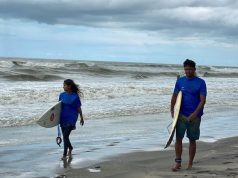

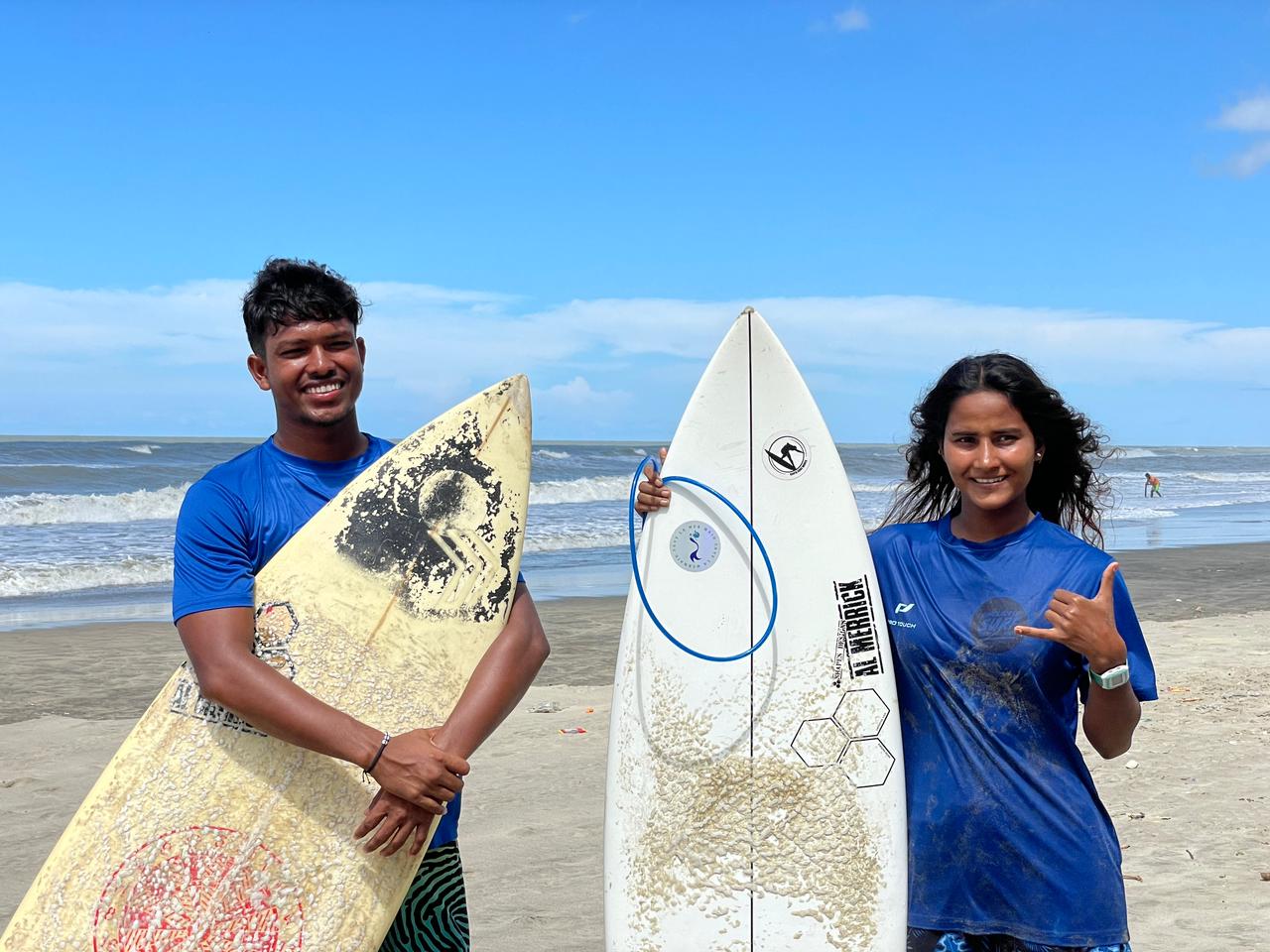
The morning sea is bright under the sun as Fatema Akter spends hours riding the waves off Cox’s Bazar. When the training session ends, the 16-year-old surfer returns to the Surf Girls and Boys Club beside the beach, takes a shower and walks to a small shop nearby.
There, her meal is often little more than tea and bread, or a couple of samosas.
This is how Bangladesh’s first female surfer to compete at the Asian Games is preparing for the biggest sporting stage of her young career.
Like Fatema, other local surfers often rely on inexpensive snacks after training. The food may ease their hunger, but it does little to meet the nutritional and calorie demands of hours of physically demanding surfing.
One Saturday, Fatema finished her morning session exhausted. It was around noon, but she had not even changed out of her surfing clothes. She soaked pieces of bread in tea and ate them.
“After surfing, we usually have tea and bread, or one or two samosas. We have no sponsors and receive no government support,” Fatema said with a smile.
She said she often comes to training without having eaten properly in the morning.
Fatema travels about four kilometres from Badshahghona in Cox’s Bazar town to the club near the pine forest, slightly north of Laboni Point. It was there that she began her journey as a surfer.
She first came to Cox’s Bazar beach to learn surfing in Class Three after hearing about the sport from friends. The first time she stood on a board, she fell into the water and cried.
After several days of training, her mother’s pressure and criticism from others forced her to stay away from surfing for nearly two weeks. But she eventually returned to regular training.
The day she finally managed to stand on the board was unforgettable.
Fatema grew up without her father. Her mother supported the family by working in other people’s homes. While working, her mother heard various comments about her daughter’s surfing and initially asked her to stop.
Fatema, however, remained determined.
“I had to listen to many things in the beginning. People would ask what I would gain from surfing and say that I would eventually have to get married anyway,” she said.
“Some of my friends also behaved as if surfing was something bad.”
But Fatema refused to give up.
“I know surfing is a good sport. Through this sport, we can present Bangladesh to the world and bring a good name to the country. So, for the past seven years, I have continued despite everything and ignored what people said,” she said.
Her participation in an Asian championship in India further strengthened her confidence.
“I was extremely happy to compete in India. It made me more interested in surfing. I want to build a career in this sport,” she said.
Fatema also wants government and private support for her club, saying more girls are interested in surfing but many leave the sport because they see few career prospects.
“Besides me, there are other female surfers. If they can build their future and careers through surfing, Bangladesh will be able to go much further,” she said.
Mahima Akter Mili, Fatema’s friend and another female surfer who has competed in an Asian championship, said many young people start surfing but eventually drop out because they see no secure future in the sport.
“Some eventually get married and start families. Despite so many obstacles, Fatema stayed on and has now reached the Asian Games,” she said.
Fatema’s equipment tells another part of the story.
The surfboard she uses every day is second-hand. She said she can use a single board for up to two years.
“Our coach Rashed brings used surfboards and other equipment from friends abroad and has built the club with those resources,” she said.
Mohammad Mannan, 20, a four-time national surfing champion, is facing similar challenges.
Mannan, who has been surfing for 14 years, has competed several times in Asian championships in the Maldives and India. He qualified for the Asian Games after winning the national surfing competition.
He said Bangladeshi surfers have to compete with old equipment while surfers from other countries train with newer boards and equipment.
“We have to surf very carefully so that the board does not break. We cannot afford to buy new boards because they are expensive,” Mannan said.
“Government support or sponsorship could help us perform much better.”
Mannan also sells seashells to help support his family.
Despite the shortages, Fatema and Mannan have secured their places at the Asian Games, where surfing is making its debut in the competition programme. The Aichi-Nagoya 2026 Asian Games will be held in Japan from September 19 to October 4, while the surfing competition is scheduled for September 25–28 at Pacific Long Beach in Tahara, Aichi.
Fatema will compete in the women’s event and Mannan in the men’s event, marking Bangladesh’s first participation in Asian Games surfing.
But even at this historic moment, Bangladesh’s surfing team is facing another problem — the absence of their regular coach.
Rashed Alam, the surfers’ longtime coach and president of the Surf Girls and Boys Club, won’t go to Japan with the team. Instead, an official of the Bangladesh Surfing Association has been selected to accompany the athletes.
Fatema and Mannan said they were disappointed with the decision.
According to them, their coach understands their surfing techniques, as well as the waves, weather, and sea conditions, and can guide them during competition. They said they have never trained with the official selected to accompany them and questioned how he would guide them at an international competition.
Bangladesh Surfing Association focal person Saifullah Sifat, however, said the association made the decision and defended his selection.
He said the team needed someone who understood different aspects of surfing. According to him, the coach lacked some of the necessary skills, while he had experience in various aspects of the sport.
The association’s general secretary, Moazzem Hossain Chowdhury Rukon, could not be reached by phone despite several attempts to contact him for comment.
Rashed Alam said the surfers were trying their best despite limited equipment and inadequate facilities. But he was concerned about their performance at the Asian Games without a coach.
“Other countries are going to the Asian Games with full teams, including coaches, while Bangladesh’s surfers are being sent without their coach. This naturally raises concerns, particularly about the performance of the male surfer,” he said.
Equipment remains another major challenge.
Bangladeshi surfers are preparing for international competition with second-hand equipment, while athletes from other Asian countries compete with newer, more modern gear.
Rashed believes greater government support, quality equipment, nutritious food for surfers and a modern surfing club could significantly improve Bangladesh’s prospects in the sport.
For now, however, Fatema and Mannan continue to train in the waves of Cox’s Bazar with limited resources.
Tea and bread may not be enough to fuel an international athlete, and second-hand boards may not match their rivals’ equipment.
Yet the two surfers are heading to Japan with a chance to make history for Bangladesh — carrying their dreams from the waves of Cox’s Bazar to the Asian Games stage.
By Abdur Rashid Manik
Photo: Abdu Rashid Manik