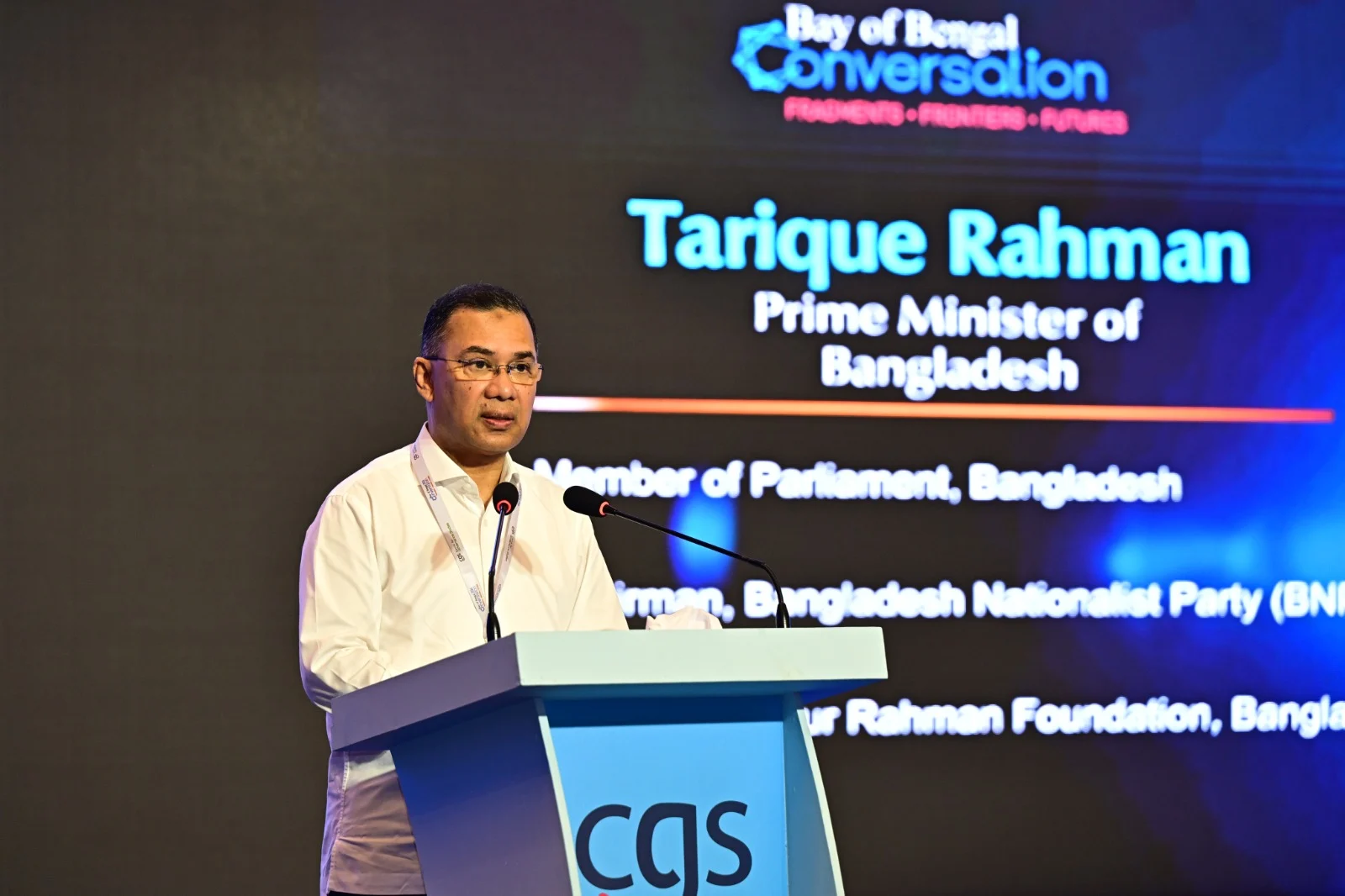
A master plan is being prepared for the Teesta River to improve water conservation and management, Prime Minister Tarique Rahman said on Saturday, highlighting water security and climate resilience as key priorities of his government.
He said the government was also planning to excavate 20,000 kilometres of canals and waterways over the next five years as part of its broader water management initiatives.
The prime minister made the remarks while addressing the inaugural session of the three-day international conference ‘Bay of Bengal Conversation (BOBC) 2026’, organised by the Centre for Governance Studies at the Pan Pacific Sonargaon Hotel in Dhaka.
“The Padma Barrage project is being advanced and a master plan for the Teesta is being prepared for water conservation and management,” Tarique said.
He said the initiatives would support agriculture while strengthening Bangladesh’s climate resilience.
Describing agriculture as a mainstay of the economy, the prime minister said the government was making access to technology, irrigation, agricultural finance and markets easier for farmers.
He said the government would also support fisheries, livestock and rural entrepreneurs, while agricultural processing and agro-product export industries would be developed alongside efforts to ensure food security.
“A strong rural economy can build a strong Bangladesh,” he said.
The prime minister said water security was important for both agriculture and climate resilience and that the planned excavation of 20,000 kilometres of canals and waterways over the next five years would contribute to that goal.
The government is also advancing the Padma Barrage project and preparing the Teesta master plan, he said.
Tarique also said the government planned to plant 250 million trees over the next five years, expand solar power use, promote waste recycling and encourage environment-friendly green factories.
The prime minister said Bangladesh’s large young population, geographical position and natural resources offered significant opportunities for economic development. He also highlighted the potential of the Bay of Bengal in shipping, fisheries, tourism, energy and regional supply chains.
He called for deeper regional cooperation in trade, energy, education, technology, climate and maritime affairs, saying Bangladesh would continue to engage with regional and global partners while safeguarding its national interests and sovereignty.
This year’s BOBC is being held from October 3 to 5 under the theme “Fragments, Frontiers and Futures: Navigating Power, Technology and Trust in a World Rewritten”. Around 200 speakers, more than 300 delegates and over 1,000 participants from more than 100 countries are taking part in the conference.