Retailers ignore government price despite a Tk223 increase, putting consumers under further pressure
The government has raised the price of a 12-kilogram liquefied petroleum gas cylinder by Tk223 to Tk2,060, but retailers in Cox’s Bazar are selling each cylinder for Tk2,200, Tk140 above the fixed price.
Although government price lists are displayed at shops, consumers cannot buy LPG at the regulated rate, forcing them to bear additional expenses.
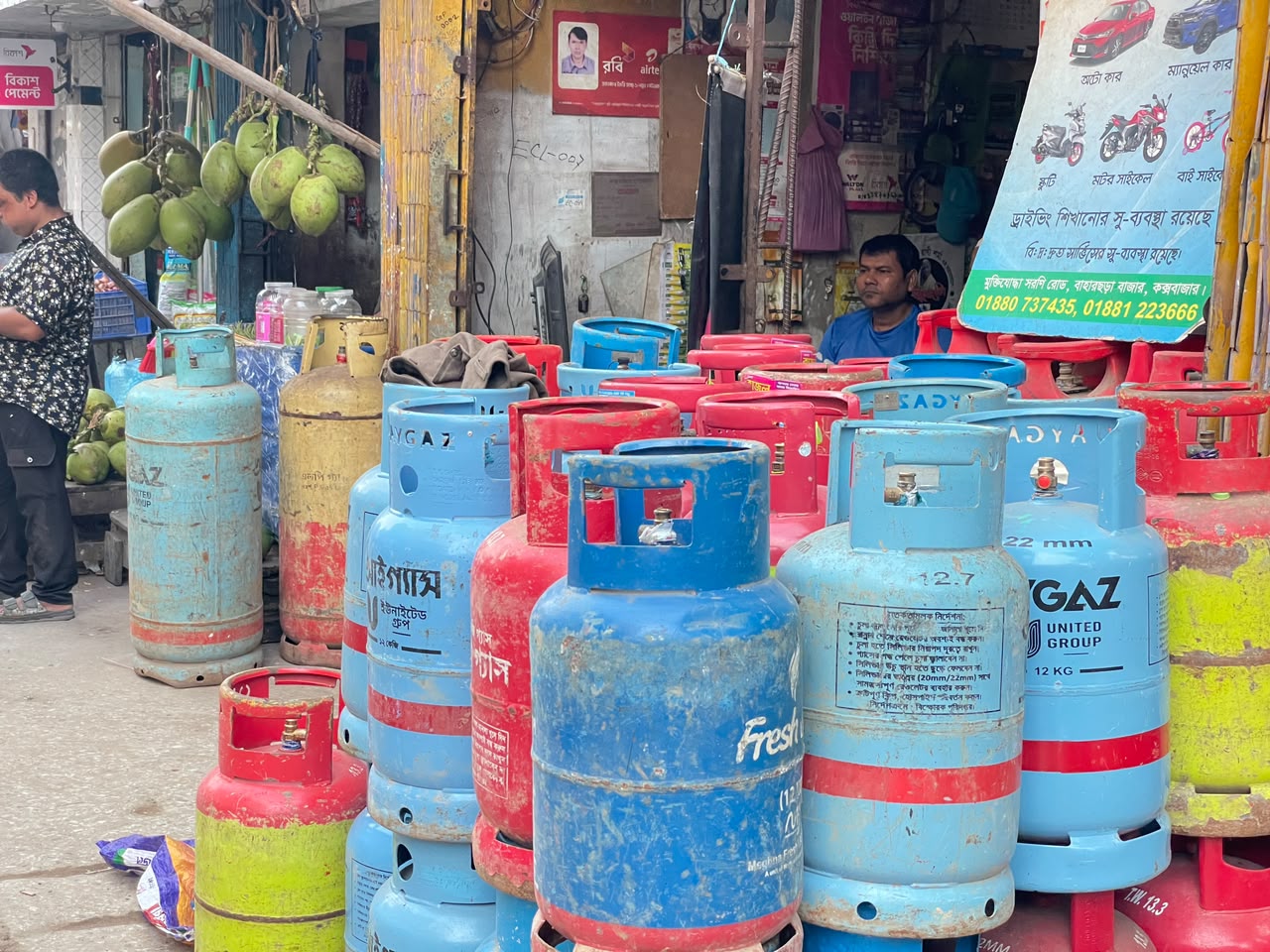
A visit to Baharchhara Bazar in Cox’s Bazar town on Tuesday afternoon found price lists at several LPG shops showing Tk2,060 for a 12kg cylinder, while retailers charged Tk2,200.
Shafiul Alam, manager of Sahil and Soha Enterprise, said his shop sold LPG supplied by BM, Omera and iGas, with each 12kg cylinder priced at Tk2,200.
Asked why he was charging more than the government-fixed price, he said, “We also have to buy gas at a higher price. On Tuesday, we bought each cylinder for Tk2,150. We sell it for Tk2,200, including the service charge.”
Kajal Sharma, proprietor of Messrs Kajal Enterprise across the road, said his shop sold only iGas cylinders, also at Tk2,200 each.
“Our purchase price is Tk2,100. We sell each cylinder for Tk2,200, including the service charge,” he said.
Consumers expressed frustration over the rising cost.
Sona Mia, a resident of Samitipara who runs a small biryani shop at Sugandha Point, said he had bought a cylinder for his household for Tk1,650 two months ago. The price has since increased considerably, with different shops quoting different rates.
“The prices of gas, fuel and everything in the market are going up, but our income is not increasing. It has become difficult to manage all the expenses,” he said.
Alhaj Sirajul Haque, president of the Cox’s Bazar LPG Distributors Association and proprietor of Messrs Champa Enterprise in the town’s Kasturaghat area, said LPG supplies in the district were inadequate compared with demand.
Distributors were having to buy gas at higher prices, making it difficult for retailers to sell at the government-fixed rate, he said.
He named several companies and businesses supplying LPG to the district, including Mummy Enterprise, Cox’s Bazar Traders, Cox’s Bazar Trade Link, Golam Arif Liton, Omera Masud Traders, K Cool Enterprise, Habib and Brothers, and Petrumetro Gas. However, he said supplies were insufficient to meet demand and sales at his shop had declined since Tuesday morning.
Sirajul Haque claimed that the district, from Eidgaon to Teknaf, required around 25,000 LPG cylinders a day, while government supply amounted to only 2,500 cylinders. The remaining demand was met through private dealers.
People also complained that LPG was being sold at even higher prices in other parts of the district.
The Bangladesh Energy Regulatory Commission on Monday evening raised the price of a 12kg LPG cylinder by Tk223 to Tk2,060, issuing a notification on the revised rate.
Earlier, on October 4, the commission had raised the price by Tk252, from Tk1,585 to Tk1,837. This means the price of a 12kg cylinder has increased by Tk475 in two revisions in less than a month.
The commission began increasing LPG traders’ commissions on October 29 and held its first public hearing on the issue. The adjustment of traders’ commissions was considered in determining the revised price.
The Consumers Association of Bangladesh, however, had called for ensuring supplies at the fixed price without increasing LPG prices or related charges. It also demanded investigations into allegations of artificial shortages, secret stockpiling and overcharging, and action against those responsible.
In a letter to the BERC chairman on October 28, CAB president AHM Shafiquzzaman said higher LPG prices and charges would further increase the financial burden on low- and middle-income households. He also argued that rising international LPG prices did not mean local transportation, storage, and distribution costs would rise at the same rate.
Even after the price was set at Tk1,585 per 12kg cylinder in September, many consumers reportedly paid as much as Tk2,500 because of alleged supply shortages. Following the October 4 revision to Tk1,837, retail prices remained above Tk2,200 in many places.
Consumers have increasingly expressed dissatisfaction as retailers continue to charge more than the government-fixed price. They have called for effective market monitoring and measures to stop overcharging and ensure supplies at the regulated rate.
By Abdu Rashid Manik
Photo: Abdu Rashid Manik