
Bangladesh’s digital transformation carries a landmark chapter rooted in Cox’s Bazar, where the country first connected to the global “information superhighway” with the landing of its submarine cable system in 2006.
On 21 May 2006, the Submarine Cable Landing Station in Cox’s Bazar was inaugurated, marking Bangladesh’s first entry into the global data network. The historic initiative was launched by then-Prime Minister Begum Khaleda Zia, opening a new frontier in the country’s communications and technology sector.
Two decades on, the Cox’s Bazar landing station has become the principal gateway for Bangladesh’s international telecommunications connectivity. Under the jurisdiction of the Posts and Telecommunications Division, Bangladesh Submarine Cable Company Limited (BSCCL) now operates the SEA-ME-WE-4 and SEA-ME-WE-5 submarine cable systems, ensuring stable and high-capacity global internet connectivity.
According to official data, the combined capacity of these two submarine cables is approximately 9,400 Gbps, of which approximately 4,100 Gbps is currently in use by mobile operators, internet service providers, and technology-driven sectors across the country. An additional 5,300 Gbps remains available, indicating significant unused capacity.
Even amid global geopolitical uncertainties and concerns over undersea cable infrastructure, BSCCL maintains that Bangladesh’s international internet connectivity remains secure, stable, and sufficiently resilient. The primary connectivity routes via Cox’s Bazar—linking to the Singapore–Chennai and Singapore–France corridors—help minimise exposure to global disruptions.
The organization also noted that SEA-ME-WE-5 still retains substantial unused capacity, while SEA-ME-WE-4 continues to operate effectively, making concerns about bandwidth shortages or a “digital blackout” largely unfounded.
Looking ahead, preparations are underway for the next-generation SEA-ME-WE-6 submarine cable project. Expected to be operational by early 2027, the system is projected to add approximately 30,000 Gbps of capacity, bringing Bangladesh’s total submarine cable capacity to nearly 38,000 Gbps. Officials say this expansion will position Bangladesh as a major digital connectivity hub in South Asia, with Cox’s Bazar at its centre.
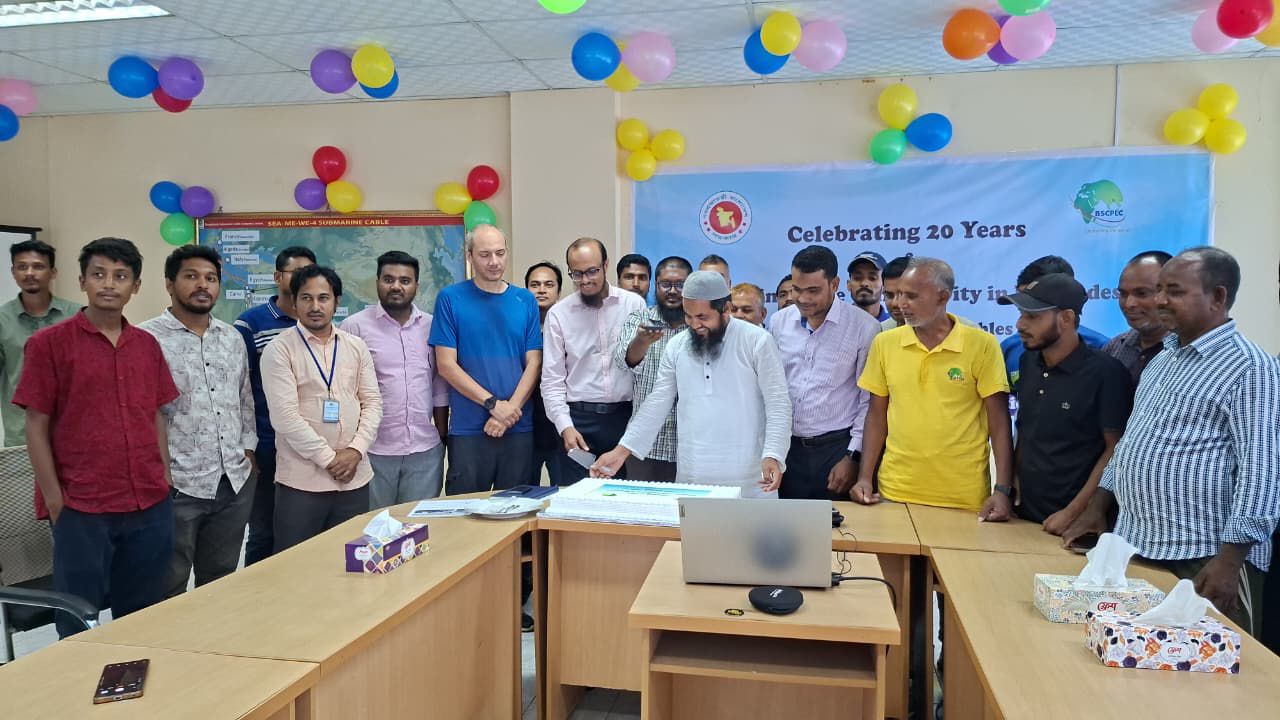
To mark the 20th anniversary of the submarine cable landing station, a modest ceremony was held on Saturday (23 May) at the Cox’s Bazar facility. Officials and staff celebrated the milestone by cutting a cake, recalling the historic moment when Bangladesh first entered the global information highway through Cox’s Bazar.
Engineer Mohammad Tarikul Islam, chief of the Cox’s Bazar landing station, joined employees in the celebration, while Managing Director Aslam Hossain marked the occasion separately with senior officials at the company’s headquarters in Dhaka.
BSCCL officials said that a reliable and sovereign international data infrastructure is now not only a means of communication but also a foundation of economic growth, digital security, and technological independence. In that journey, Cox’s Bazar remains at the heart of Bangladesh’s digital history.
Cox’s Bazar Life Report
Photo: Courtesy